ISO/IEC 42001 vs. NIST AI RMF: Which AI Governance Standard Is Right for Your Organization? (2026)


📌 Key Takeaways
- NIST AI RMF tells you what AI risk management should achieve — it is outcomes-based, flexible, free, and de facto mandatory for US federal agencies. ISO 42001 tells you what a verifiable AI management system must contain — it is requirements-based, structured, certifiable, and commercially valuable. They are complementary, not competing.
- ISO 42001 adoption is accelerating sharply in 2026: more than 350 organizations globally are certified (April 2026), and 72% of enterprise buyers now screen for ISO 42001 during procurement — making it function like ISO 27001 did for cloud services a decade ago.[7]
- Microsoft 365 Copilot received its second consecutive ISO 42001 recertification in May 2026 with zero non-conformities — alongside SAP, AWS, KPMG, CrowdStrike, and IBM, signaling that certification is becoming a standard enterprise AI vendor expectation.
- For ISO 27001-certified organizations, the path to ISO 42001 certification is substantially shorter: 3–6 months versus 6–12 months for organizations without an existing management system, because the Annex SL management infrastructure is already in place.
- The sequencing logic for most enterprise programs: start with NIST AI RMF for operational foundation (free, broadly applicable, immediately useful for risk management), then layer ISO 42001 certification for external demonstrability once the governance program is mature enough to audit.
The question comes up in almost every enterprise AI governance conversation: ISO 42001 or NIST AI RMF? The answer — which most people find frustrating but which is genuinely correct — is “both, in the right sequence.”
They are not the same thing. They are not competing alternatives. They serve different functions, create different types of value, and are needed by different stakeholders. NIST AI RMF gives you the operational substance of AI risk management. ISO 42001 gives you the certified management system structure that makes that substance auditable and credentialed.
What’s changed since this article was first published: ISO 42001 has crossed from “emerging standard” to “procurement expectation” territory. 72% of enterprise buyers now screen for ISO 42001 during procurement, and organizations with certification experience 60% fewer AI incidents compared to uncertified peers.[8] The question is no longer whether to pursue ISO 42001 — for organizations selling AI to enterprise buyers, it’s increasingly when and in what sequence.
💬 According to EverydayOnAI
The “NIST vs ISO 42001” framing keeps appearing because people assume these are competing choices and they want to know which one to pick. Neither comparison is productive — NIST AI RMF answers the question “what should our AI risk management achieve?” while ISO 42001 answers the question “can we prove our AI management system meets an independently auditable standard?” Those are different questions, asked by different audiences, at different stages of governance maturity. The organizations that pick one or the other and treat it as sufficient consistently end up with either operational capability without external credibility (NIST-only) or a management system structure with thin operational substance (ISO-only). The correct answer is both — sequenced correctly.
This article is part of our Enterprise AI Governance Implementation Series. For broader framework landscape coverage, see 7 AI Governance Frameworks You Should Know in 2026.
Head-to-Head: What Each Framework Actually Is
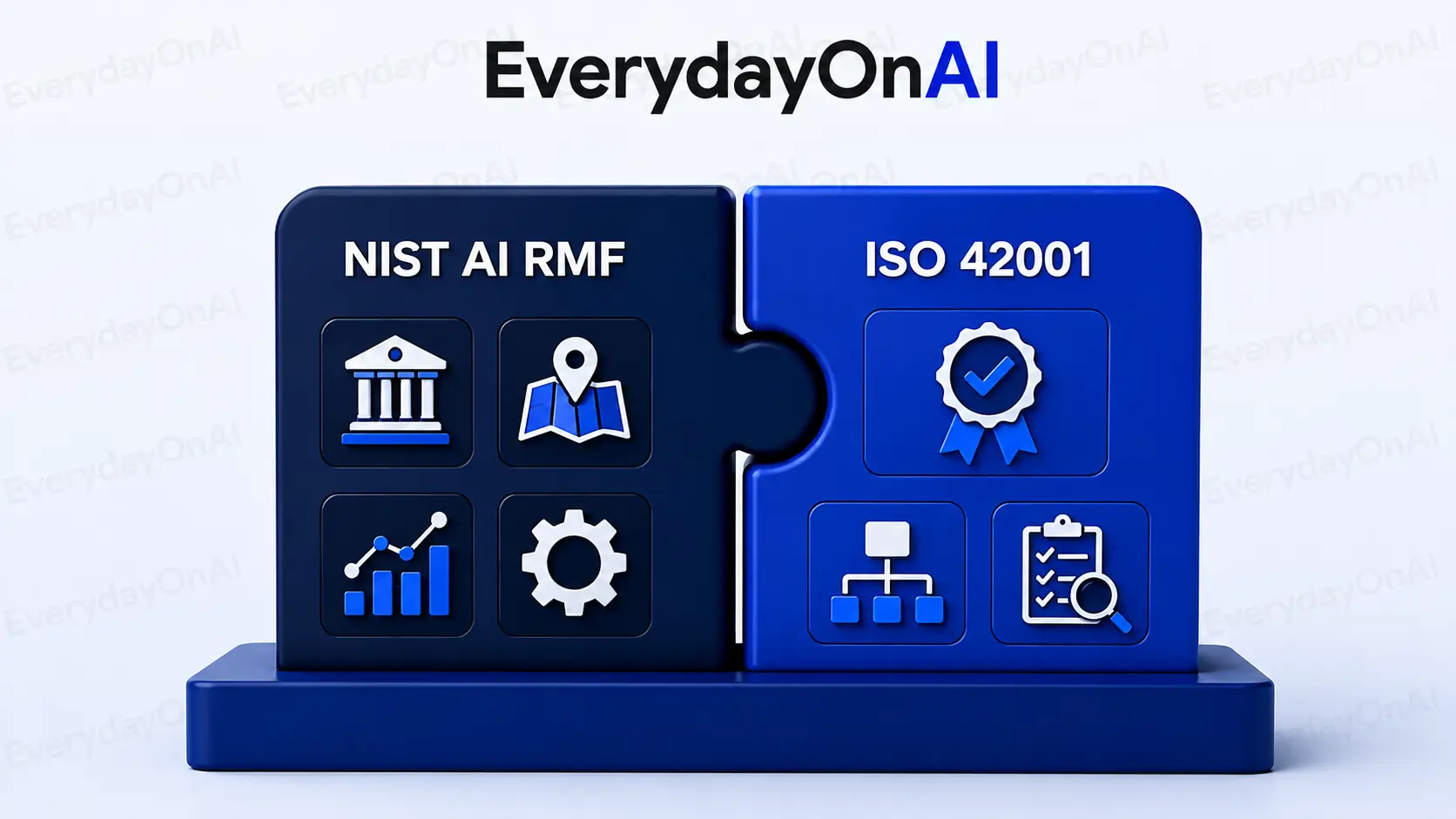
NIST AI RMF 1.0 is a voluntary risk management framework published January 26, 2023, organized around four core functions: GOVERN, MAP, MEASURE, and MANAGE.[1] Its design philosophy is outcomes-based: it tells organizations what they should achieve (a risk-aware AI culture, comprehensive AI inventory, quantified risk assessment, managed residual risk) while leaving significant flexibility in how those outcomes are achieved. That flexibility is its greatest strength and the reason it cannot provide certification.
ISO/IEC 42001:2023 is a certifiable AI Management System (AIMS) standard specifying requirements for establishing, implementing, maintaining, and continually improving a management system for responsible AI development and use.[2] Its design philosophy is requirements-based: it specifies what organizations must have in terms precise enough for an accredited third-party auditor to verify. That verifiability enables certification.
“ISO/IEC 42001 is not a competitor to NIST AI RMF. They are not the same. NIST tells you what good AI risk management looks like. ISO 42001 tells you what a certifiable management system for AI governance looks like. Most mature programs need both.”
— HiComply, “ISO 42001 vs NIST AI RMF: How to Choose the Right Framework,” November 2025[3]
📋 Section Summary
- NIST AI RMF is outcomes-based, flexible, free, and de facto mandatory for US federal agencies — it tells you what AI risk management should achieve.
- ISO 42001 is requirements-based, structured, and certifiable — it specifies what an AI management system must contain in terms auditable by an accredited third party.
- The key distinction: NIST AI RMF gives you operational substance; ISO 42001 gives you the certified structure that makes that substance demonstrable to external stakeholders.
ISO 42001 in 2026: Adoption and Market Data
The ISO 42001 market has moved substantially since the standard was published in December 2023. What started as a small group of early adopters has crossed into mainstream enterprise adoption territory — driven primarily by procurement requirements from large enterprise buyers.
350+
organizations globally certified as of April 2026, rising sharply through 2026[7]
72%
of enterprise buyers now screen for ISO 42001 during AI vendor procurement[8]
60%
fewer AI incidents at ISO 42001-certified organizations vs. uncertified peers[8]
0
non-conformities in Microsoft 365 Copilot’s second consecutive ISO 42001 recertification (May 2026)[10]
The certified organization list now includes major AI vendors across categories: Microsoft 365 Copilot (recertified May 2026 with zero non-conformities), SAP, AWS, KPMG, CrowdStrike, Anthropic, IBM, ServiceNow, Snowflake, and many others.[7] The pattern reflects what happened with ISO 27001 for cloud services a decade ago: enterprise buyers embedded certification as a procurement requirement, which created a rapid vendor certification cycle that is now playing out for AI governance.
Microsoft’s recertification statement is instructive: “ISO 42001 recertification is not a destination; it is the annual proof point of continuous improvement.”[10] Organizations pursuing ISO 42001 primarily for the certificate — rather than for the governance discipline the certification process enforces — consistently achieve lower-quality outcomes. The process is where the value is generated; the certificate is the evidence it was done.
💬 According to EverydayOnAI
The 72% buyer screening figure is the number that should change how enterprise AI teams think about ISO 42001 prioritization. This isn’t a “nice to have” certification if you’re selling AI capabilities to enterprise customers — it’s increasingly a deal qualifier. The pattern mirrors exactly what happened with SOC 2 and ISO 27001 for SaaS vendors five to eight years ago: early movers treated it as a competitive differentiator; then the majority moved and it became table stakes; then laggards faced losing deals they couldn’t have anticipated losing. The AI governance certification cycle appears to be compressing that timeline considerably.
📋 Section Summary
- ISO 42001 adoption has crossed from early-adopter to mainstream enterprise territory: 350+ certified organizations globally, 72% of enterprise buyers screening for it in procurement, and leading AI vendors (Microsoft, SAP, AWS, KPMG) publicly certified.
- The procurement pressure driving adoption mirrors ISO 27001’s trajectory for cloud services — what starts as a differentiator rapidly becomes a minimum requirement in competitive enterprise sales.
- Organizations pursuing certification primarily for the credential rather than the governance discipline consistently achieve lower-quality outcomes — the process enforces governance practices that the certificate merely evidences.
NIST AI RMF Deep Dive: Four Functions
The NIST AI RMF’s four functions are not sequential phases — they are simultaneous, continuously operating dimensions of a mature AI governance program.
GOVERN establishes the organizational risk culture, policies, accountability structures, and processes that apply across all AI risk management activities. It is the foundational function — without GOVERN fully operational, MAP and MEASURE produce findings that go unaddressed. GOVERN outcomes include: clear roles and responsibilities for AI risk management; documented accountability for each AI system’s performance; policies for AI use across the organization; and mechanisms for ongoing communication and reporting on AI risks.
MAP establishes the context for AI risk management: identifying AI systems and their intended uses, characterizing the populations and contexts affected, analyzing potential positive and negative impacts, and assessing the scope of risk for each system. MAP requires a complete AI inventory, an AI system registry with deployment context documentation, and a structured process for risk scoping and stakeholder analysis.
MEASURE analyzes and quantifies the risks identified in MAP. This includes quantitative and qualitative risk assessment, bias and fairness testing (covered in detail in our Algorithmic Bias Audit guide), security assessment, and performance evaluation against defined standards.
MANAGE allocates resources to address identified risks, implements treatments (accept, mitigate, transfer, or avoid), implements monitoring, and maintains the governance documentation trail. MANAGE includes the post-deployment monitoring, incident response, and continuous improvement cycles.
Why NIST AI RMF is the right starting point: It is free, comprehensive, flexible, de facto mandatory for US federal agencies per OMB M-24-10, and widely referenced by enterprise procurement and cyber insurance programs. For US state AI governance compliance, Colorado SB 26-189 and the Texas Responsible AI Governance Act both recognize alignment with NIST AI RMF as evidence of reasonable care.[9]
📋 Section Summary
- The four functions (GOVERN, MAP, MEASURE, MANAGE) operate simultaneously, not sequentially — GOVERN is foundational; without it, the other three produce findings nobody acts on.
- NIST AI RMF is free, broadly adopted, de facto mandatory for US federal agencies, and recognized by state AI laws (Colorado, Texas) as evidence of reasonable care.
- Starting with NIST AI RMF gives the most broadly useful governance foundation before layering ISO 42001’s certification structure on top.
ISO/IEC 42001 Deep Dive: Management System Requirements
ISO 42001 uses the Annex SL harmonized structure shared by ISO 27001 and ISO 9001 — covering context and leadership (Clauses 4–5), planning and risk assessment (Clause 6), support and resources (Clause 7), operations and controls (Clause 8), performance evaluation (Clause 9), and improvement (Clause 10).[4]
ISO 42001’s Annex A specifies 38 AI-specific controls across nine control objectives — the operational requirements that translate management system requirements into AI governance practices. Annex A covers AI policy, internal organization, resource requirements, AI impact assessment, AI system lifecycle management, data management for AI, information for interested parties, and use of AI systems. The AI Impact Assessment (supported by ISO 42005:2025, the companion standard published in 2025) represents the most substantial work organizations undertake for conformance — the 9 Clause Article 27 FRIA mapping for EU AI Act deployers starts here.[8]
The certification process requires: engagement with an accredited certification body (certified under ISO/IEC 42006:2025), a gap assessment against the standard’s requirements, implementation of identified gaps, an internal audit of the management system, a management review, and an external audit in two stages (documentation review and operational evidence review). Organizations typically submit 75–100 audit artifacts during certification.[8]
ISO 27001 fast path: Organizations already certified in ISO 27001 can pursue ISO 42001 certification in 3–6 months rather than 6–12 months, because the management system infrastructure (internal audit program, management review process, documented information control, continual improvement mechanisms) is already in place and can be extended to cover AI governance.[3] Schellman’s 2026 AI governance research confirms this: “You may already have an enterprise IT risk management process, internal audit program, or management review program that supports preexisting ISMS or PIMS governance efforts. In some cases, these processes can be easily modified to address some of the additional requirements posed by ISO 42001.”[11]
📋 Section Summary
- ISO 42001’s 38 Annex A controls across nine control objectives are what certification auditors verify — the management system clauses provide the structure; Annex A provides the AI-specific operational content.
- Organizations typically submit 75–100 artifacts during Stage 2 certification, with the AI Impact Assessment (now methodologically supported by ISO 42005:2025) representing the most substantial single work item.
- ISO 27001-certified organizations can typically complete ISO 42001 certification in 3–6 months rather than 6–12 months, with the existing ISMS infrastructure serving as the foundation.
Full Comparison: 12 Key Dimensions
| Dimension | NIST AI RMF 1.0 | ISO/IEC 42001:2023 |
|---|---|---|
| Type | Voluntary risk management framework | Certifiable management system standard |
| Design approach | Outcomes-based, principle-driven, flexible | Requirements-based, verifiable, structured |
| Certifiable? | No | Yes — via ISO/IEC 42006:2025 accredited bodies |
| Cost | Free (public domain) | Startups: $15K–$40K; Mid-market: $85K–$150K; Enterprise: $350K–$650K+[8] |
| Implementation timeline | 3–6 months (basic); 9–12 months (comprehensive) | 3–6 months (ISO 27001-certified); 6–12 months (new org) |
| Flexibility | Very high — adaptable to any sector or org size | Structured — requirements must be met even if implementation varies |
| US federal mandatory? | Yes — OMB M-24-10 requires for federal agencies | No — though referenced in federal AI procurement |
| Enterprise procurement | Referenced in procurement guidance | 72% of enterprise buyers now screen for it[8] |
| EU AI Act alignment | Crosswalk available; not a compliance safe harbor | Strong mapping to Articles 9, 10, 11, 17, 27, 72; ISO developing EU AI Act-specific guidance |
| ISO 27001 integration | Supplementary — different architecture | Shared Annex SL structure — extends existing ISMS directly |
| Incident reduction | No published certification-linked data | 60% fewer AI incidents vs. uncertified peers[8] |
| Companion standards | NIST AI 600-1 (GenAI), NIST AI 100-2 (adversarial ML) | ISO 42005:2025 (AI Impact Assessments), ISO 42006:2025 (certification body requirements) |
📋 Section Summary
- The most practically important distinction in 2026: NIST AI RMF is de facto mandatory for US federal contexts; ISO 42001 is increasingly required for enterprise commercial contexts (72% procurement screening).
- Cost structures are substantially different — NIST AI RMF is free, while ISO 42001 certification ranges from $15K (startup) to $650K+ (large enterprise) depending on scope and existing management system maturity.
- The incident reduction data (60% fewer AI incidents with ISO 42001 certification) is the strongest available evidence that the certification is producing governance outcomes, not just documentation.
When to Use Each: The Decision Framework
Start with NIST AI RMF if: You are a US federal agency or federal contractor (OMB M-24-10 makes this effectively mandatory). You are beginning your AI governance program and need a comprehensive foundation. You need to operationalize AI risk management across a diverse portfolio quickly. You are responding to a cyber insurance AI questionnaire or state AI law reasonable-care requirement. You cannot yet commit the 6–12 month timeline for ISO 42001 certification.
Start with ISO 42001 if: You sell AI capabilities to enterprise buyers and certification is a contractual or procurement requirement. You have existing ISO 27001 certification and a fast-path to ISO 42001 is available. You need to demonstrate AI governance maturity to global customers, regulators, or board stakeholders. You are preparing for EU AI Act conformity assessment obligations (ISO 42001 certification substantially reduces third-party assessment costs for providers of AI embedded in regulated products under Annex I).
Use both if: Your AI governance program is reaching operational maturity and you need both operational discipline (NIST AI RMF) and external credibility (ISO 42001 certification). This is the right answer for most large enterprises and AI vendors selling to enterprise buyers.
Combining Both: The Right Sequence
The organizations that combine NIST AI RMF and ISO 42001 most effectively do so in a specific sequence: NIST AI RMF first as operational foundation; ISO 42001 second as certification layer.
The reason for this sequence: ISO 42001 certification requires a functioning AI management system to audit. Attempting ISO 42001 certification without first operationalizing NIST AI RMF-equivalent governance produces a documentation compliance exercise with thin operational substance — which is exactly the failure mode the certification process is designed to make visible. Organizations that attempt ISO 42001 first often spend more time and money achieving certification because they’re building the management system and preparing for certification simultaneously rather than sequentially.
The bridge between the two frameworks is well-documented. NIST AI RMF GOVERN maps cleanly to ISO 42001 Clauses 5-7 (leadership, planning, support). MAP maps to Clause 6 planning and Annex A impact assessment controls. MEASURE maps to Clause 9 performance evaluation and NIST profiles’ quantitative assessment guidance. MANAGE maps to Clause 10 improvement and Annex A system lifecycle controls.
Organizations already running NIST AI RMF programs typically achieve ISO 42001 Stage 1 audit readiness in 2–4 months, because most of the substantive evidence — AI system inventory, risk assessments, documented policies, management review records, incident reports — already exists and simply needs to be mapped to ISO 42001’s specific clause and Annex A control structure.[4]
✓ Combined Implementation Sequence
- ★ Phase 1 (Months 1–6): Implement NIST AI RMF — establish GOVERN infrastructure, AI inventory (MAP), risk assessment and bias testing (MEASURE), treatment and monitoring (MANAGE)
- Phase 2 (Months 4–8): Engage ISO 42001 certification body for gap assessment against ISO 42001 clause requirements and Annex A controls
- ★ Phase 3 (Months 6–10): Close ISO 42001 gaps — primarily: internal audit program, formal management review documentation, explicit Annex A control statements
- Phase 4 (Months 9–12): Stage 1 and Stage 2 ISO 42001 audit; certification
- Ongoing: Annual NIST AI RMF maturity assessment + ISO 42001 surveillance audit (Stage 3)
EU AI Act Alignment: How Both Map to the Regulation
Neither NIST AI RMF nor ISO 42001 is a compliance safe harbor for the EU AI Act — organizations cannot substitute framework alignment for EU AI Act conformity assessment obligations. But both frameworks provide substantial coverage of the AI Act’s requirements, and organizations implementing both are significantly better positioned for EU AI Act compliance than organizations implementing neither.
Following the May 2026 Digital Omnibus agreement, most high-risk system obligations now apply from December 2, 2027 (Annex III) or August 2, 2028 (Annex I) — extending the runway for organizations to complete their NIST AI RMF implementation and ISO 42001 certification before EU AI Act compliance deadlines arrive.
| EU AI Act Requirement | NIST AI RMF Coverage | ISO 42001 Coverage | Supplemental Work Required |
|---|---|---|---|
| Article 9 Risk Management System | GOVERN + MAP + MEASURE + MANAGE lifecycle | Clauses 6, 8, Annex A controls | Minimal — strong overlap |
| Article 10 Data Governance | MAP 2.3 (data quality and lineage) | Annex A data management controls | Add: demographic representativeness documentation (see Algorithmic Bias Audit guide) |
| Article 11 / Annex IV Technical Documentation | MANAGE documentation practices | Clause 7.5 documented information | Yes — Annex IV has 9 specific sections requiring explicit documentation |
| Article 17 Quality Management System | GOVERN (policies, procedures, management) | Strong — ISO 42001 is a QMS-equivalent | Minimal for ISO 42001-certified organizations |
| Article 27 FRIA (qualifying deployers) | MAP stakeholder analysis + MEASURE impact assessment | Annex A impact assessment (+ ISO 42005 methodology) | Yes — FRIA has specific legal requirements and notification obligations beyond either framework |
| Article 72 Post-Market Monitoring | MANAGE post-deployment monitoring | Clause 9.1 monitoring and measurement | Add EU AI Act-specific reporting timelines and serious incident reporting obligations |
Before & After: Two Scenarios
✖ ISO-Only Approach
An enterprise pursues ISO 42001 certification directly without implementing NIST AI RMF operationally. The certification process produces well-documented policies and a management system structure, but AI risk assessment and monitoring remain shallow. The resulting governance program looks good in a compliance questionnaire and fails when a bias incident requires rapid, evidence-based response.
✔ NIST First, ISO Second
The same enterprise implements NIST AI RMF operationally first — building a real AI inventory, running bias audits, implementing monitoring. When they pursue ISO 42001 certification, the certification body finds evidence of operational governance rather than only documentation. Certification is achieved faster because the substance already exists; the ISO structure is mapped to existing practices.
✖ NIST-Only, No Certification
An enterprise AI vendor implements NIST AI RMF comprehensively but doesn’t pursue ISO 42001 certification. In a competitive enterprise sales process, the procurement team asks for the vendor’s AI governance certification. A detailed description of NIST AI RMF implementation is provided. The competing vendor shows an ISO 42001 certificate. The deal goes to the certified vendor.
✔ NIST + ISO 42001 Combined
The same vendor, having invested in both, shows the ISO 42001 certificate as the answer to “do you have AI governance certification?” then backs it up with the NIST AI RMF operational depth that demonstrates the certification reflects real governance rather than documentation compliance. The deal closes faster and at a higher price point because governance is no longer a question in the buyer’s due diligence.
Tool: Which Standard Should You Start With?
🎯 Interactive Tool
NIST AI RMF vs ISO 42001: Where Should You Start?
Answer three questions based on your organization’s current situation.
1. What is your most urgent AI governance driver right now?
2. Do you already hold ISO 27001 certification?
3. What’s your available timeline for the initial governance program build?
This is directional guidance based on the framework characteristics covered in this article. Actual sequencing should account for your specific regulatory exposure, existing management system maturity, and certification body availability.
Frequently Asked Questions
What is the difference between ISO 42001 and NIST AI RMF?
Design philosophy and certifiability. NIST AI RMF is outcomes-based, flexible, and free — it tells you what AI risk management should achieve and is de facto mandatory for US federal agencies. ISO 42001 is requirements-based, structured, and certifiable — it specifies what a verifiable AI management system must contain. They are complementary: NIST provides operational substance, ISO 42001 provides certification structure.
Is NIST AI RMF or ISO 42001 better?
They serve different purposes — neither is categorically better. NIST AI RMF is better for AI risk management operational practice. ISO 42001 is better for demonstrating AI governance maturity externally — 72% of enterprise buyers now screen for it in procurement,[8] and certified organizations experience 60% fewer AI incidents. Most mature enterprise programs need both, with NIST AI RMF implemented first as the operational foundation.[4]
How does ISO 42001 relate to ISO 27001?
They share the harmonized Annex SL structure — ISO 42001 is architecturally identical to ISO 27001 in management system design, meaning organizations already certified in ISO 27001 can pursue ISO 42001 certification with significantly reduced effort. The management system infrastructure (internal audit, management review, documented information control, continual improvement) already exists and extends directly to AI governance. For ISO 27001-certified organizations, ISO 42001 certification typically takes 3–6 months rather than 6–12 months.[3]
How many companies have ISO 42001 certification?
More than 350 organizations globally as of April 2026, rising sharply as accredited certification bodies scale audit capacity.[7] Publicly confirmed certified organizations include Microsoft (recertified May 2026 with zero non-conformities[10]), SAP, AWS, KPMG, CrowdStrike, Anthropic, IBM, ServiceNow, and Snowflake. Adoption is accelerating: 72% of enterprise buyers now screen for ISO 42001 during vendor procurement.
How much does ISO 42001 certification cost?
$15,000–$40,000 (startups); $85,000–$150,000 (mid-market); $350,000–$650,000+ (large enterprise). Costs vary significantly with organization size, AI system complexity, and existing management system maturity.[8] Organizations with existing ISO 27001 certification typically reduce implementation costs by 40–60% by extending existing ISMS infrastructure rather than building from scratch. Ongoing surveillance audits add 30–40% of initial certification costs annually.
📚 References and Sources
- NIST, “AI Risk Management Framework (AI RMF 1.0),” NIST AI 100-1, January 26, 2023. Official NIST documentation. nist.gov
- ISO/IEC 42001:2023, “Information technology — Artificial intelligence — Management system.” Certifiable via ISO/IEC 42006:2025 accredited bodies. iso.org
- HiComply, “ISO 42001 vs NIST AI RMF: How to Choose the Right Framework,” November 2025. Complementary use; ISO 27001-certified organization path to ISO 42001 (3–6 months). hicomply.com
- SoftwareSeni, “EU AI Act NIST AI RMF and ISO 42001 Compared — Which Framework to Implement First,” November 2025. Sequencing logic; NIST-first reduces ISO 42001 implementation time; ISO 42001 as enterprise sales table stakes. softwareseni.com
- GAICC, “Global AI Governance Comparison 2026: EU AI Act vs NIST AI RMF vs ISO/IEC 42001,” March 2026. Framework relationship analysis; convergence toward complementary use. gaicc.org
- EC Council, “EU AI Act vs NIST AI RMF vs ISO/IEC 42001: A Plain English Comparison,” March 2026. EU AI Act crosswalk; three-framework comparison. eccouncil.org
- AI Compliance Vendors, “ISO 42001 Certified Companies: Verified Public List,” May 17, 2026. 350+ certified organizations globally as of April 2026; verified list of certified organizations including Microsoft, SAP, AWS, KPMG, CrowdStrike, Anthropic, IBM, ServiceNow, Snowflake. aicompliancevendors.com
- ElevateConsult, “ISO 42001 Certification Cost Breakdown: What Enterprise AI Teams Pay in 2026,” March 26, 2026. 72% of enterprise buyers screen for ISO 42001 during procurement; certified organizations experience 60% fewer AI incidents; cost breakdown: startups $15K–$40K, mid-market $85K–$150K, enterprise $350K–$650K+; 75–100 audit artifacts typically submitted; AI Impact Assessment as most substantial conformance work. elevateconsult.com
- GAICC, “What ISO 42001 Solves and Why It Matters for U.S. Organizations in 2026,” May 3, 2026. Colorado SB 26-189 and Texas Responsible AI Governance Act recognize ISO 42001 alignment as evidence of reasonable care; federal procurement referencing ISO 42001 alongside NIST AI RMF. gaicc.org
- Help Net Security, “Microsoft’s Copilot trust test: Zero findings, more models, wider oversight,” May 28, 2026. Microsoft 365 Copilot second consecutive ISO 42001 recertification with zero non-conformities; certification covers governance, risk assessment, data management, transparency, human oversight. helpnetsecurity.com
- Schellman, “What To Know About AI Governance & ISO 42001 in 2026,” May 2026. ISO 27001 + ISO 42001 integration; preexisting management system infrastructure reusable; AIUC-1 as emerging agentic AI standard built on ISO 42001 and NIST AI RMF. schellman.com
Sources verified June 21, 2026. ISO 42001 certified company counts and procurement screening percentages change frequently — verify current figures before using in procurement or regulatory documents. This article does not constitute legal or certification advice.
📚 Enterprise AI Governance Series
- → AI Governance for Enterprise: Policy to Operational Readiness (Pillar)
- → What Does a Chief AI Officer (CAIO) Actually Do?
- → How to Build an AI Governance Committee
- → Algorithmic Bias Audit: What It Is and How to Do It
- → How to Govern Agentic AI Systems
- → Top 8 AI Governance Tools in 2026–2027
- → AI Governance as Competitive Advantage
Download the NIST AI RMF → ISO 42001 Bridge Guide
A complete crosswalk mapping NIST AI RMF GOVERN-MAP-MEASURE-MANAGE functions to ISO 42001 Clauses 4–10 and Annex A controls — so organizations implementing NIST AI RMF can efficiently extend to ISO 42001 certification with the documentation work already done.
Share this article