AEO Checklist 2026: Is Your Content Answer-Ready? (40-Point Audit)

📌 Key Takeaways
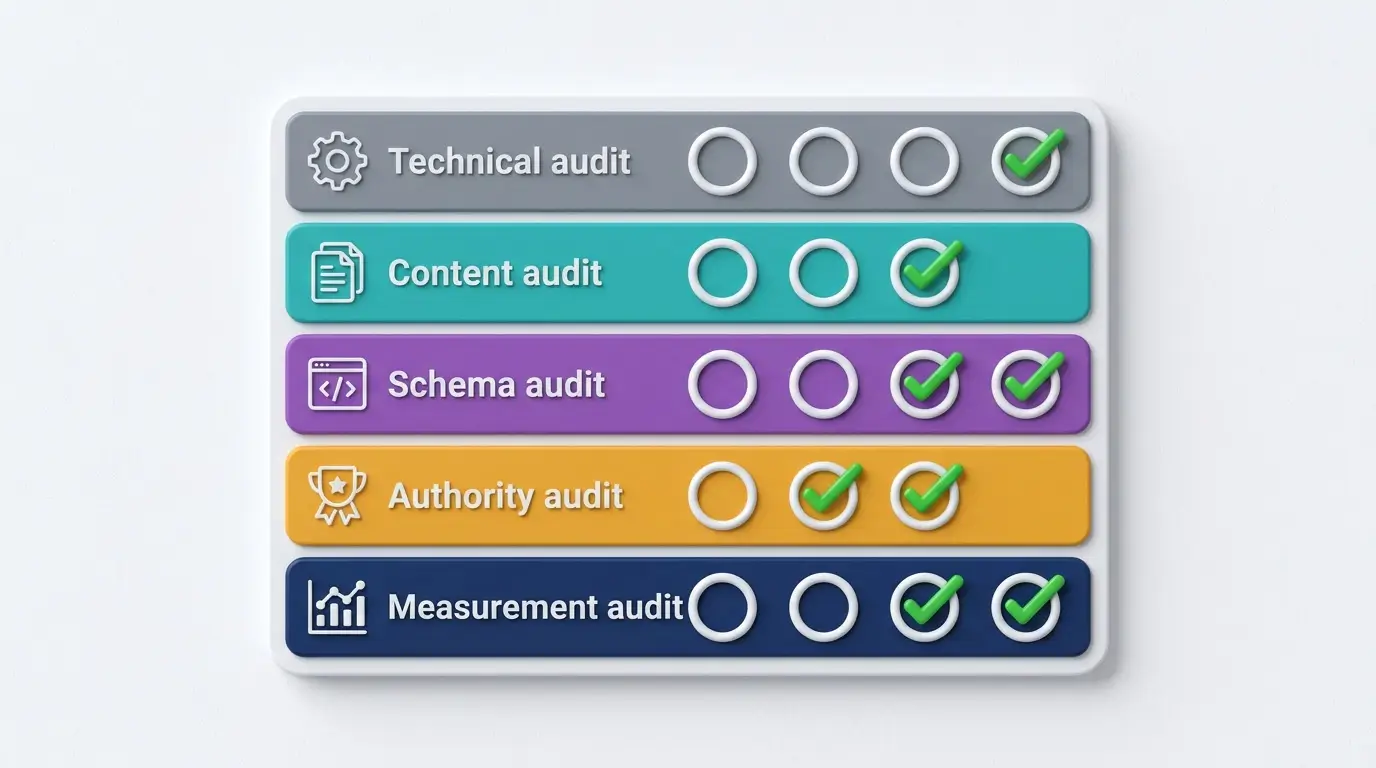
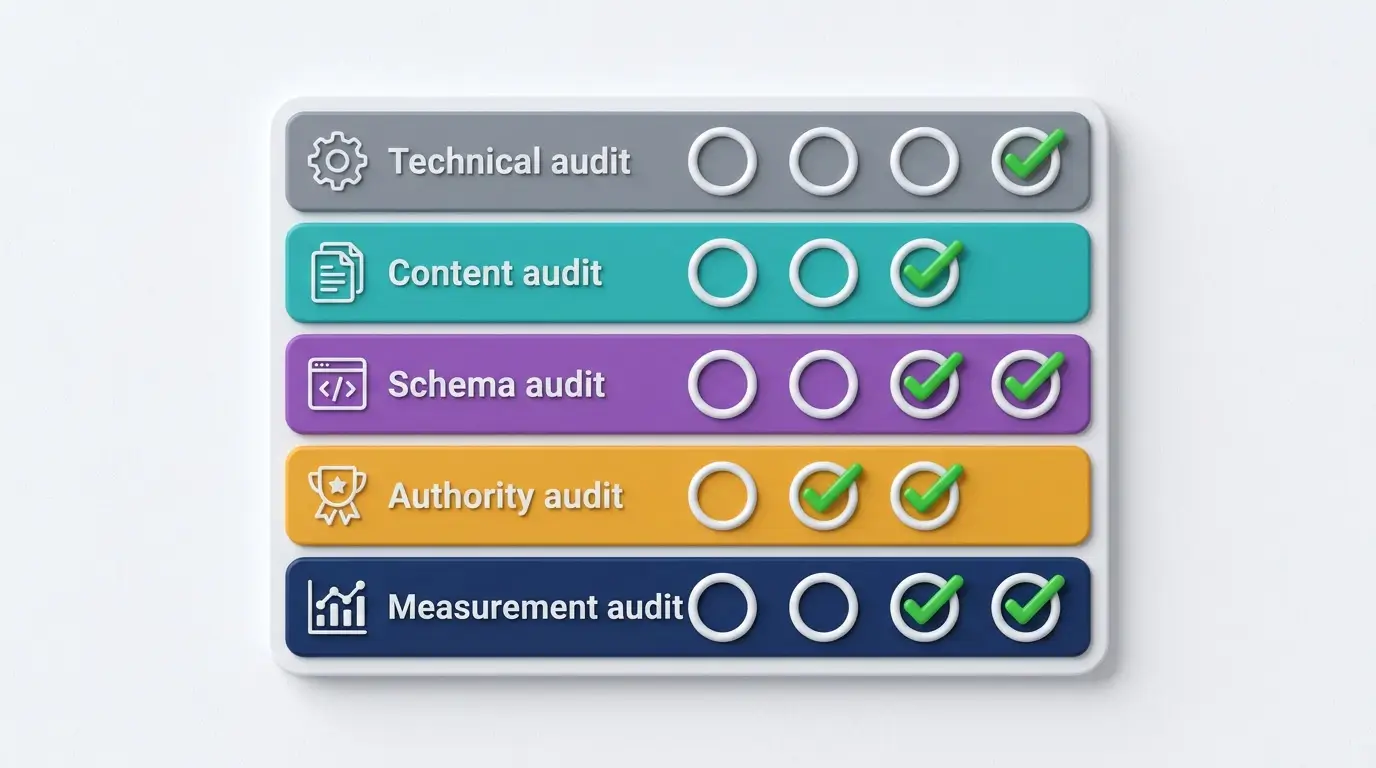
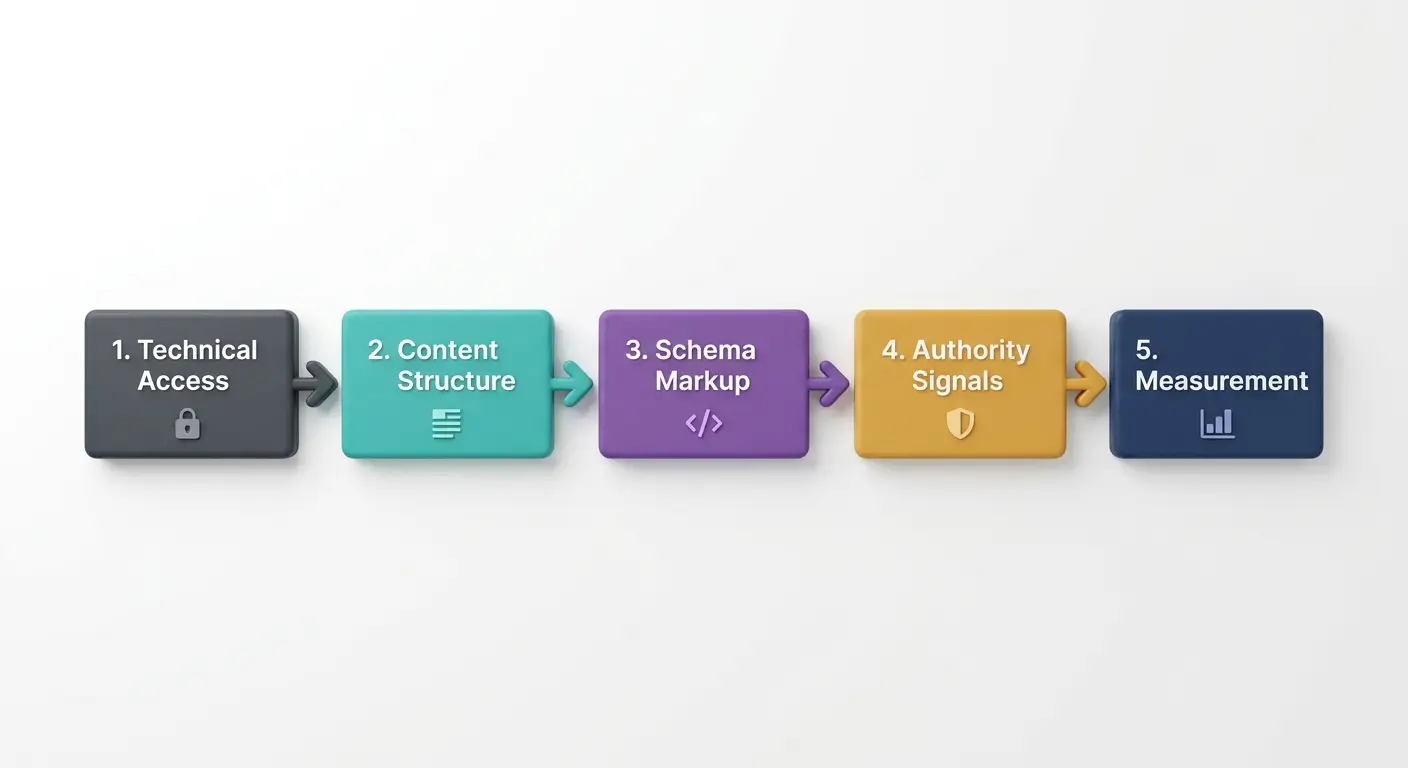
- A complete AEO audit covers five dimensions in sequence: Technical Access, Content Structure, Schema Markup, Authority Signals, and Measurement. Pages can fail one dimension while performing well in others — and a single failed dimension can make all other optimizations irrelevant.
- Roughly 60% of AI Overview citations come from pages that do not rank in the top 20 organic results (AirOps research, 2026) — confirming that extractability and structure, not ranking position, are the primary determinants of AI citation eligibility.
- Only 30% of brands remain visible from one AI answer to the next (AirOps research) — making quarterly audits and monthly monitoring essential, not optional.
- Technical access issues are the most catastrophic single-point failures: a page blocked to GPTBot, PerplexityBot, or ClaudeBot makes all content and schema optimization irrelevant. Fix these first, always.
- Target score: 70%+ (28 of 40 points) for meaningful AEO readiness. 85%+ (34 points) indicates strong answer-readiness — shift focus to maintenance and authority building rather than structural remediation.
📋 Table of Contents
- Why Most Pages That Rank Still Fail AEO Audits~ 3 min
- How to Use This Checklist~ 1 min
- Dimension 1: Technical Access (8 items)~ 3 min
- Dimension 2: Content Structure (12 items)~ 4 min
- Dimension 3: Schema Markup (7 items)~ 3 min
- Dimension 4: Authority Signals (7 items)~ 3 min
- Dimension 5: Measurement (6 items)~ 2 min
- Scoring & Priority Timeline~ 2 min
- Case Study: From 0 to 2,600 Citations — What the Audit Showed~ 3 min
- Frequently Asked Questions~ 2 min
- Conclusion~ 1 min
Why Most Pages That Rank Still Fail AEO Audits
The most counterintuitive finding in 2026 AI search research is this: roughly 60% of AI Overview citations come from pages that do not rank in the top 20 organic results.[1] Rankings and AI citations are not the same signal. A page can hold position #1 and receive zero AI citations. A page ranking at position #25 can be cited in every relevant AI Overview, if its content is extractable enough.
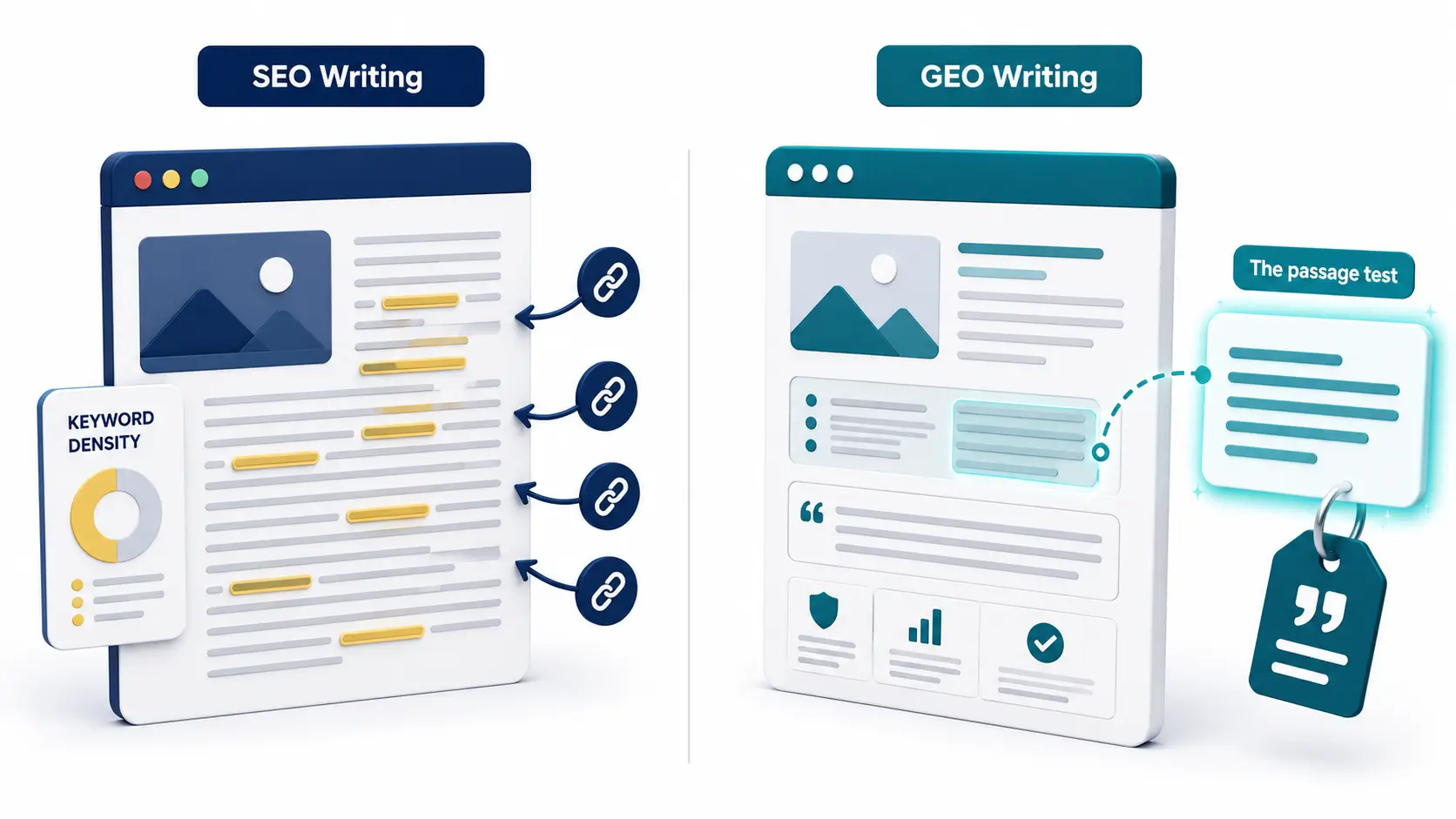
This is why AEO audits are a separate exercise from traditional SEO audits. Traditional audits ask: Can Google rank this page? AEO audits ask: Can AI systems extract and reuse this page’s content as a cited source? The answers to those two questions are increasingly diverging — and only 30% of brands maintain consistent AI visibility from one answer generation to the next, according to AirOps research.[1]
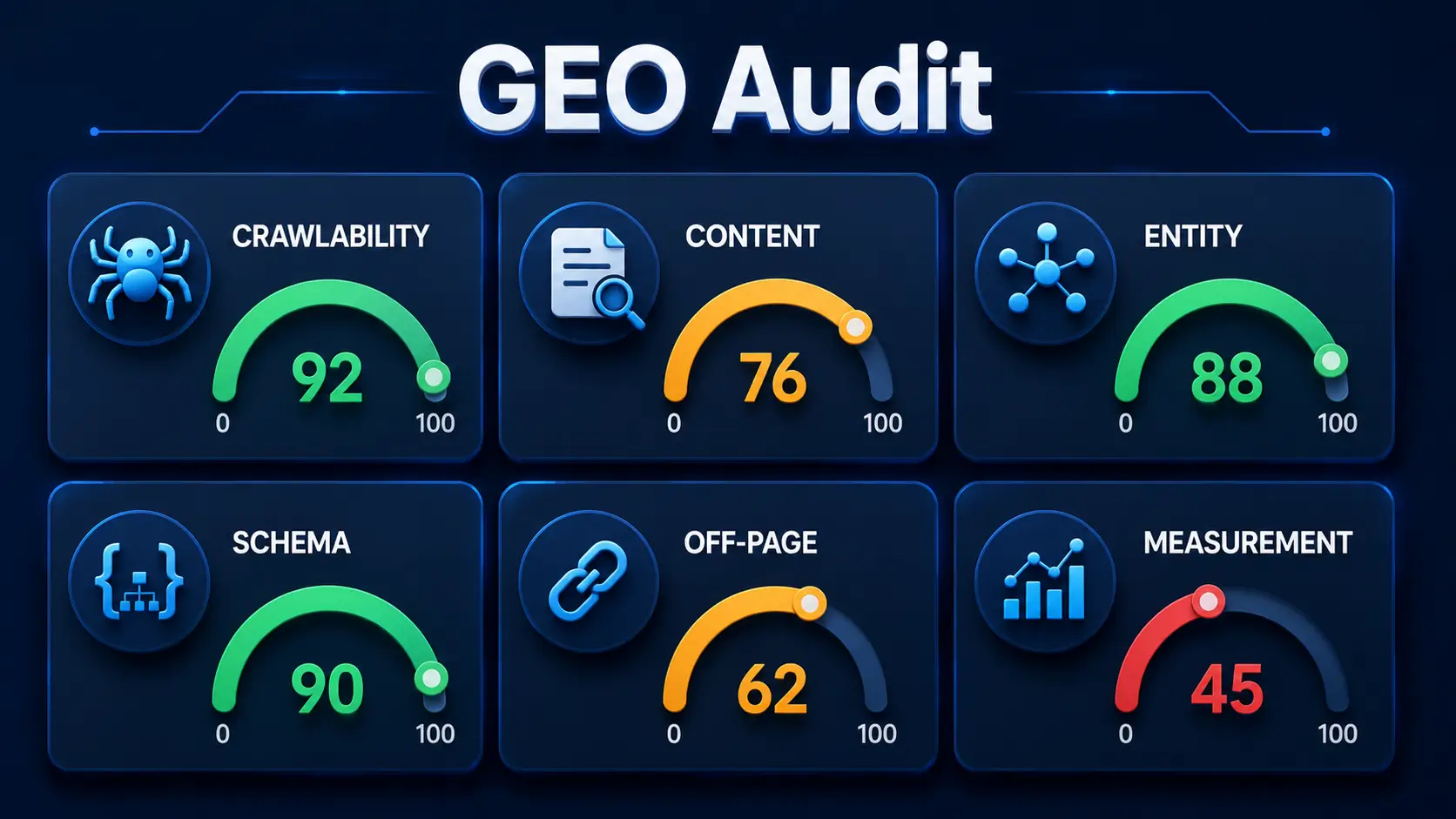
The five-dimension framework in this checklist reflects the actual reasons pages fail AEO audits, derived from the lseo.com 2026 AEO audit framework, AirOps’ 48-factor checklist, and FirstAnswer’s 100-point audit methodology — all published in 2026. The five dimensions are: Technical Access, Content Structure, Schema Markup, Authority Signals, and Measurement. Each is a separate way a well-written page can be completely invisible to AI answer systems.
60%
of AI Overview citations come from pages outside the organic top 20[1]
30%
of brands remain visible from one AI-generated answer to the next[1]
78%
of organizations now use AI in at least one business function[2]
89%
of B2B buyers use generative AI as a top information source at every buying stage[2]
📋 Section Summary
- 60% of AI Overview citations come from pages outside organic top 20 — ranking and AI citation are separate signals driven by separate optimization criteria.
- Only 30% of brands maintain consistent AI visibility across consecutive answer generations — making the AEO audit a recurring governance function, not a one-time project.
- The 5-dimension framework (Technical, Content, Schema, Authority, Measurement) covers the distinct ways a page can fail AI citation eligibility independently of its traditional SEO performance.
How to Use This Checklist
Run the checklist in dimension order — Technical Access first, Measurement last. Technical issues must be resolved before content changes have any effect; measurement must come last because you need a baseline before optimizations begin. Each item is scored as: Pass (1 point) or Fail / Not implemented (0 points). Total possible: 40 points.
Two labels appear next to each item:
- CRITICAL — A fail here makes all other optimizations in this dimension irrelevant. Fix before moving on.
- HIGH — Most commonly responsible for AI citation failures in audited sites. High priority after Critical items.
- MEDIUM — Meaningful improvement but not a blocker if Critical and High items are resolved.
🎯 Interactive Tool
AEO Audit Score Calculator
Check off every item that’s already true for your page, then calculate your score. All 40 items from the checklist below are here — this just totals them and tells you where to focus first.
0 / 8
0 / 12
0 / 7
0 / 6
This is a self-assessment tool for directional guidance. Scoring 70%+ (28/40) indicates meaningful AEO readiness; 85%+ (34/40) indicates strong readiness. It does not replace a full technical audit and does not guarantee AI citation, ranking, or traffic outcomes.
Dimension 1: Technical Access (8 items)
Technical access failures are the only category where a single fail can make every other optimization completely irrelevant. If a page returns an empty div or loading shell when fetched with a bot user-agent, it is not crawlable by AI systems, and all other AEO work on that page has no effect.
🔒 Technical Access
8 items / 8 points
CRITICAL
CRITICAL
CRITICAL
CRITICAL
CRITICAL
HIGH
HIGH
MEDIUM
📋 Section Summary
- Items 01-05 are CRITICAL — a fail on any one of these makes all content and schema optimization irrelevant for that page. Fix before proceeding.
- Cloudflare Bot Fight Mode (item 04) is the most frequently missed technical blocker — it can block AI crawlers even when robots.txt explicitly allows them.
- Page rendering with a bot user-agent (item 05) is the definitive test: what a bot actually receives when it fetches the page, regardless of what robots.txt says.
Dimension 2: Content Structure (12 items)
Content structure is the dimension most directly responsible for AEO citation failures — and the one most within your control without requiring technical changes. The most effective audit framework checks answer readiness: whether each page clearly resolves a specific user question, with a direct answer near the top, logical heading levels, and consistent formatting for facts, steps, lists, and supporting context.
📋 Content Structure
12 items / 12 points
CRITICAL
HIGH
HIGH
HIGH
HIGH
HIGH
HIGH
MEDIUM
MEDIUM
MEDIUM
MEDIUM
MEDIUM
📋 Section Summary
- Item 09 (direct answer first) is the single highest-impact content change across AEO research — the extraction algorithm reads top-to-bottom and stops at the first extractable answer per section.
- Items 12, 13 (native HTML list and table markup) are structural — visually correct but structurally wrong implementations (div-based) are extraction barriers regardless of content quality.
- Item 14 (self-contained statistics) addresses the gap between hyperlink-only attribution (insufficient for AI) and inline source attribution (required for AI to correctly reproduce a cited claim).
Dimension 3: Schema Markup (7 items)
Schema markup is the most frequently misunderstood AEO dimension — with two important nuances. First, FAQPage, HowTo, and Speakable schema directly target AEO surfaces (snippets, PAA, voice). Second, per the Ahrefs May 2026 difference-in-differences study, schema markup showed no statistically significant effect on ChatGPT/AI Mode citations and was associated with a 4.6% decrease in Google AI Overview citations — meaning schema serves AEO surfaces but is not the lever for GEO/LLM citation specifically. See the AEO vs SEO guide for the full breakdown.
🔒 Schema Markup
7 items / 7 points
HIGH
HIGH
HIGH
MEDIUM
MEDIUM
MEDIUM
HIGH
📋 Section Summary
- FAQPage, HowTo, and Speakable schema (items 21-23) directly target AEO surfaces — featured snippets, PAA, and voice search. These are confirmed high-value for AEO specifically.
- Per Ahrefs’ May 2026 study, schema markup does not significantly affect ChatGPT or AI Overview citation frequency — it serves AEO surfaces, not GEO/LLM citation. Allocate schema effort accordingly.
- Schema validation (item 27) is a prerequisite for any schema delivering its intended benefit — invalid JSON-LD is silently ignored by Google, producing zero effect despite appearing correct in the source code.
Dimension 4: Authority Signals (7 items)
Authority signals are the longest-lead dimension — they cannot be built overnight. But they are increasingly the differentiator between pages that pass all technical and content checks and still lose citations to higher-authority competitors covering the same topics.
HIGH
HIGH
HIGH
MEDIUM
MEDIUM
MEDIUM
MEDIUM
📋 Section Summary
- Author bio + author page with Person schema (items 28-29) are the most immediately actionable authority items — they can be implemented in hours and directly address Google’s E-E-A-T requirements.
- Unlinked brand mentions (item 31) are an undertracked authority signal — AI platforms use them independently of backlinks to assess brand credibility within a topic area.
- Primary source citations (item 32) affect both E-E-A-T trustworthiness signals and AI system confidence in reproducing your claims — aggregator citation chains weaken both simultaneously.
Dimension 5: Measurement (6 items)
Measurement is the dimension most sites skip — and the one that makes every other dimension’s improvements visible. Without a baseline, you cannot demonstrate that AEO work is producing results. An AEO audit should be treated as an ongoing governance function rather than an annual task — at minimum, a comprehensive audit quarterly, with lighter monthly reviews for critical pages.
📊 Measurement
6 items / 6 points
CRITICAL
HIGH
HIGH
MEDIUM
MEDIUM
MEDIUM
📋 Section Summary
- Item 35 (baseline documentation) is CRITICAL — without a pre-optimization baseline, you cannot attribute any improvement to AEO work specifically, making the investment invisible to stakeholders.
- GA4 AI referral filtering (item 36) captures the conversion rate advantage (4.4x vs organic, Semrush 2026) that makes AI SEO investment defensible to leadership — but only if the tracking is set up before traffic arrives.
- Monthly lightweight checks (item 40) bridge the gap between quarterly full audits for high-velocity topics where AI coverage shifts faster than a quarterly cycle can track.
Scoring & Priority Timeline
| Score | Points | Status | Recommended Action |
|---|---|---|---|
| 85-100% | 34-40 / 40 | Strongly answer-ready | Shift to maintenance: quarterly freshness cycle, monthly monitoring, authority building |
| 70-84% | 28-33 / 40 | Meaningfully AEO-ready | Address remaining HIGH items; prioritize authority building for long-term citation gains |
| 50-69% | 20-27 / 40 | Foundation present, gaps remain | Fix all CRITICAL and HIGH items before moving to MEDIUM; structure changes first |
| Below 50% | 0-19 / 40 | Rebuild required | Start with Dimension 1 (Technical Access); do not invest in content or schema until access is confirmed |
🕐 Recommended Remediation Timeline
This timeline is directly aligned with the remediation priority sequence documented by AirOps’ 48-factor AEO audit framework: technical access issues block everything else, so fix those first; content structure improvements typically deliver faster results than authority-building efforts; schema implementation sits between the two in both timeline and impact.
Case Study: From 0 to 2,600 Citations — What the Audit Showed
TRM Agency’s 28-day case study (documented in our AEO Keyword Research guide) produced 2,600 AI citations from a site that already had page-one visibility. Running the 5-dimension framework against what they documented reveals exactly which checklist dimensions drove the result.
📋 Case Study: 5-Dimension Audit Reconstruction
TRM Agency — Own Site (28-Day Window, Early 2026)
| Dimension | Pre-Campaign Status | What They Did | Citation Impact |
|---|---|---|---|
| 1. Technical | Already passing — site had established page-one presence | No changes needed | Prerequisite confirmed ✅ |
| 2. Content | Organized around individual keywords; no question-chain structure | Reorganized around query fan-out clusters — seed question + 3-4 follow-ups per page | Primary driver — AI systems pulled from the full chain, multiplying citation count |
| 3. Schema | Not documented in the case study | Cited Google Search Central’s fan-out documentation as framework — implies structured approach | Contributing factor |
| 4. Authority | Already established — page-one visibility implies domain credibility | No changes; existing authority was the prerequisite | Prerequisite confirmed ✅ |
| 5. Measurement | GSC AI Overview impression tracking already active | 28-day GSC window used to measure citation volume directly | 2,600 citations documented ✅ |
The case study demonstrates the checklist principle clearly: Dimensions 1 and 4 (Technical, Authority) were already passing — they were the prerequisite, not the intervention. Dimension 2 (Content Structure) was the primary intervention. Dimension 5 (Measurement) made the result visible and attributable.
💬 According to EverydayOnAI
The TRM case study is the clearest available demonstration that the checklist dimensions are genuinely independent variables. Technical access and authority were already solid — so all the citation gain came from one dimension: content restructuring around question chains. If those two dimensions had been failing, the same content restructuring would have produced zero results. This is why the audit sequence matters as much as the audit items themselves. Running content optimization before checking technical access is the most common way AEO work produces no measurable result despite being executed correctly.
Frequently Asked Questions
What does an AEO checklist audit?
An AEO checklist audits five dimensions: technical access, content structure, schema markup, authority signals, and measurement. All five must pass before a page is genuinely answer-ready — a page can fail one dimension while performing well in the other four and still be completely invisible to AI answer systems. Traditional SEO audits focus on rankings, crawlability, and backlinks. AEO audits focus on whether AI systems can access, understand, extract, and confidently cite your content in generated answers.
How often should I run an AEO audit?
Comprehensive AEO audits quarterly; monthly lightweight checks between full audits. AI Overview coverage grew from 31% to 48% of queries in a single year (BrightEdge, 2026), and only 30% of brands remain visible from one AI answer to the next (AirOps).[1] The landscape shifts faster than annual or semi-annual cycles can track. Monthly: test 5-10 priority prompts and check GA4 AI referral trend. Quarterly: run the full 40-point audit and refresh any statistics older than one review cycle.
What AEO audit score should I aim for?
Target 70%+ (28 of 40 points) as a meaningful AEO readiness threshold; 85%+ (34 points) indicates strong answer-readiness. Pages scoring 50-70% have a workable foundation but need targeted improvements. Pages scoring below 50% typically have foundational issues in Technical Access or Content Structure that require remediation before AEO-specific optimizations produce results. The 70% threshold aligns with FirstAnswer’s research across their 100-point audit framework.[5]
What is the most common reason pages fail AEO audits?
Content structure — specifically, burying the direct answer mid-paragraph rather than leading with it immediately after the relevant heading. Technical access issues (AI crawlers blocked in robots.txt or Cloudflare) are less common but more catastrophic: they make all other optimizations irrelevant. AirOps research found roughly 60% of AI Overview citations come from pages outside the top 20 organic results[1] — confirming that structure and extractability, not ranking position, determine citation eligibility.
Does passing an AEO checklist guarantee AI citation?
No — a checklist removes barriers but does not guarantee selection. AI citation involves competition: even perfectly structured, technically accessible content may lose citations to a higher-authority domain covering the same topic. The checklist maximizes citation eligibility; citation frequency is also influenced by domain authority, content freshness, and consistency of brand mentions across third-party sources. Passing all 40 items puts your content in the eligible pool — how frequently it’s selected from that pool depends on competitive factors beyond any single page’s structure.
Conclusion: Start with the Critical Items, Then Work Forward
The 40-item checklist above consolidates five years of AEO research into a single, sequenced audit — from the technical prerequisites that make AI crawling possible to the measurement systems that make AEO investment visible to stakeholders. The sequence is not arbitrary: Technical Access failures make content and schema optimization irrelevant, while measurement failures make every improvement invisible.
If you run only one thing from this article today, run item 35: the manual prompt baseline test. Search 15 target queries in ChatGPT, Perplexity, and Google AI Overviews. Document who is cited. That 20-minute exercise tells you more about your current AI search visibility than any analytics dashboard — and it gives you the before snapshot that makes every subsequent improvement measurable.
💬 According to EverydayOnAI
After reviewing multiple AEO audit frameworks published in 2026, the most consistent finding is that teams overinvest in schema and underinvest in content structure and measurement. Schema is visible, implementable, and feels like “doing something.” Content restructuring — reordering paragraphs, rebuilding headings as questions, cutting paragraphs from 80 words to 50 — feels unglamorous. And measurement setup (GA4 filters, prompt testing logs) feels administrative. But the case study evidence consistently points to content structure and measurement as the dimensions that produce documented results, while schema serves a narrower purpose than its prominence in vendor content suggests. Run the checklist in order. Fix what’s critical. Then measure whether it worked.
📚 References and Sources
- AirOps, “AEO Audit Checklist: 48 Critical Factors for Answer Engine Optimization in 2026,” January 2026. Roughly 60% of AI Overview citations come from pages outside the organic top 20; only 30% of brands remain visible from one AI answer to the next; AEO audits measure citation readiness, not just traditional rankings. airops.com
- RevvGrowth, “AEO Audit Checklist to Assess Your AI Search Visibility,” May 2026. 78% of organizations use AI in at least one business function; 89% of B2B buyers rely on generative AI as a top information source at every buying stage. revvgrowth.com
- Stackmatix, “AEO Content Audit: 5-Step Checklist for AI Search Visibility (2026),” March 2026. llms.txt as forward-looking AEO technical signal; AI citation tracking tools (Otterly, Profound) for automated monitoring; monthly manual prompt testing recommended as baseline practice. stackmatix.com
- ailabsaudit.com, “AI Visibility Checklist 2026: 25 Actions, Every Statistic Sourced,” May 2026. Write answer in first two sentences after heading; headings as actual questions or sharp affirmations per Google May 2026 AI Optimization Guide; FAQ sections built from real questions mirror prompt formats; Princeton paper cited for heading-question alignment improving retrieval rank. ailabsaudit.com
- FirstAnswer, “The Complete AEO Audit Checklist for Small Businesses,” March 2026. 100-point AEO audit framework; 70+ points as meaningful AEO readiness threshold; 80+ indicates strong readiness; social media full profile URLs as entity authority signal. firstanswer.ca
- JDM Web Technologies, “AI SEO Ranking Factors 2026,” June 2026. Unlinked brand mentions cited as a top AI search visibility factor — functions independently of backlinks as an AI citation authority signal. jdmwebtechnologies.com
- AEO PRO Lab, “AEO Production Checklist for Client Service Pages,” March 2026. Five-stage AEO production checklist; FAQPage schema required for PAA and FAQ snippet eligibility; page rendering test with bot user-agent as definitive technical access check. aeoprolab.com
- lseo.com, “AEO Audit Checklist for 2026: Steps to Improve Trust,” April 2026. Three-discipline framework: answer readiness + governance (fact ownership, review workflows) + iteration; AEO audits should be treated as ongoing governance functions rather than annual tasks; comprehensive audit quarterly, lighter monthly reviews for critical pages. lseo.com
Sources verified June 15, 2026. AEO audit criteria continue to evolve as AI platforms update their citation behavior — treat any specific scoring threshold or timeline as a 2026 benchmark requiring re-evaluation annually. This article does not constitute professional SEO advice and does not guarantee AI citation outcomes.
📚 AEO Sub-Pillar — Complete
This is the final article in the AEO sub-pillar of the AI SEO Hub. You have now covered the full AEO discipline — from definition to keyword research, writing specs, and this final audit checklist.
-
→ What is AI SEO? The Complete Guide (Pillar)
The full AI SEO stack — how AEO connects to GEO and LLMO. -
→ What is AEO? (Sub-pillar)
The AEO overview — four surfaces, data, and the Snippet-Readiness Checker tool. -
→ GEO vs AEO: Key Differences Explained
Per-keyword decision framework — which playbook applies to each target query. -
→ AEO vs SEO: What Changes and What Stays
The foundation audit — what SEO fundamentals still apply, and what AEO adds on top. -
→ AEO Keyword Research: Finding Answer-Intent Queries
Query fan-out mapping, 5-tool stack, and the 0-12 priority scoring system. -
→ How to Write for Featured Snippets & Voice Search
Exact writing specs for paragraph (40-60w), list (5-8 items), and table (3-4 cols) formats. -
→ Next: GEO Complete Guide →
Ready to go deeper on GEO? The GEO sub-pillar covers AI citation strategy for ChatGPT, Perplexity, and Google AI Overviews.
Run Your First AEO Audit This Week
Start with item 35 — the manual prompt baseline test. 15 queries in ChatGPT, Perplexity, and Google AI Overviews. 20 minutes. It tells you more about your current AI search visibility than any analytics dashboard.
Share this article