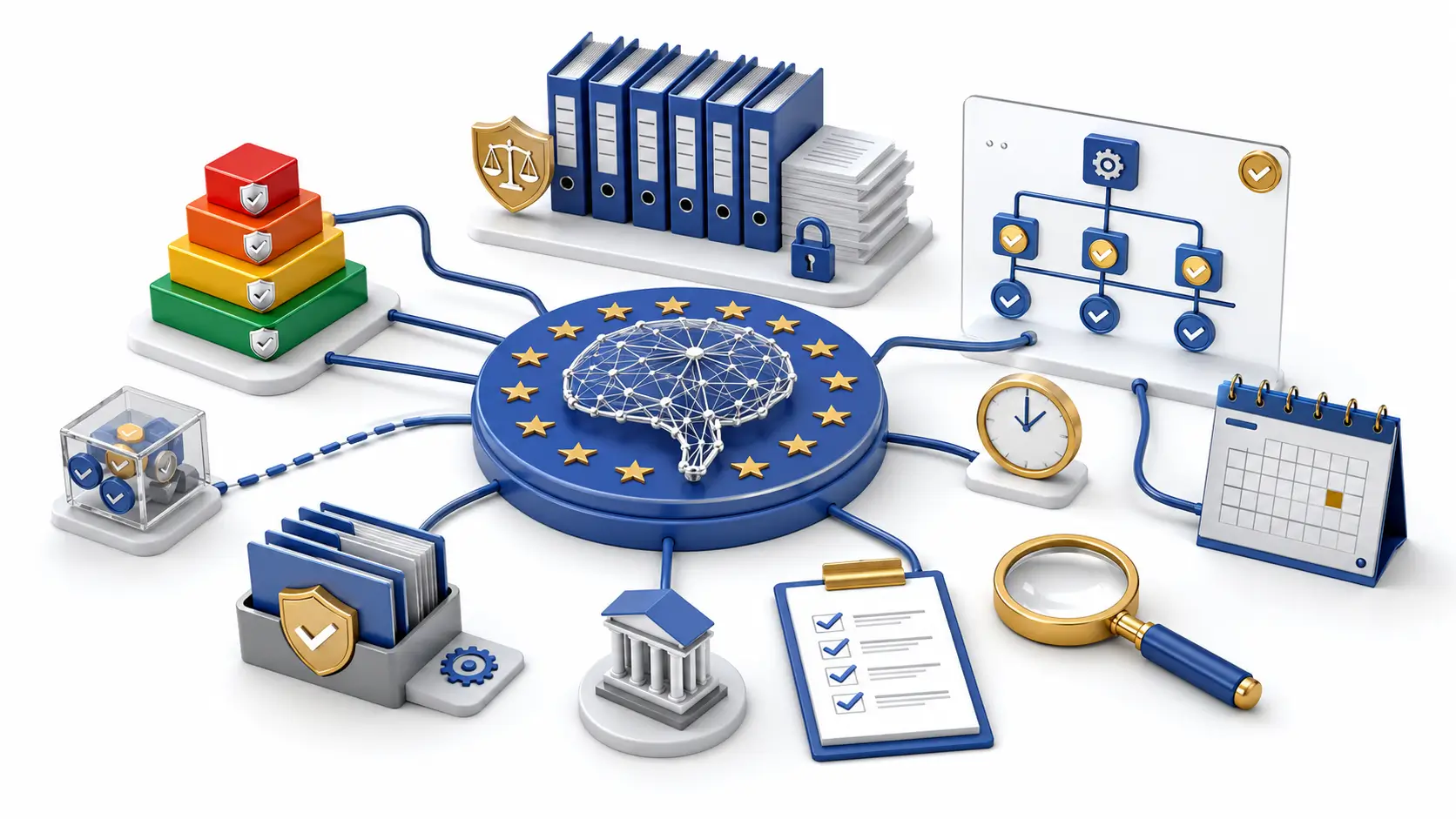
AI Governance Maturity Model: 5 Enterprise Readiness Levels
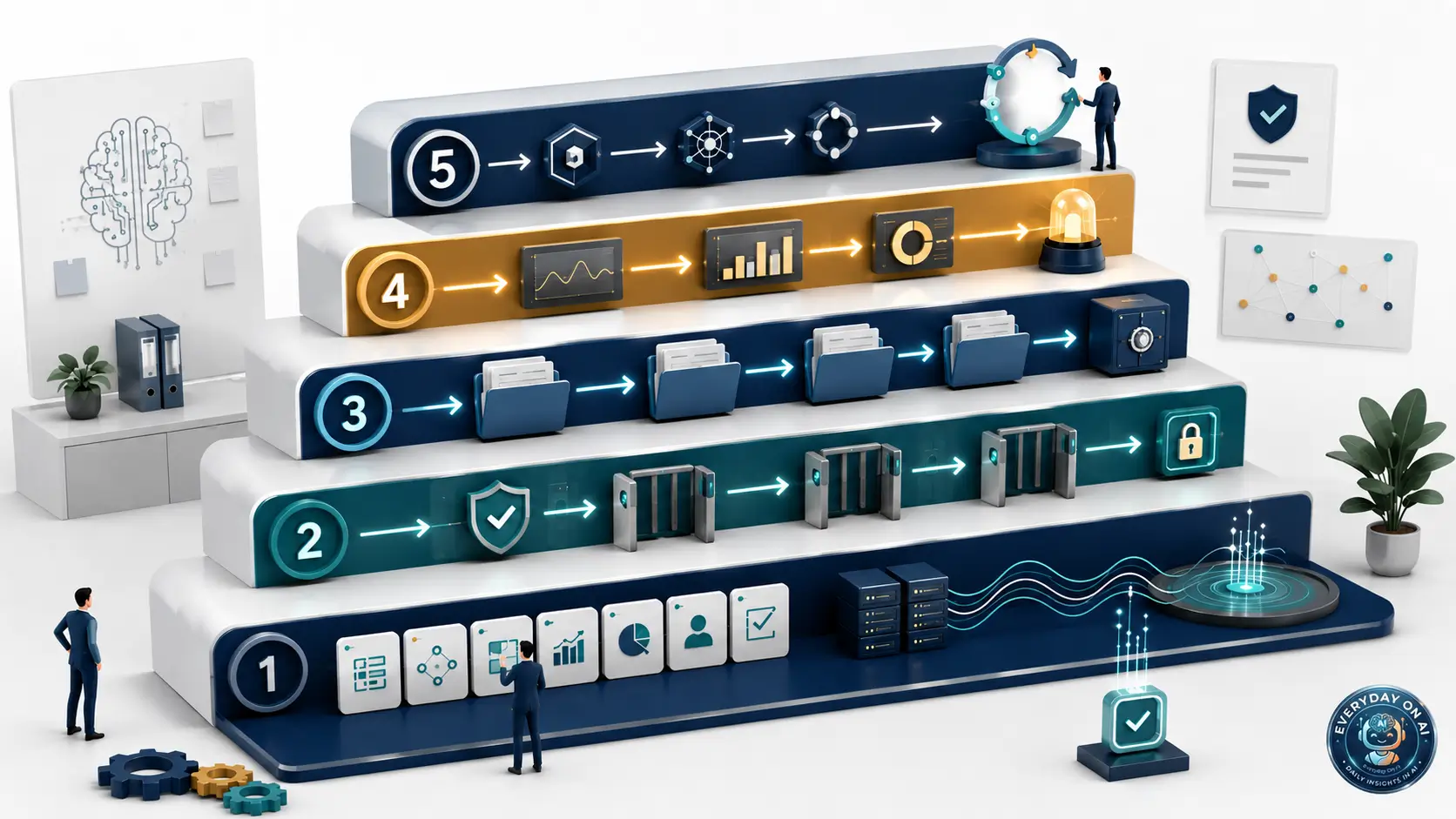

AI Governance Maturity Model: The 5 Enterprise Readiness Levels for 2026
An AI governance maturity model helps enterprise teams understand whether AI oversight is informal, policy-based, controlled, audit-ready, or adaptive. The real test is not whether the organization has an AI policy. The test is whether live AI systems are inventoried, risk-classified, approved, monitored, logged, reviewed, and improved with evidence. In 2026, this matters because chatbots, RAG systems, embedded vendor AI, and AI agents can move from experimentation to business-critical workflows faster than traditional governance can follow.
Short definition: an AI governance maturity model is a scoring framework that shows how effectively an organization governs AI systems through owners, controls, evidence, monitoring, and continuous improvement.
AI governance maturity should be measured by evidence under pressure. A mature program can trace a system from business purpose to risk decision, human oversight, vendor dependency, logs, incident response, and change history without a special task force.
Beginner-friendly explanation
Think of AI governance maturity like security maturity. At Level 1, people use AI tools without a shared map. At Level 5, the organization knows what AI exists, who owns it, what it can affect, how it is controlled, what evidence proves control, and how controls adapt when the system changes.
Key Takeaways
- The maturity model should evaluate operational evidence, not the appearance of policy maturity. NIST AI RMF emphasizes govern, map, measure, and manage functions. [1]
- AI governance maturity improves when AI management is treated as a documented system with continual improvement, consistent with ISO/IEC 42001. [3]
- High-risk AI contexts require stronger evidence because the EU AI Act includes lifecycle risk management, technical documentation, record-keeping, and transparency duties. [4]
- Generative AI raises maturity requirements because risks can arise across lifecycle stages and vary across model, system, application, and ecosystem context. [5]
- AI agents are a maturity stress test because organizations must govern actions, tool permissions, logs, and rollback controls, not only generated text. [8]
Who Should Read This?
This article is for teams that need a practical readiness score before AI adoption outruns governance. It is built for enterprise AI teams, security engineers, AI engineers, ML engineers, CTOs, CISOs, AI governance leads, product managers, compliance officers, legal teams, internal audit, and procurement.
CISO / Security Engineer
Use it to identify where AI controls are missing across identity, logging, prompt abuse, tool actions, incident response, and vendor risk.
AI Governance Lead
Use it to convert abstract governance principles into an operating model with owners, workflows, and evidence.
AI Engineer / ML Engineer
Use it to understand when technical work needs model cards, dataset records, drift metrics, evaluation reports, and change controls.
CTO / Product Manager
Use it to prioritize governance work without blocking every AI experiment with the same level of control.
Compliance / Internal Audit
Use it to determine whether AI controls are repeatable, testable, and supported by retained evidence.
Section Summary
- The maturity model is designed for cross-functional teams, not only compliance.
- Different roles see different evidence gaps, so the score should combine technical and governance views.
- The best use case is prioritization: deciding what must improve next.
What Is an AI Governance Maturity Model?
An AI governance maturity model is a structured scale for assessing how reliably an organization governs AI systems. It should evaluate whether AI systems are known, owned, risk-assessed, approved, monitored, secured, documented, and improved. A useful maturity model does not reward policy volume. It rewards repeatable controls and evidence.
This model uses five levels: ad hoc, policy-based, controlled, audit-ready, and adaptive. The levels reflect how governance moves from informal behavior to documented policy, then to operational controls, then to audit-ready evidence, and finally to continuous risk adaptation.
The model fits well with the NIST AI RMF because NIST frames AI risk management through govern, map, measure, and manage functions. [1] It also fits ISO/IEC 42001 because that standard specifies requirements for establishing, implementing, maintaining, and continually improving an Artificial Intelligence Management System. [3]
It should also reflect trustworthy-AI principles such as accountability, transparency, robustness, safety, security, and respect for human rights, because maturity without accountable outcomes becomes paperwork. [6]
Research that applies maturity-model thinking to the NIST AI RMF also treats maturity as an assessment of operational practices, not merely executive declaration. [10]
Section Summary
- Maturity is the ability to govern consistently, not the number of governance documents.
- The five levels describe how far governance has moved from informal use to adaptive oversight.
- A practical model maps to NIST AI RMF and ISO/IEC 42001 without pretending that one model guarantees compliance.
Why AI Governance Maturity Matters in 2026
AI adoption now spans employee copilots, customer support bots, retrieval-augmented knowledge tools, code assistants, decision-support models, and agents that can use tools. The maturity gap appears when an organization has many AI pilots but cannot answer basic questions: which systems are live, who owns them, what data they access, what risk level they carry, which vendors are involved, and how incidents are handled.
Regulatory pressure is one reason maturity matters, but it is not the only reason. The EU AI Act requires high-risk AI systems to use documented lifecycle risk management and technical documentation. [4] Enterprise buyers ask similar questions even outside the EU because they need to manage their own risk when they buy AI-enabled products.
Security maturity is also relevant. NIST Cybersecurity Framework 2.0 helps organizations reduce cybersecurity risk and provides resources for profiles and mappings. [2] AI governance maturity should borrow the same discipline: define current state, define target state, identify gaps, prioritize actions, and preserve evidence.
“reduce cybersecurity risks”
Source: NIST Cybersecurity Framework 2.0. [2]
EverydayOnAI read: AI maturity should borrow the same profile-based habit: know current state, target state, gaps, and evidence.
Section Summary
- Maturity matters because AI systems are moving into production and vendor products faster than governance workflows.
- Regulators and enterprise buyers both ask evidence-based questions.
- Security maturity offers a useful pattern: current profile, target profile, gaps, and measurable improvement.
The 5 Levels of Enterprise AI Readiness
The five-level model is a practical scoring system. It is not a universal standard. Use it to create a shared language, run a baseline assessment, and select the next improvements. Most organizations are not one level everywhere. A company may be Level 4 for regulated ML systems, Level 2 for employee copilots, and Level 1 for vendor AI embedded in SaaS tools.
| Level | Name | What it looks like | Evidence test | Main risk |
|---|---|---|---|---|
| 1 | Ad hoc AI | AI use is experimental, informal, and often outside central visibility. | No reliable inventory of systems, owners, data, vendors, or approvals. | Shadow AI, inconsistent decisions, unreviewed data exposure. |
| 2 | Policy-based governance | AI policy exists, but adoption relies on teams remembering to follow it. | Policies and training exist, but system-level evidence is inconsistent. | Policy theater: governance looks mature until evidence is requested. |
| 3 | Controlled governance | High-risk systems go through defined intake, risk review, approval, and launch gates. | Inventory, owner, risk class, approval, and minimum controls exist for important systems. | Controls may still be manual and not consistently monitored after launch. |
| 4 | Audit-ready governance | Governance records are retained, linked, dated, and testable across the lifecycle. | A reviewer can trace system purpose, data, model, controls, monitoring, incident, vendor, and change evidence. | Governance can be strong but slow if evidence workflows are too manual. |
| 5 | Adaptive governance | Controls adjust when model behavior, data, retrieval sources, agent permissions, regulations, or business context change. | Monitoring, change triggers, issue patterns, vendor updates, and control performance drive reassessment. | Over-automation or false confidence if adaptive signals are poorly designed. |
Level 1: Ad hoc AI
At Level 1, teams experiment with AI tools without a consistent inventory or intake process. This may be reasonable for early learning, but it becomes risky when AI reaches customer workflows, sensitive data, regulated decisions, or agentic actions. The first improvement is simple: create visibility.
Level 2: Policy-based governance
At Level 2, the organization has an AI policy, training, and perhaps an AI acceptable-use standard. This is progress, but it is fragile. The program depends on voluntary compliance and does not yet prove that real systems follow the policy.
Level 3: Controlled governance
At Level 3, AI intake, risk classification, approval, and minimum controls exist. This is the first level where governance becomes operational. NIST AI RMF language is useful here because teams can map systems, measure risk, and manage controls through repeatable workflow. [1]
Level 4: Audit-ready governance
At Level 4, evidence is retained and testable. This level matters when buyers, auditors, regulators, or internal assurance teams ask for proof. For high-risk EU contexts, technical documentation and record-keeping expectations make this evidence discipline especially important. [4]
Level 5: Adaptive governance
At Level 5, governance learns from monitoring, incidents, user feedback, vendor changes, model updates, and regulatory changes. Generative AI makes this level more important because NIST notes that GAI risks can differ from or intensify traditional software risks and can be difficult to estimate. [5]
Section Summary
- Maturity may differ by system class; do not force one enterprise score without nuance.
- Level 3 is the turning point where governance becomes operational.
- Level 5 is not bureaucracy; it is the ability to adapt controls when AI behavior or context changes.
AI Governance Maturity Self-Assessment Widget
Use this widget to estimate the maturity level for one AI system or one portfolio. It is a practical guide, not a certification.
Section Summary
- The widget scores inventory, controls, evidence, and adaptation.
- A system can have a policy and still be Level 2 if evidence is weak.
- The next action should move one level higher, not chase perfection everywhere.
Architecture and Trust Boundary: What Maturity Must Cover
Mature AI governance follows the AI system architecture. It covers data inputs, prompt layers, model providers, retrieval sources, tool actions, outputs, user feedback, monitoring, and incident response. This is especially important for generative AI because risks can arise from human behavior, model inputs, model outputs, system integration, and value-chain components. [5]
Maturity architecture
A maturity model should test whether each layer has an owner, evidence, and reassessment trigger.

Impact for Chatbots, RAG, and AI Agents
For chatbots, maturity means the organization controls user disclosure, content policy, escalation, sensitive data, and monitoring. For RAG, maturity means source governance, access control, retrieval evaluation, and citation behavior are documented. For agents, maturity means tool permissions, approval gates, action logs, rollback, and incident response are tested. OWASP’s 2025 LLM risk list is useful because it names risks that directly stress immature programs, including prompt injection, sensitive information disclosure, supply chain, excessive agency, vector weaknesses, misinformation, and unbounded consumption. [8]
Section Summary
- Maturity must cover architecture layers, not only governance committees.
- RAG and agent systems expose weak maturity faster than traditional prediction models.
- Trust boundaries help decide where controls and logs must exist.
Metrics, Logs, and Evidence by Maturity Level
AI governance maturity should be measured with metrics that a reviewer can test. Do not rely only on self-reported survey answers. Combine quantitative indicators, record sampling, and interviews. NIST SP 800-53 describes controls as flexible and customizable within an organization-wide risk management process, which is a useful principle for evidence-based maturity scoring. [9]
| Metric area | Level 1–2 signal | Level 3 signal | Level 4–5 signal |
|---|---|---|---|
| Inventory | Unknown or spreadsheet-based list without owners. | Inventory includes owners, purpose, data, risk class, and status. | Inventory links to evidence, monitoring, vendor reviews, and change triggers. |
| Risk classification | Policy exists but systems are not consistently classified. | Risk classification completed for production or high-impact systems. | Risk class updates after material changes, incidents, and monitoring findings. |
| Approvals | Approval is informal or captured in chat. | Defined intake and approval gates exist. | Approvals, exceptions, expiry dates, and compensating controls are auditable. |
| Monitoring | No system-specific monitoring beyond uptime or generic logs. | Key systems have metrics and owner review. | Monitoring thresholds trigger reassessment and incident workflow. |
| Vendors | Vendor AI is reviewed only through standard procurement. | AI-specific vendor review exists for key systems. | Vendor model, API, data, security, and change evidence is linked to system risk. |
| Agents | Agents treated like chatbots. | Tool permissions and approvals defined. | Action logs, rollback, budget limits, and escalation drills are tested. |
Section Summary
- Metrics should show whether governance is operating, not only whether policy exists.
- Inventory, approvals, monitoring, vendors, and agents are high-signal maturity dimensions.
- Level 5 requires feedback loops that trigger reassessment when risk changes.
Governance and Defense Controls by Level
Controls should scale by risk. A Level 1 organization may need basic acceptable-use rules and an AI inventory. A Level 3 organization needs risk intake, approval workflow, and minimum controls for production systems. A Level 4 organization needs retained evidence and testable audit trails. A Level 5 organization needs adaptive reassessment based on monitoring, incident patterns, vendor changes, and model behavior.
- Level 1 to 2: publish acceptable use, identify shadow AI, create intake, and train teams.
- Level 2 to 3: add system inventory, owner register, risk classification, impact assessment, and approval workflow.
- Level 3 to 4: build evidence packs, logging standards, vendor AI files, monitoring review, and incident records.
- Level 4 to 5: add automated reassessment triggers, control-health metrics, agent action reviews, and post-incident learning loops.
FTC guidance is useful at the control-design level because it reminds companies to be transparent about automated tools, explain decisions in consumer-impacting contexts, and test outcomes for fairness where relevant. [7]
Section Summary
- Controls should be risk-scaled rather than identical for every AI use case.
- The move from Level 3 to Level 4 is mostly an evidence-retention challenge.
- The move from Level 4 to Level 5 is a feedback-loop and reassessment challenge.
90-Day Implementation Blueprint to Move Up One Level
The safest maturity goal is often to move one level, not to jump from ad hoc AI to adaptive governance in a single quarter. Use the roadmap below for a realistic improvement cycle.
Days 1–15: Baseline the real portfolio
Create or refresh the AI inventory. Include internal tools, vendor AI, embedded SaaS AI, customer-facing AI, RAG systems, and agents. Mark unknowns honestly.
Days 16–30: Define risk tiers and intake
Create risk questions for purpose, users, data sensitivity, decision impact, autonomy, vendor dependency, and regulatory exposure. Do not overcomplicate the first version.
Days 31–45: Select minimum controls
Define minimum controls for low, medium, high, and critical AI systems. Include security, privacy, human oversight, monitoring, and vendor review.
Days 46–65: Build evidence packs for priority systems
Use the evidence-pack approach for systems with customer exposure, sensitive data, decision impact, or agentic actions. This connects maturity scoring to proof. [4]
Days 66–80: Create metrics and review cadence
Track inventory coverage, expired reviews, open exceptions, unresolved incidents, vendor review age, and monitoring alert handling.
Days 81–90: Run an assurance review
Sample a few systems and test whether records match reality. This exposes whether the program is truly Level 3 or Level 4.
Section Summary
- A 90-day cycle should focus on one maturity-level improvement.
- Start with portfolio visibility before designing complex controls.
- Assurance sampling is the fastest way to find the gap between process design and real operation.
Recommended Tool Categories for Maturity Assessment
Maturity assessment can begin in spreadsheets, but it should not stay there forever. Tooling becomes important when the portfolio grows, evidence ages quickly, vendors change, or agents create action logs.
| Tool category | Best maturity use | What not to assume | Relevant level |
|---|---|---|---|
| AI inventory / governance registry | System ID, owner, purpose, risk class, status, and review dates. | Do not assume discovery is complete without business validation. | Level 2–5 |
| GRC platform | Controls, approvals, exceptions, risk acceptance, audit workflow. | Do not assume a generic risk register captures model, retrieval, and agent details. | Level 3–5 |
| Model registry / ML platform | Model versioning, deployment metadata, evaluation artifacts. | Do not assume model lineage covers business risk or legal use context. | Level 3–5 |
| Observability / logging | Prompt logs, retrieval traces, tool calls, monitoring alerts, incident review. | Do not log sensitive data without privacy and retention controls. | Level 4–5 |
| Vendor risk management | AI supplier review, data terms, API dependencies, change notices. | Do not assume standard security questionnaires cover AI behavior changes. | Level 3–5 |
Section Summary
- Tooling should follow the maturity model, not define it.
- A registry and evidence index become essential as AI use scales.
- Observability is useful only when logging, privacy, retention, and review workflows are defined.
Before and After: What Changes When You Apply This
| Area | Before | After | Why It Matters |
|---|---|---|---|
| Executive reporting | Leadership hears that AI policy exists. | Leadership sees maturity level by portfolio, risk tier, and evidence coverage. | Readiness becomes measurable without pretending the score is certification. |
| AI inventory | AI systems are known by individual teams but not centrally visible. | Systems have owners, purpose, data category, risk class, and status. | Shadow AI and vendor AI become governable. |
| Audit readiness | Assurance depends on interviews and manual file collection. | Evidence packs link approvals, controls, monitoring, incidents, vendors, and changes. | Reviewers can test process operation. |
| RAG systems | Governance focuses on model provider and ignores retrieval sources. | Source inventory, access control, freshness, and retrieval evaluation become maturity criteria. | RAG-specific risk becomes visible. |
| AI agents | Agents are assessed as chatbots with extra features. | Tool permissions, action logs, approval gates, rollback, and escalation are required. | Governance covers actions and consequences. |
Mini Case Study: When a Level 2 Program Meets an AI Agent
| Context / Stage / Moment | What happened | Risk / failure point | Better control / lesson |
|---|---|---|---|
| Product team pilots an internal AI agent | The agent summarizes support tickets and can create draft refunds through an internal tool. | The AI policy allows experimentation but does not define tool-permission approval. | Move from Level 2 policy to Level 3 controlled governance for agentic workflows. |
| Security review | Security asks for action logs and rollback procedure. | The team has chat logs but not tool-call logs or approval thresholds. | Agent maturity requires action evidence, not only conversation evidence. |
| Compliance review | Compliance asks whether customers could be affected by agent-created drafts. | Human review exists informally, but the oversight plan has no trigger criteria. | Define human approval gates and exception handling before production. |
| Post-pilot decision | The team wants to expand the agent to more workflows. | Expansion would increase autonomy before maturity improves. | Require Level 3 controls before expansion and Level 4 evidence before business-critical use. |
Section Summary
- Agents reveal the limits of policy-only governance.
- Tool-call logging and rollback are maturity controls, not optional engineering details.
- Expansion should depend on control maturity, not only pilot success.
Common Mistakes When Measuring AI Governance Maturity
Mistake 1: Counting policies as maturity
Policies are necessary, but they are not evidence that systems are governed. A program with many policies but no inventory may still be Level 2.
Mistake 2: Ignoring vendor AI
Enterprise AI often enters through SaaS products, APIs, and embedded features. Vendor AI belongs in the maturity assessment because accountability and data risk can still affect the organization.
Mistake 3: Averaging away high-risk gaps
A portfolio average can hide critical systems with weak controls. Score by system class and risk tier.
Mistake 4: Treating annual review as adaptive governance
Annual review is useful, but adaptive governance requires triggers from incidents, monitoring, changes, and vendor updates.
Mistake 5: Measuring agents like chatbots
Agents can take actions. Maturity assessment should cover tool permission, action logs, approval gates, rollback, and escalation.
Section Summary
- The biggest scoring error is confusing documentation volume with operational control.
- Vendor AI and agentic AI need explicit maturity questions.
- Use risk-tier scoring to avoid hiding weak controls behind enterprise averages.
FAQ
What is an AI governance maturity model?
An AI governance maturity model is a structured way to evaluate how well an organization controls AI across policy, inventory, risk, approvals, monitoring, evidence, and continuous improvement.
What are the five levels of AI governance maturity?
The five levels are ad hoc, policy-based, controlled, audit-ready, and adaptive. Each level describes how repeatable and evidence-based AI governance is.
How do you measure AI governance maturity?
Measure maturity by checking inventory coverage, owner assignment, risk classification, approval workflow, monitoring, incident handling, vendor review, and evidence freshness.
What is audit-ready AI governance?
Audit-ready AI governance means the organization can show dated, owner-linked evidence that AI systems are risk-assessed, approved, monitored, changed, and reviewed through a repeatable process.
How does agentic AI change governance maturity?
Agentic AI raises maturity requirements because organizations must govern tool permissions, action logs, approval gates, rollback controls, and escalation workflows, not only model outputs.
Which frameworks should this maturity model map to?
It can map to NIST AI RMF, ISO/IEC 42001, the EU AI Act where applicable, security control frameworks, and internal enterprise risk management requirements.
Conclusion
The AI governance maturity model gives enterprise teams a practical way to move from AI policy to AI readiness. The goal is not to achieve a perfect score. The goal is to know where governance is informal, where it is controlled, where it is audit-ready, and where it can adapt as AI systems change.
A mature AI governance program is not the one with the most committees. It is the one that can prove which AI systems exist, why they are allowed, how they are controlled, what evidence exists, and what changes trigger review.
5 Things to Remember
- Maturity should be scored by system evidence, not policy quantity.
- Most organizations have mixed maturity across different AI portfolios.
- RAG and AI agents require trust-boundary controls that older models may not cover.
- Audit-ready governance needs dated, owner-linked, retrievable evidence.
- Adaptive governance means reassessment happens when risk changes, not only once per year.
References
- National Institute of Standards and Technology, “AI Risk Management Framework,” January 2023. The AI RMF is voluntary and helps organizations incorporate trustworthiness into AI design, development, use, and evaluation. https://www.nist.gov/itl/ai-risk-management-framework
- National Institute of Standards and Technology, “Cybersecurity Framework 2.0,” February 2024. CSF 2.0 helps organizations reduce cybersecurity risks and includes resources for profiles and mappings. https://www.nist.gov/cyberframework
- International Organization for Standardization, “ISO/IEC 42001:2023 Information technology — Artificial intelligence — Management system,” December 2023. ISO/IEC 42001 specifies requirements for an Artificial Intelligence Management System. https://www.iso.org/standard/42001
- European Union, “Regulation (EU) 2024/1689 Artificial Intelligence Act,” July 2024. The regulation includes requirements for high-risk AI systems covering risk management, technical documentation, record-keeping, transparency, and instructions for use. https://eur-lex.europa.eu/eli/reg/2024/1689/oj/eng
- National Institute of Standards and Technology, “Artificial Intelligence Risk Management Framework: Generative Artificial Intelligence Profile,” July 2024. The profile identifies risks unique to or exacerbated by generative AI and suggested actions for governance, mapping, measurement, and management. https://nvlpubs.nist.gov/nistpubs/ai/NIST.AI.600-1.pdf
- OECD.AI, “OECD AI Principles overview,” updated May 2024. The principles promote innovative and trustworthy AI that respects human rights and democratic values. https://oecd.ai/en/ai-principles
- Federal Trade Commission, “Using Artificial Intelligence and Algorithms,” April 2020. FTC guidance emphasizes transparency, explainability, fairness, empirical soundness, and accountability in AI and algorithms. https://www.ftc.gov/business-guidance/blog/2020/04/using-artificial-intelligence-and-algorithms
- OWASP Gen AI Security Project, “2025 Top 10 Risk & Mitigations for LLMs and Gen AI Apps,” 2025. OWASP lists prompt injection, sensitive information disclosure, supply chain, excessive agency, vector weaknesses, misinformation, and unbounded consumption among major LLM application risks. https://genai.owasp.org/llm-top-10/
- National Institute of Standards and Technology, “SP 800-53 Rev. 5: Security and Privacy Controls for Information Systems and Organizations,” September 2020, updated 2025. The publication provides a flexible catalog of security and privacy controls and includes audit, accountability, risk assessment, and supply-chain control families. https://csrc.nist.gov/pubs/sp/800/53/r5/upd1/final
- Dotan, Blili-Hamelin, Madhavan, Matthews, and Scarpino, “Evolving AI Risk Management: A Maturity Model based on the NIST AI Risk Management Framework,” January 2024. The paper argues for evaluating where organizations sit relative to operational practices for sociotechnical risk mitigation. https://arxiv.org/abs/2401.15229
Download the AI Governance Maturity Scorecard
Use the five-level model to score your AI portfolio, then connect the score to evidence packs and improvement actions.
Share this article