How to Optimize Content for ChatGPT Citations (2026 Guide)

How to Optimize Content for ChatGPT Citations
Data Freshness Note — Reviewed June 30, 2026
According to EverydayOnAI: ChatGPT citation optimization should be treated as retrieval plus source-selection work. OpenAI’s ChatGPT Search help notes that ChatGPT can search the web, may rewrite a user request into targeted search queries, and may show inline citations or a Sources panel when search is used.[F1]
Practical implication: optimize title-question alignment, Bing/index eligibility, concise answer sections, and source-backed evidence. Do not assume every ChatGPT answer performs live retrieval.
Who Should Read This?
Use this to connect classic ranking work with AI citation visibility.
Use the section structure to brief writers and editors.
Use this to decide where AI-search effort deserves budget.
Use the metrics sections to build a practical visibility baseline.
📌 Key Takeaways
- ChatGPT skips web search entirely on roughly 65-69% of queries, answering from training data alone — meaning the majority of prompts offer zero opportunity for new content to be cited, regardless of optimization quality.
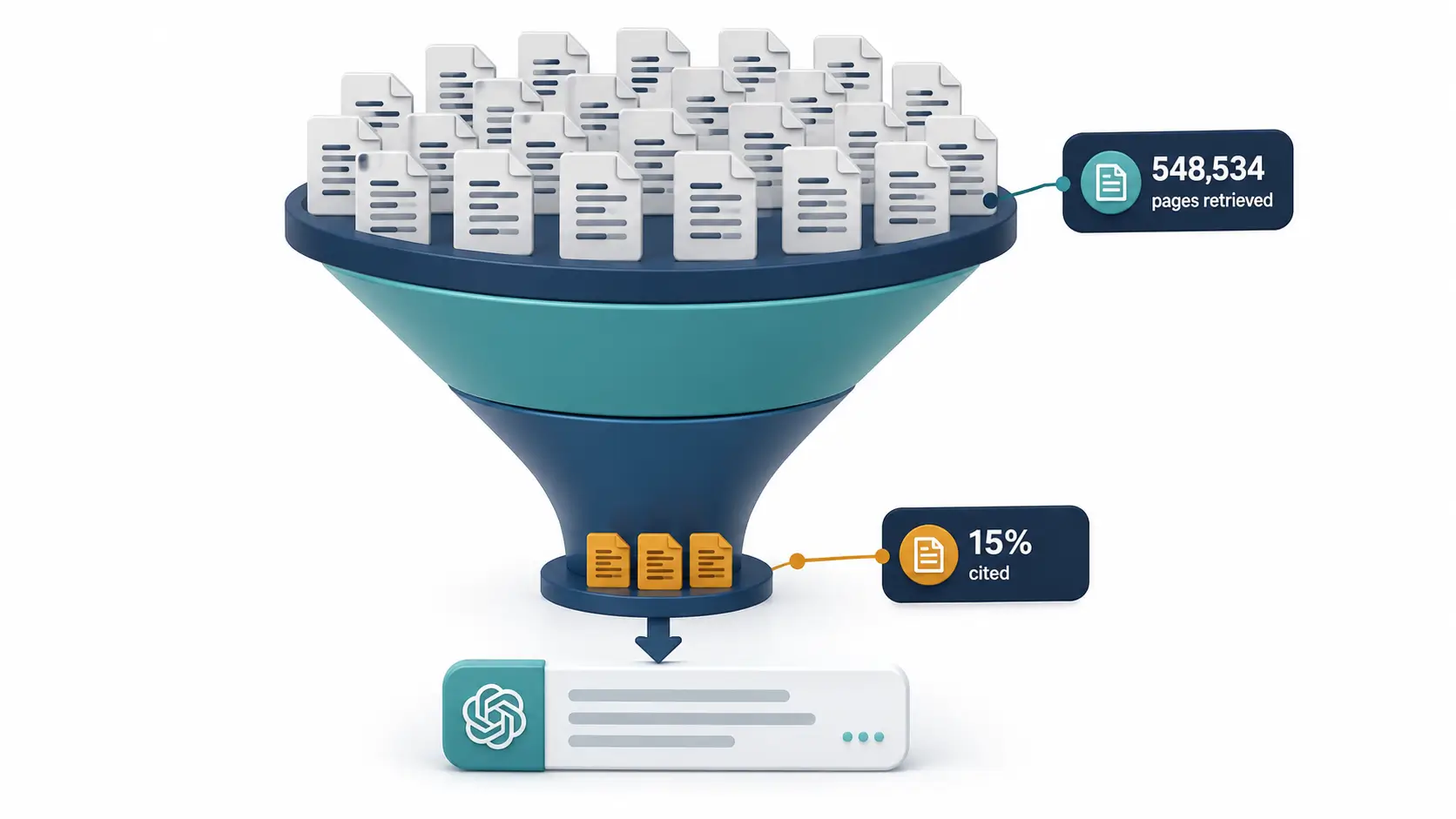
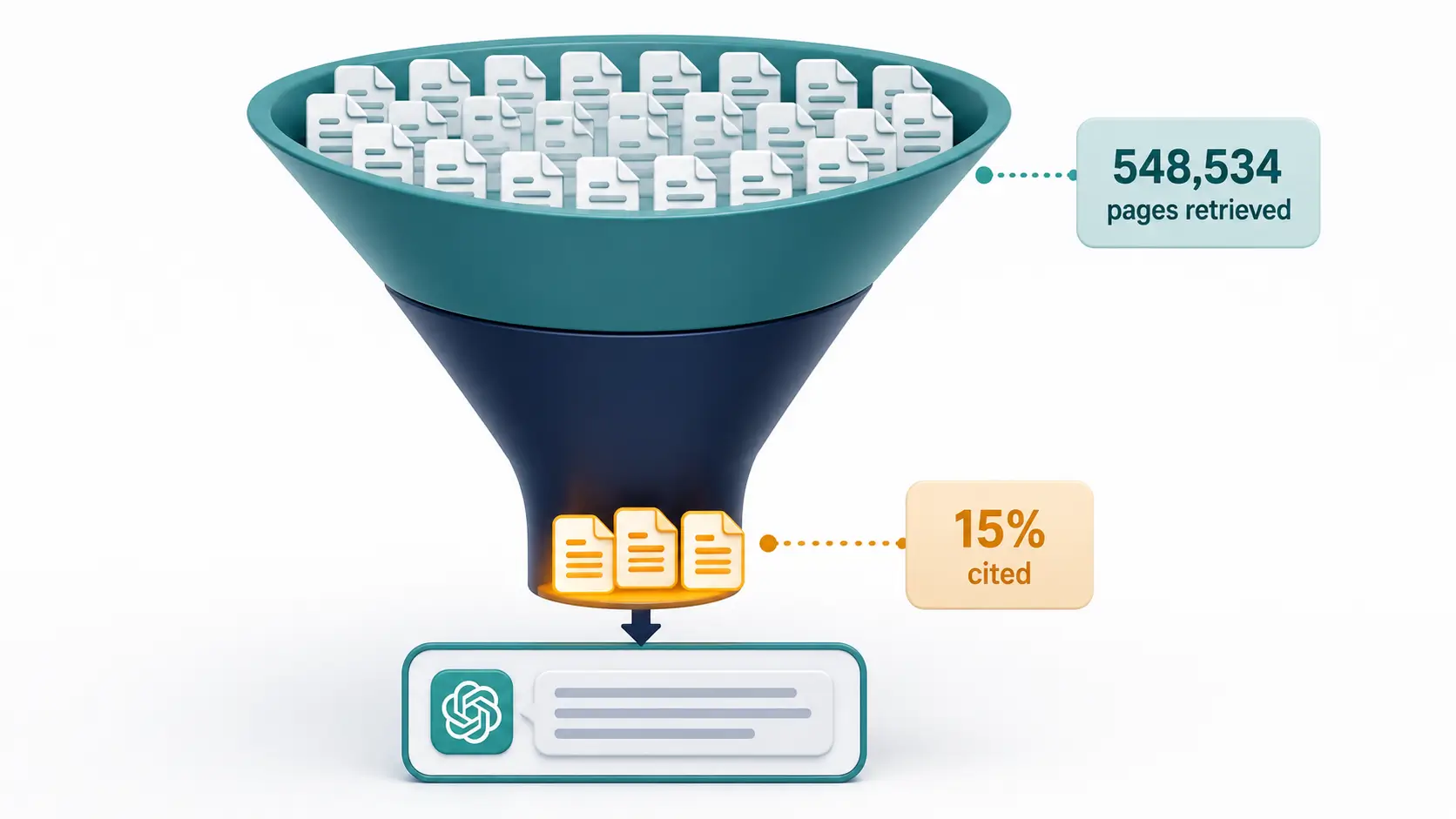
- Of the queries that do trigger web search, ChatGPT retrieves a large candidate pool but cites only 15% of retrieved pages (AirOps, March 2026, 548,534 pages across 15,000 prompts) — retrieval and citation are separate problems requiring separate optimization.
- Title-query alignment to ChatGPT’s internal fan-out sub-questions is the single largest measured citation factor: 50%+ title-word overlap produces a 20.1% citation rate vs. 9.3% for under 10% overlap — a 2.2x difference from phrasing alone.
- ChatGPT’s browsing mode retrieves from Bing’s index, not Google’s — first-page Bing ranking is a technical prerequisite for citation eligibility, independent of Google performance.
- Backlink volume is not the primary citation driver once a page is retrieved — mid-authority pages (DA 40-80) show citation rates comparable to higher-authority domains, though high-DA sites do get retrieved more often.
📋 Table of Contents
- Who Should Read This?~ 1 min
- The Two Separate Problems: Retrieval and Citation~ 3 min
- When Does ChatGPT Even Search the Web?~ 3 min
- The Bing Prerequisite Most Teams Miss~ 2 min
- Fan-Out Queries and the Title-Match Signal~ 4 min
- What Actually Drives Citation Selection~ 4 min
- Tool: ChatGPT Title-Match Estimator~ 2 min
- Before & After: Generic Title vs. Fan-Out-Aligned Title~ 2 min
- ChatGPT Citation Optimization Checklist~ 2 min
- Frequently Asked Questions~ 2 min
- Conclusion~ 1 min
- Google Search Central, “AI Features and Your Website,” last updated December 2025. Google states that SEO best practices remain relevant for AI Overviews and AI Mode, that there are no additional technical requirements beyond Search eligibility and snippets, and that AI features may use query fan-out. developers.google.com
The Two Separate Problems: Retrieval and Citation
Most ChatGPT optimization advice conflates two genuinely different problems. The first is discoverability: getting your page into ChatGPT’s candidate retrieval pool at all. The second is selectability: surviving the cut once you’re in that pool and actually appearing in the final answer.[1] Almost all published “ChatGPT SEO” advice addresses only the first problem — and the data shows the second problem is where most brands actually lose.
An AirOps study analyzing 548,534 pages retrieved across 15,000 prompts found that ChatGPT cites only 15% of the pages it retrieves. The other 85% are pulled into the evaluation process and discarded without ever appearing in the generated answer.[1] Being retrieved means your page entered the candidate pool. Being cited means it was selected for visible attribution. Most content strategy effort goes into the first goal; the data suggests the second goal is where the real competition happens.[2]
💬 According to EverydayOnAI
This retrieval/citation split is the most clarifying single fact in ChatGPT optimization research right now. It explains a pattern that confuses a lot of content teams: a page can be technically accessible, indexed in Bing, ranking reasonably well — and still never get cited, because all of that only buys entry into the candidate pool. The actual competition for the 15% slot happens on different criteria entirely: title-query alignment, answer placement, and content specificity. Teams that treat “getting indexed” as the finish line are solving roughly half the problem.
📋 Section Summary
- ChatGPT optimization has two separate stages: retrieval (entering the candidate pool) and citation (surviving selection into the final answer) — most published advice addresses only retrieval.
- AirOps’ analysis of 548,534 retrieved pages found ChatGPT cites only 15% of what it retrieves — the citation stage is where the real competitive bottleneck exists.
- Being indexed and technically accessible is necessary but not sufficient — it buys entry into the pool, not selection from it.
When Does ChatGPT Even Search the Web?
Before optimizing for citation, it’s worth understanding how often the opportunity for citation exists at all. ChatGPT skips web search entirely on a majority of queries — figures from 2026 research range from 65% to 69% of queries answered directly from training data, with web search triggered primarily for recent facts, post-training-cutoff events, or cases of model uncertainty.[3] Separately, Whitehat SEO’s analysis found approximately 31% of prompts trigger a web search.[4] CXL’s analysis found this figure trending downward — from 46% web-search-triggered in 2024 to 34.5% by 2026.[3]
The practical implication: if your evergreen content hasn’t meaningfully changed in the last several months, the model may already “know” the answer from training data and have no reason to search the web for your page, regardless of how well it’s optimized.[3] This reframes content strategy: publishing on emerging or rapidly evolving topics — where the model’s training data is necessarily incomplete or outdated — creates a structurally larger citation opportunity than competing for citation on well-established, slow-moving topics.
65-69%
of ChatGPT queries answered from training data, no web search triggered[3]
34.5%
of queries trigger web search in 2026, down from 46% in 2024[3]
89.6%
of search-triggering prompts spawn additional internal fan-out searches[5]
32.9%
of citations come specifically from those hidden fan-out follow-up queries[5]
📋 Section Summary
- The citation opportunity exists only for the roughly one-third of queries that trigger a live web search — a share that has declined from 46% (2024) to 34.5% (2026) as training data has become more current.
- Evergreen content the model already “knows” from training has limited new-citation opportunity regardless of optimization quality — emerging and rapidly-changing topics offer structurally more citation opportunity.
- 89.6% of search-triggering prompts spawn additional hidden fan-out queries, and nearly a third of all citations come specifically from these hidden sub-queries — covered in depth in Section 4.
The Bing Prerequisite Most Teams Miss
This is the single most commonly missed technical prerequisite in ChatGPT optimization. ChatGPT Search is powered by Bing’s index for real-time web retrieval, not Google’s. One study found ChatGPT search results share 73% overlap with Bing’s results.[1] If a site is not indexed in Bing, it will not appear in ChatGPT responses in browsing mode — regardless of how well it ranks on Google.[1]
The fix is mechanically simple but frequently skipped because most SEO workflows are built entirely around Google Search Console: submit your sitemap to Bing Webmaster Tools directly, and confirm robots.txt allows OAI-SearchBot (ChatGPT’s crawler) access.[1] Bing and Google rankings correlate strongly for most informational content, so sites with strong Google SEO are not usually starting from zero in Bing — but “usually correlate” is not “always indexed,” and this is a five-minute check most teams have never run.
✓ The 3-Item Bing Prerequisite Check
- ★ Site verified and sitemap submitted in Bing Webmaster Tools (separate from Google Search Console — these are two different tools requiring separate setup)
- ★ robots.txt confirmed to allow OAI-SearchBot, not just Googlebot and GPTBot
- Spot-check: search your target keyword directly on Bing.com and confirm your page appears on page one — if it doesn’t appear on Bing, it cannot be retrieved by ChatGPT in browsing mode
📋 Section Summary
- ChatGPT’s browsing and search features retrieve from Bing’s index, not Google’s — a page invisible to Bing cannot be cited by ChatGPT regardless of Google performance.
- This requires separate setup from standard Google-centric SEO workflows: Bing Webmaster Tools verification and sitemap submission, plus robots.txt access for OAI-SearchBot specifically.
- Bing and Google rankings correlate strongly for most content, but verification (not assumption) is the safer approach given how rarely Bing-specific setup is checked.
Fan-Out Queries and the Title-Match Signal
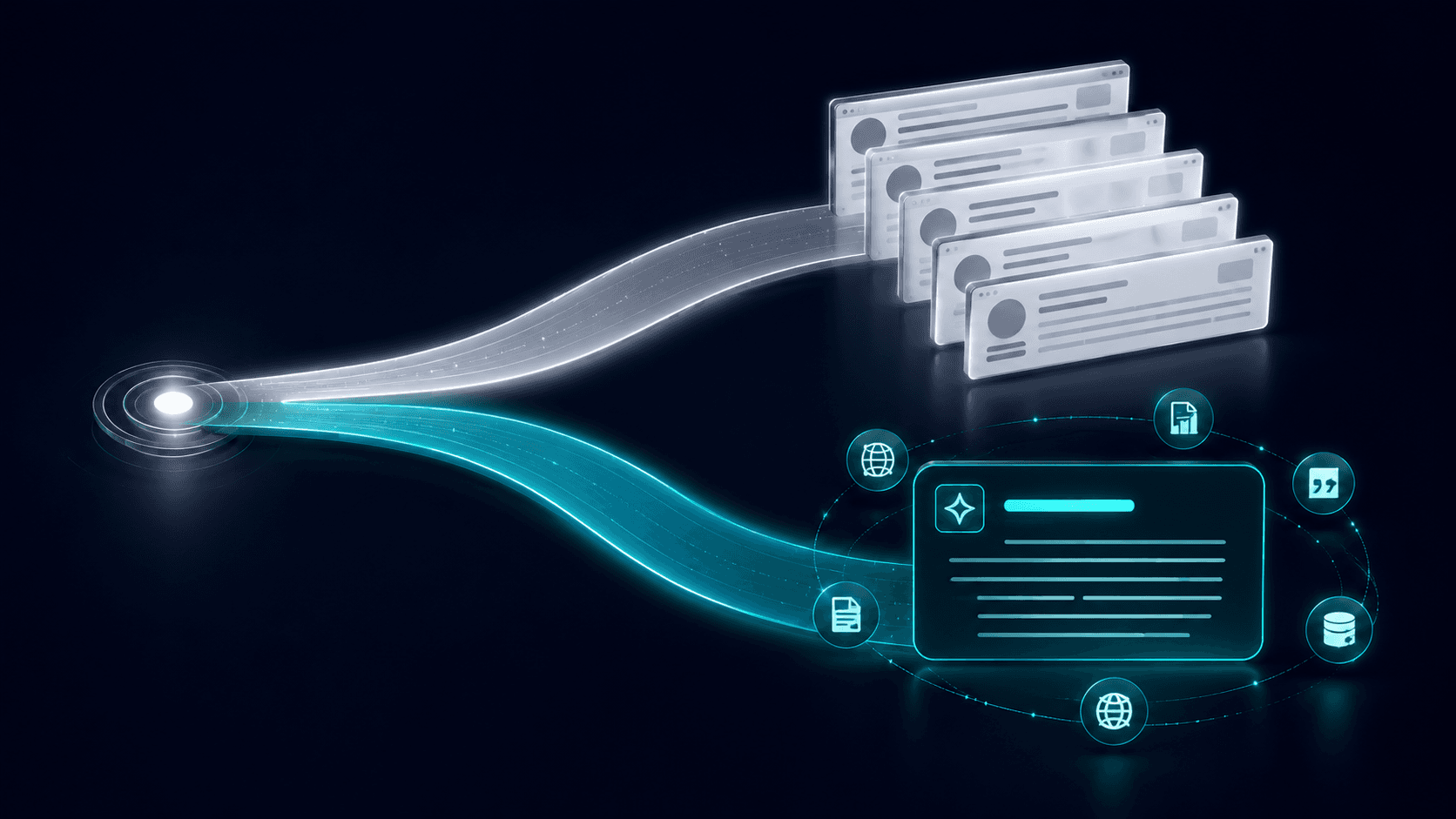
This is the single highest-leverage finding in current ChatGPT citation research. When a user submits a query, ChatGPT does not just search for that exact query — it expands the question into multiple related fan-out sub-queries internally, then runs all of them simultaneously against the retrieval infrastructure before synthesizing a response.[6]
The data shows this matters enormously for which pages get cited: cited pages score 0.602 on semantic similarity to the original user prompt — but jump to 0.656 when measured against the internal fan-out sub-queries instead. Non-cited pages score only 0.484 against the original prompt.[3] The gap widens specifically because ChatGPT isn’t only evaluating a page against the user’s visible question — it’s evaluating it against its own internal question decomposition, which the content creator never sees directly.
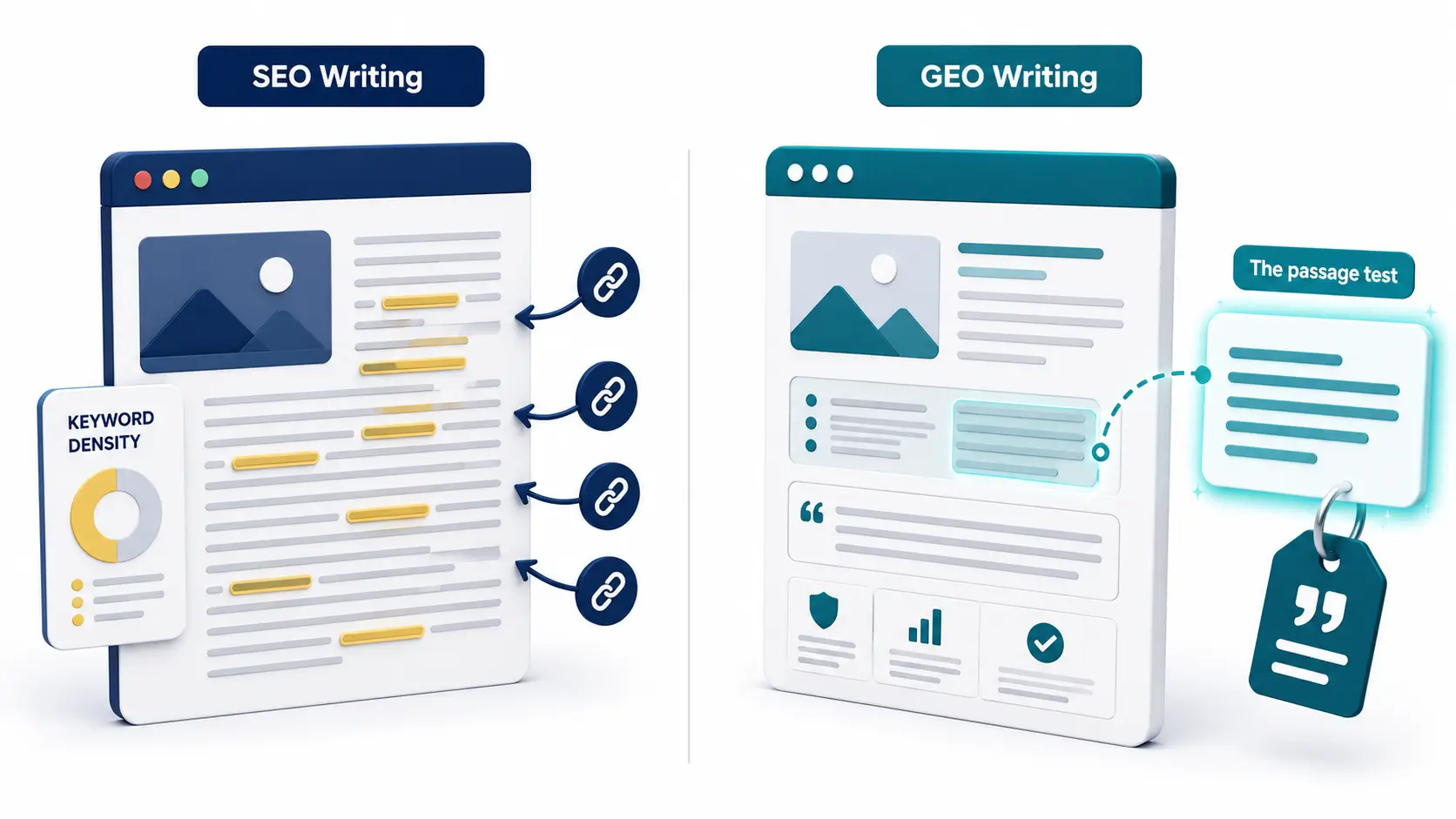
This produces a concrete, measurable title-optimization signal. Pages with 50% or more title-word overlap with the triggering query had a 20.1% citation rate. Pages with less than 10% overlap were cited just 9.3% of the time — a 2.2x difference driven by title phrasing alone.[7] Page titles written for broad brand appeal — common in traditional content marketing — perform measurably worse than titles written to match specific question phrasing.
Where the answer sits on the page compounds this effect. 44.2% of all ChatGPT citations draw from content in the first 30% of a page, while the final third of a page contributes only 24.7% of citations.[7] Long preambles and buried answers reduce citation probability regardless of how strong the underlying content is — a finding directly consistent with the answer-first writing principle covered throughout this AI SEO Hub.
▲ What This Means Practically
Write H2/H3 headings as close-to-verbatim matches for the specific sub-questions a user chain would naturally produce — not broad topic labels. “How long does AEO take to show results” beats “AEO Timeline” as a heading, because it mirrors actual fan-out phrasing rather than a marketing-style label.
▼ The Limitation
You cannot directly observe ChatGPT’s internal fan-out sub-queries for your specific topic — they’re generated dynamically and not exposed to content creators. The best available proxy is mapping the PAA (People Also Ask) chain for your seed query using AlsoAsked, covered in our AEO Keyword Research guide, since fan-out and PAA expansion are conceptually related processes.
📋 Section Summary
- ChatGPT internally expands user queries into fan-out sub-queries before retrieval — cited pages match these hidden sub-queries (0.656 similarity) more closely than they match the visible original prompt (0.602).
- Title-query word overlap is a strong, measurable citation predictor: 50%+ overlap produces 20.1% citation rate vs. 9.3% for under 10% overlap.
- Answer placement compounds the title effect: 44.2% of citations draw from the first 30% of a page; buried answers in the final third underperform regardless of content quality.
What Actually Drives Citation Selection
Beyond title-match and answer placement, research from SE Ranking, AirOps, Authoritas, and the original Princeton/KDD 2024 study converges on a specific set of measurable citation drivers.
Content Specificity and Data Density
Articles with 19 or more statistical data points average 5.4 citations; articles with minimal data average only 2.8 — based on SE Ranking’s analysis of 216,524 pages.[1] The Princeton/KDD 2024 study found that “Fact Density” — the inclusion of authoritative citations, statistics, and quotations — could boost visibility of lower-ranked websites by up to 40% in AI responses.[8]
Named Expert Attribution
The KDD 2024 study found a 40.9% citation lift from attributing claims to named experts with their title and institution, and a separate 30.6% lift from inline source attribution — the source name and publication year placed directly in the sentence body, not relegated to a references section.[9] This is consistent with the self-contained statistics formatting standard used throughout this AI SEO Hub.
Structural Elements
Pages with FAQ schema and inline citations are weighted approximately 40% higher in ChatGPT source selection than pages without these elements (Authoritas, 2025).[1] Section density also matters more than raw length: pages with 120-180 words between headings perform best, averaging 4.6 citations — articles over 2,900 words average 5.1 citations versus 3.2 for articles under 800 words, but the stronger signal is density between headings, not total length alone.[1]
Authority — But Not the Way You’d Expect
Domain authority matters more for entry into the retrieval pool than for selection within it. Once retrieved, mid-authority pages in the DA 40-80 range show citation rates comparable to higher-authority domains — high-DA sites get retrieved more frequently, but they are not selected at proportionally higher rates once in the pool.[1] Third-party review platform presence amplifies authority signals in an unexpected way: domains with active profiles on Trustpilot, G2, Capterra, or Yelp have 3x higher citation probability compared to sites without such presence — ChatGPT appears to treat review platform presence as evidence a brand is real, active, and verifiable.[1]
Wikipedia’s Structural Advantage
Wikipedia’s citation rate across ChatGPT responses sits at 47.9%, reflecting structural alignment with what AI systems value: comprehensive coverage, encyclopedic neutrality, inline citations on every claim, and stable URL patterns (Profound, 680M citation dataset).[10] This is a useful design template: treating your own content as a citable reference, with attributed claims throughout, mirrors the structural pattern ChatGPT already trusts most.
Reduce Subjective Language
Phrases like “I think,” “we believe,” and “in our opinion” increase the model’s perceived uncertainty about a claim — described in GEO literature as increasing “perplexity,” a measure of linguistic uncertainty. Objective, declarative sentences reduce this uncertainty and increase the likelihood text is selected for the final output.[11]
📋 Section Summary
- Citation drivers, in approximate order of evidence strength: title-fan-out alignment (2.2x effect), named expert attribution (40.9% lift), data density (19+ stats = 5.4 vs 2.8 citations), FAQ schema/inline citations (~40% selection weight boost), and review platform presence (3x probability boost).
- Authority matters differently than in traditional SEO — it predicts retrieval pool entry more than citation selection within the pool, with mid-authority sites competing effectively once retrieved.
- Objective, declarative, fact-attributed writing — modeled on Wikipedia’s structural pattern — measurably outperforms subjective or hedged language for citation selection.
Tool: ChatGPT Title-Match Estimator
Given the 2.2x citation rate difference tied to title-query overlap (Section 4), check your headline against your target query before publishing.
🎯 Interactive Tool
ChatGPT Title-Match Estimator
Enter your target query (the question a user would actually ask) and your current H2/H3 heading or page title. This estimates word overlap — the strongest single measured predictor of ChatGPT citation rate in 2026 research.
Based on DesignRush/AirOps 2026 research: 50%+ title-word overlap with the triggering query correlates with a 20.1% citation rate, vs. 9.3% for under 10% overlap. This tool estimates overlap directionally — it does not access ChatGPT’s actual internal fan-out queries, which are not exposed to content creators.
Before & After: Generic Title vs. Fan-Out-Aligned Title
✖ Before — Brand-Style, Low Overlap
H2: “AEO Timeline” — for the query “how long does AEO take to show results.” Word overlap with query: 1 of 6 key words (“AEO”). Estimated citation tier: ~9.3% (low overlap).
✔ After — Fan-Out-Aligned, High Overlap
H2: “How Long Does AEO Take to Show Results?” — direct match to the query. Word overlap: 5 of 6 key words. Estimated citation tier: ~20.1% (high overlap).
The information under each heading can be identical. The only change is the heading itself — moving from a marketing-style topic label to a near-verbatim match of the question a user (and by extension, ChatGPT’s fan-out process) would actually phrase. Per the 2.2x citation rate gap documented in Section 4, this single change is among the highest-leverage, lowest-effort edits available for existing content.
ChatGPT Citation Optimization Checklist
✓ Technical Prerequisites
- ★ Site verified in Bing Webmaster Tools, sitemap submitted (separate from Google Search Console)
- ★ robots.txt allows OAI-SearchBot access
- Spot-check target keywords directly on Bing.com to confirm page-one presence
✓ Title & Heading Optimization
- ★ H2/H3 headings rewritten as near-verbatim question matches, not broad topic labels
- Use the Title-Match Estimator above on your top 10 target pages
- PAA chains mapped via AlsoAsked as a proxy for ChatGPT’s internal fan-out sub-queries
✓ Content Structure & Density
- ★ Direct answer placed in the first 30% of the page — no long preambles before the answer
- 19+ specific statistical data points per pillar article, each with inline source attribution
- Section density of 120-180 words between headings, rather than optimizing for total length alone
- Claims attributed to named experts with title and institution where applicable
- FAQ schema implemented with inline citations in answer text
✓ Authority & Trust Signals
- Active, complete profiles on Trustpilot, G2, Capterra, or Yelp where applicable to your business type
- Objective, declarative writing — minimal use of “I think,” “we believe,” “in our opinion”
- Content treated as a citable reference: attributed claims throughout, stable URL patterns, comprehensive coverage
✓ Measurement
- ★ Baseline: run 15-20 target prompts through ChatGPT, recording citation frequency and competing cited brands
- Track branded search volume alongside AI citation — citation without a click can still drive a branded search query downstream
- Use a dedicated AI citation tracking tool (Ahrefs Brand Radar, Profound, Semrush Enterprise AIO) for at-scale monitoring if budget allows
Frequently Asked Questions
Does ChatGPT always search the web before answering?
No. ChatGPT skips web search entirely on roughly 65-69% of queries, answering directly from training data when it already has sufficient information.[3] Web search triggers primarily for recent facts, post-training-cutoff events, or cases where the model is uncertain. This means evergreen content that hasn’t meaningfully changed has little opportunity to be newly cited, since the model already “knows” the answer without needing to retrieve a page.
What index does ChatGPT use for web search?
ChatGPT’s browsing and search features use Bing’s index for real-time web retrieval, not Google’s.[1] First-page Bing ranking for target queries is a technical prerequisite for ChatGPT citation eligibility in browsing mode — a page invisible to Bing cannot be retrieved by ChatGPT regardless of its Google ranking. Bing and Google rankings correlate strongly for most informational content, but sites should verify Bing indexing and submit a sitemap to Bing Webmaster Tools directly rather than assuming Google visibility is sufficient.
Why does ChatGPT retrieve a page but not cite it?
Retrieval and citation are separate stages. An AirOps study of 548,534 retrieved pages across 15,000 prompts found ChatGPT cites only 15% of what it retrieves[1] — the other 85% are evaluated and discarded. Citation selection depends on signals largely separate from retrieval eligibility: title-query alignment to ChatGPT’s internal fan-out sub-questions, how early in the page the direct answer appears, and whether the content includes specific, attributable data the model can confidently quote rather than generic restated information.
Does a high Google ranking guarantee a ChatGPT citation?
No, but it helps as a trust signal rather than a guarantee. One 2026 report found 55.8% of ChatGPT-cited pages ranked in Google’s top 20, and pages ranking #1 on Google were 3.5 times more likely to be cited than pages outside the top 20.[5] However, a separate Ahrefs study of 15,000 long-tail queries found only 12% of URLs cited by ChatGPT, Gemini, and Copilot ranked in Google’s top 10 for the same query, and 80% of LLM citations didn’t rank anywhere in Google’s top 100.[6] Google ranking is a positive signal, not a prerequisite.
What single content change has the biggest impact on ChatGPT citation rate?
Title-query alignment to ChatGPT’s internal fan-out sub-questions shows the largest measured effect. Pages with 50% or more title-word overlap with the triggering query had a 20.1% citation rate, compared to 9.3% for pages with less than 10% overlap — a 2.2x difference from title phrasing alone.[7] The Princeton/KDD 2024 study separately found that attributing claims to named experts with title and institution produced a 40.9% citation lift, and inline source attribution produced a 30.6% lift.[9]
Conclusion: Solve Selection, Not Just Discovery
The recurring theme across every data source in this article is the same: most ChatGPT optimization effort goes toward the discoverability problem (indexing, crawlability, basic SEO) while the actual competitive bottleneck — the 85% of retrieved pages that never get cited — is decided by a narrower set of signals most teams aren’t actively managing: title-query fan-out alignment, answer placement within the first third of the page, fact density, and named attribution.
The single highest-leverage action from this article: audit your top 10-15 pages’ H2/H3 headings against the actual questions users ask (not your internal topic labels), using the Title-Match Estimator above. Per the documented 2.2x citation rate gap, this is a low-effort, high-leverage edit on content you’ve already published — no new content required, no link-building campaign, just rewriting headings to match how people actually ask questions.
💬 According to EverydayOnAI
The Bing prerequisite in Section 3 is the detail we’d flag as most likely to be silently costing teams citations right now. Every SEO workflow we’ve seen is built around Google Search Console by default — Bing Webmaster Tools is rarely part of the standard setup checklist. Given that ChatGPT’s browsing mode runs on Bing specifically, a site that’s never explicitly verified in Bing could be doing everything else right in this article — title alignment, fact density, named attribution — and still never get retrieved in the first place. Check Bing first. It’s a five-minute task that the rest of this checklist depends on.
📚 References and Sources
- Erlin.ai, “ChatGPT Search Optimization (2026 Guide),” April 14, 2026. Bing index as primary retrieval source (73% overlap); mid-authority DA 40-80 pages competitive with higher-authority once retrieved; Trustpilot/G2/Capterra/Yelp presence = 3x citation probability (SE Ranking, Nov 2025); FAQ schema + inline citations weighted ~40% higher (Authoritas, 2025); 216,524-page analysis on data density (SE Ranking); 120-180 words/heading section density correlating with 4.6 average citations. erlin.ai
- DesignRush, “85% of Content Never Makes It Into ChatGPT’s Answers. Brands Must Adapt Again,” May 13, 2026, citing AirOps and HigherVisibility. Retrieval vs. citation distinction; 85% of retrieved pages never surface. news.designrush.com
- CXL, “Why your pages aren’t surfacing in ChatGPT citations (And how to fix it),” May 6, 2026, citing Semrush 17-month analysis and Ahrefs 1.4M prompt breakdown. ChatGPT skips web search on ~65% of queries; web search trigger rate declined from 46% (2024) to 34.5% (2026); average cited page age ~500 days; cited pages score 0.602/0.656 semantic similarity (prompt/fan-out) vs. 0.484 for non-cited pages. cxl.com
- Whitehat SEO, “AI Content Strategy,” April 6, 2026. Approximately 31% of prompts trigger web search via Bing index in real time; typically four unique sources cited per turn; Kevin Indig/Growth Memo analysis of 3 million ChatGPT responses (Feb 2026). whitehat-seo.co.uk
- AirOps, cited via Mean.ceo, “Startup News: Shocking 2026 Insights on ChatGPT Citation Rates,” ~June 2026. 89.6% of prompts trigger extra internal fan-out searches; 32.9% of citations come from hidden fan-out queries; 55.8% of cited pages rank Google top 20; position #1 = 3.5x more likely to be cited. blog.mean.ceo
- XLR8 AI, “ChatGPT Optimization Guide: How to Get Your Brand Cited in 2026,” citing Ahrefs study of 15,000 long-tail queries and an OpenAI-commissioned NBER study. Only 12% of LLM-cited URLs rank Google top 10; 80% of LLM citations don’t rank Google top 100; ~49% of ChatGPT interactions are “Asking” information-seeking queries; query fan-out and RAG cosine-similarity retrieval mechanism. tryxlr8.ai
- DesignRush (same source as ref-2). Title-query word overlap data: 50%+ overlap = 20.1% citation rate, <10% overlap = 9.3% (2.2x difference); 44.2% of citations from first 30% of page, final third contributes only 24.7%. news.designrush.com
- Princeton/Georgia Tech/Allen Institute for AI (Aggarwal et al.), “GEO: Generative Engine Optimization,” ACM KDD 2024, cited via Yotpo 2026. “Fact Density” (authoritative citations, statistics, quotations) boosts lower-ranked site visibility by up to 40% in AI responses; traditional keyword stuffing found to have negligible or negative effect on AI rankings. yotpo.com
- GeoCopy, “ChatGPT Optimization: How to Get Your Content Cited by ChatGPT,” updated May 2026, citing Aggarwal et al. KDD 2024 and Profound’s 680M citation dataset. 40.9% citation lift from named expert attribution (title + institution); 30.6% lift from inline source attribution (name + year in body text); Wikipedia’s 47.9% citation rate across ChatGPT responses; ChatGPT base mode vs. browsing mode distinction. geocopy.io
- Profound, 680M citation dataset, cited via GeoCopy 2026. Wikipedia’s 47.9% citation rate reflecting structural alignment — comprehensive coverage, encyclopedic neutrality, inline citations, stable URLs. geocopy.io
- Yotpo, “ChatGPT SEO & GEO 2026: 12 Tips To Get Cited In AI Answers,” ~May 2026. Subjective phrases (“I think,” “we believe”) increase model perplexity/uncertainty; objective declarative sentences increase selection likelihood; sites with 32,000+ referring domains ~3.5x more likely to be cited by ChatGPT; Gartner’s predicted 25% decline in traditional search volume by 2026. yotpo.com
Sources verified June 16, 2026. ChatGPT’s retrieval and citation behavior is actively evolving — web search trigger rates, fan-out mechanics, and citation weighting are subject to change as the underlying model and product features are updated. This article does not constitute professional SEO advice and does not guarantee citation outcomes.
📚 Go Deeper: Complete AI SEO Hub on EverydayOnAI
-
→ GEO Complete Guide: How to Get Cited by ChatGPT, Perplexity & Google AI
The GEO sub-pillar — full structural framework this ChatGPT-specific guide builds on. -
→ How to Get Cited in Perplexity AI
Perplexity’s citation behavior differs meaningfully from ChatGPT’s — covered as a separate platform-specific guide. -
→ GEO vs SEO: Full Comparison Guide
The foundational comparison covering earned media bias and how GEO differs structurally from traditional SEO. -
→ AEO Keyword Research: Finding Answer-Intent Queries
The PAA chain-mapping methodology used here as a proxy for ChatGPT’s hidden fan-out sub-queries. -
→ What is AI SEO? The Complete Guide (Pillar)
The full AI SEO stack — how ChatGPT-specific GEO work fits within the broader strategy.
Check Your Bing Visibility Today
Most ChatGPT optimization advice assumes you’re already indexed in Bing. Verify your site in Bing Webmaster Tools, submit your sitemap, and confirm OAI-SearchBot access — the five-minute technical check most teams have never run.
Share this article