GEO vs SEO: Full Comparison Guide (2026)

GEO vs SEO: What Is the Difference for AI Search?
Data Freshness Note — Reviewed June 30, 2026
According to EverydayOnAI: the SEO-versus-GEO debate should not be framed as replacement. Google’s official AI features guidance says standard SEO fundamentals still apply, while AI Overviews and AI Mode can use query fan-out and surface supporting links from the Search index.[F1]
Practical implication: keep technical SEO, indexing, structured data accuracy, and internal linking as the foundation. Layer GEO on top through extractable passages, entity clarity, sourced claims, and third-party authority signals.
Who Should Read This?
Use this to connect classic ranking work with AI citation visibility.
Use the section structure to brief writers and editors.
Use this to decide where AI-search effort deserves budget.
Use the metrics sections to build a practical visibility baseline.
📌 Key Takeaways
- SEO optimizes for ranking position in a list of search results. GEO optimizes for being retrieved, synthesized, and cited inside AI-generated answers — a fundamentally different unit of success, measured by citation frequency rather than rank.
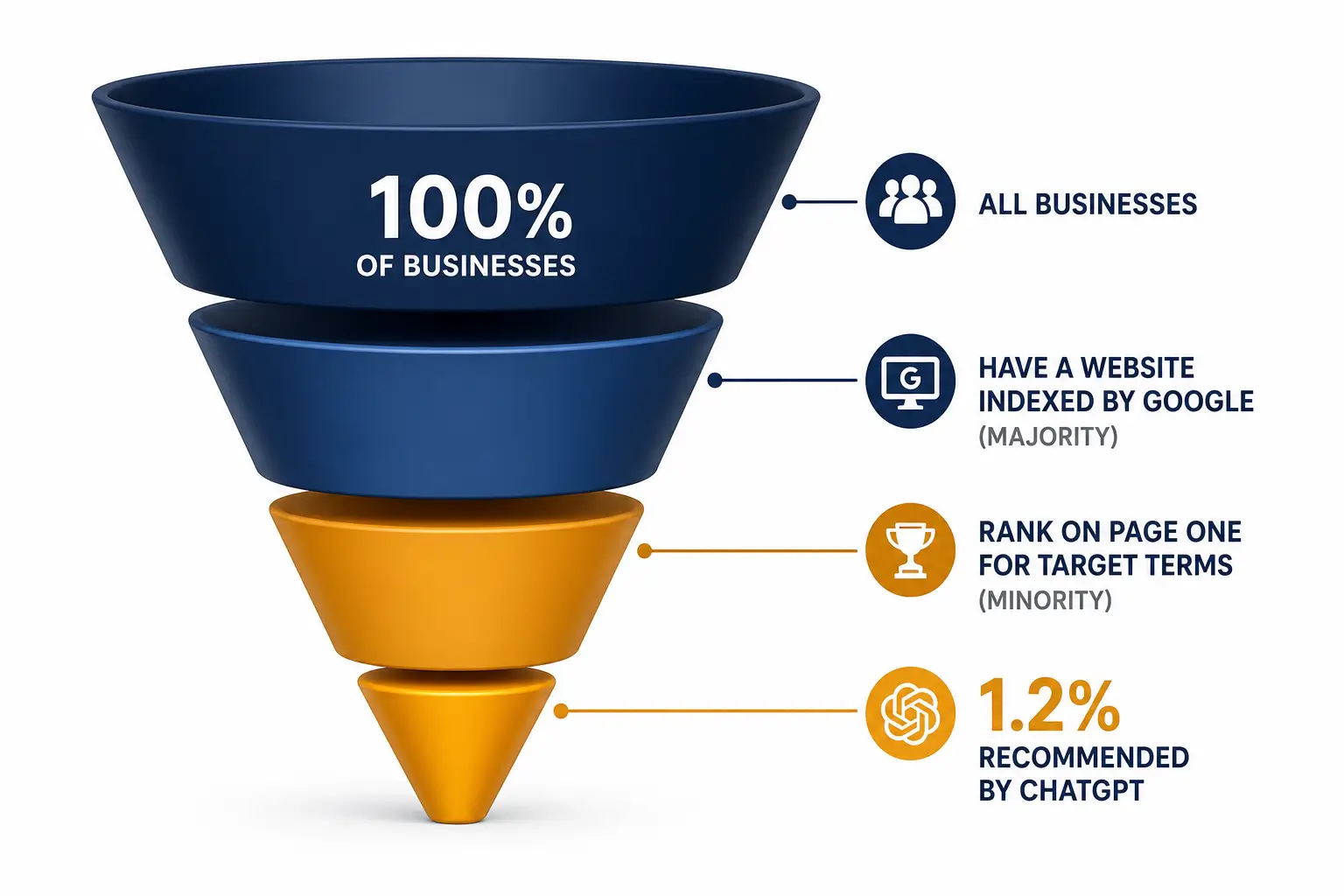
- Only 1.2% of businesses are recommended on ChatGPT (SOCi, 2026), even though Google AI Overviews now appear on 35-40% of all search queries — confirming that AI citation selectivity is extreme, and ranking well does not translate to AI visibility automatically.
- 2025 academic research building on the original Princeton GEO study identified “earned media bias” — AI search systems systematically favor third-party, independently published sources over brand-owned content, a dynamic with no direct equivalent in traditional SEO ranking factors.
- GEO does not replace SEO. Every available 2026 industry source confirms this — Google’s AI Overviews show a pronounced bias toward content that already ranks well in traditional search, creating a compounding advantage for sites with existing SEO authority.
- Brands optimized for GEO see up to 3x more citations in AI answers compared to traditional SEO-only sites (Search Engine Journal, cited via TheeDigital, 2026), and report 35% higher brand visibility in AI-generated answers (Gartner, cited via TheeDigital, 2026).
📋 Table of Contents
- Who Should Read This?~ 1 min
- The Core Distinction: Rank vs. Cite~ 3 min
- The Numbers: How Selective AI Citation Really Is~ 3 min
- Earned Media Bias: The GEO Factor SEO Never Had~ 4 min
- GEO vs SEO: Full Comparison Table~ 3 min
- What Carries Over from SEO to GEO (and What Doesn’t)~ 3 min
- Tool: Is This a GEO Problem or an SEO Problem?~ 2 min
- Before & After: Content Written for SEO vs. GEO~ 3 min
- GEO Readiness Checklist (Building on Your SEO Foundation)~ 2 min
- Frequently Asked Questions~ 2 min
- Conclusion~ 1 min
- Google Search Central, “Optimizing your website for generative AI features on Google Search,” published May 2026. Google says SEO remains relevant, generative AI features rely on Search ranking and quality systems, and unique, valuable content matters for AI features. developers.google.com
- Google Search Central Blog, “Introducing Search Generative AI performance reports in Search Console,” June 3, 2026. Google announced dedicated generative AI visibility reports for Search and Discover, rolling out first to a subset of websites. developers.google.com
The Core Distinction: Rank vs. Cite
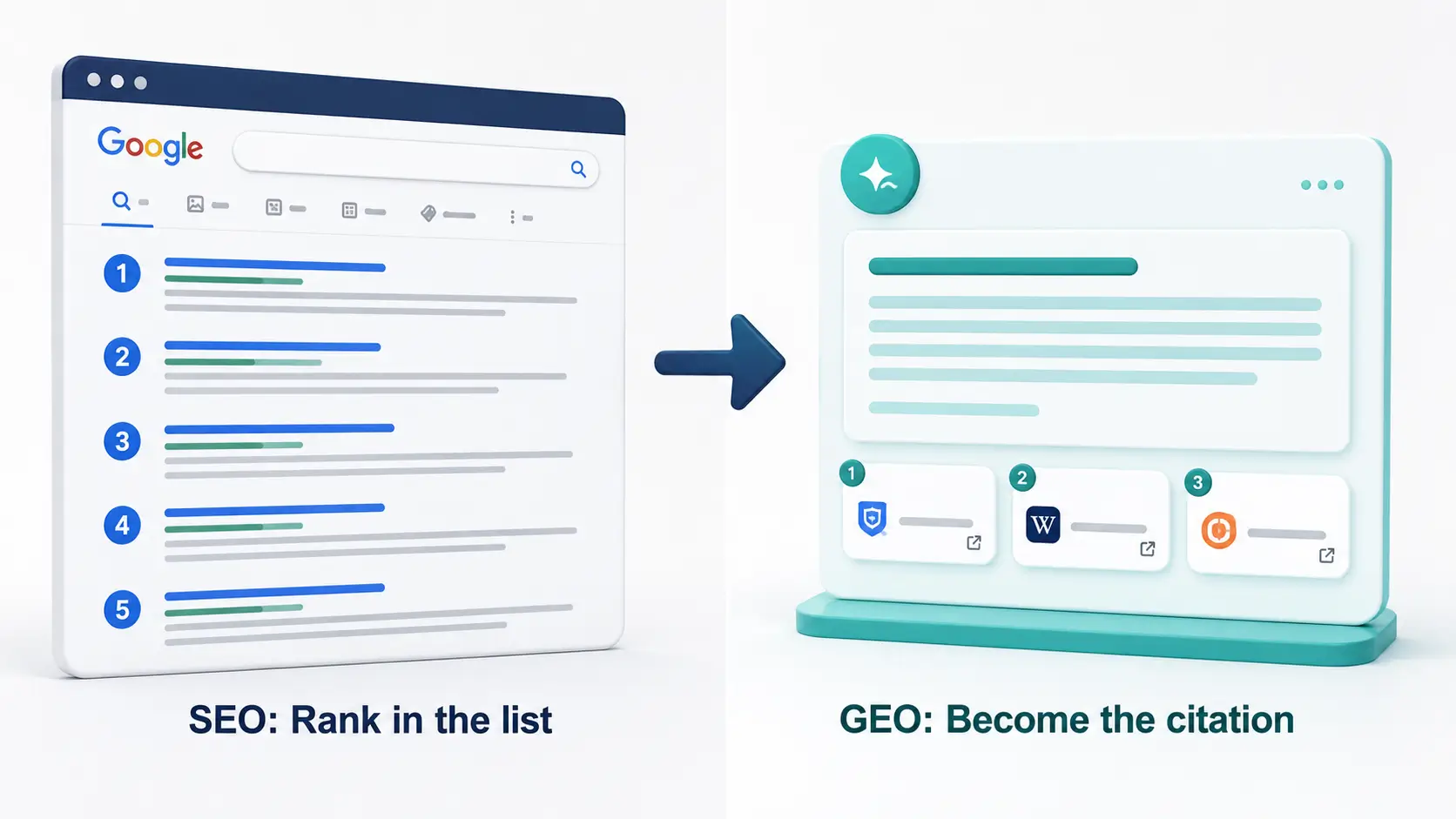
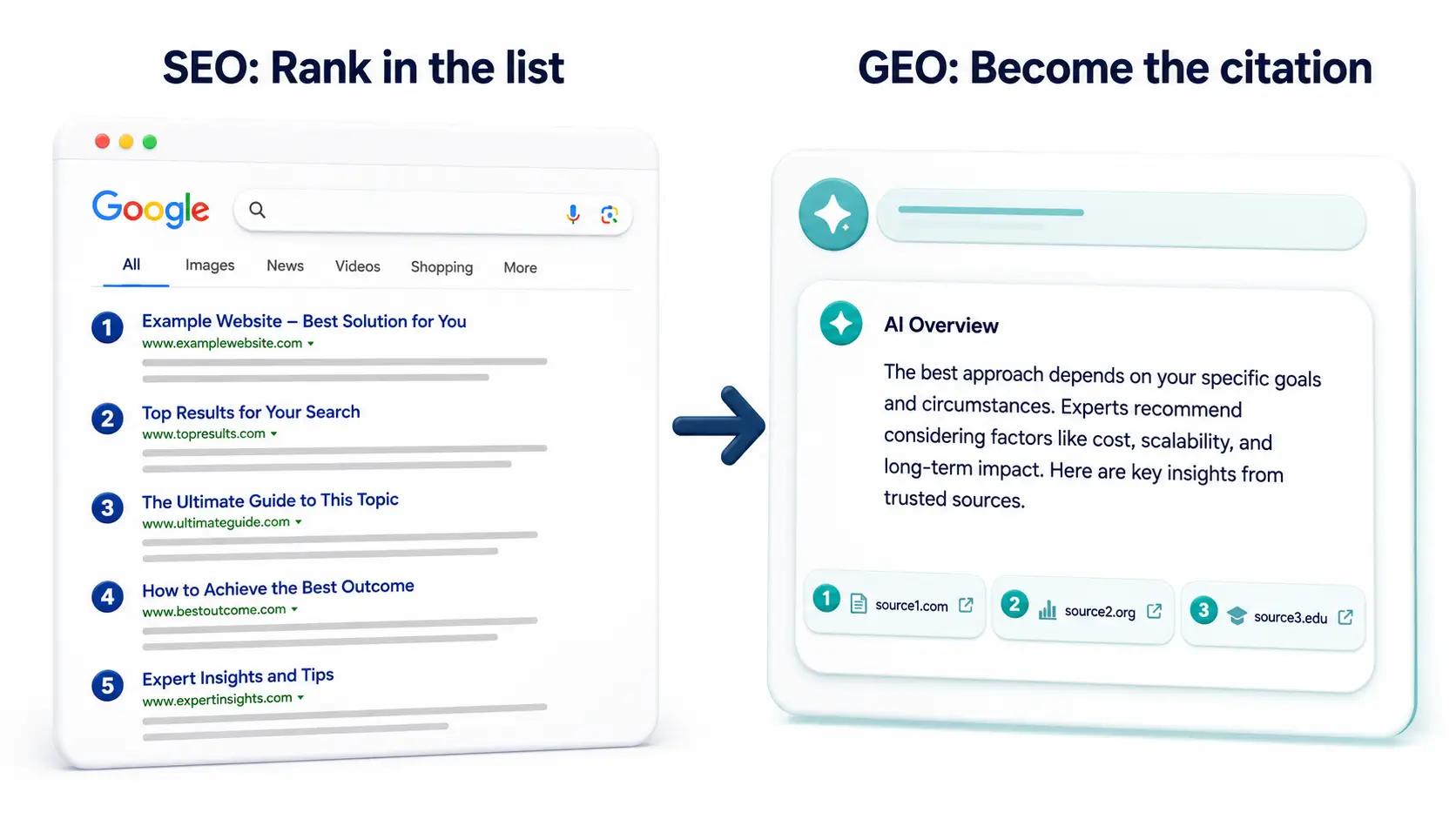
SEO is the practice of optimizing content to rank higher on traditional search engine results pages — focused on keywords, backlinks, technical performance, and on-page structure to drive organic traffic to your site.[1] GEO (Generative Engine Optimization) is the practice of structuring content so it can be understood, trusted, and reused by generative AI systems — AI-powered search experiences, copilots, and large language models — measured by whether your content is cited, quoted, or referenced rather than where it ranks.[1]
The clearest way to state the distinction: where traditional SEO says “rank #1 on Google,” GEO says “become the source AI trusts to answer a question.”[2] These are not the same goal pursued through different tactics — they are different goals entirely, which is why a page can succeed completely at one and fail completely at the other.
The mechanism behind this divergence is structural. In traditional search, links drive traffic, pass authority, and serve as the primary way users navigate to content. In the generative AI world, citations have replaced links — and when an AI synthesizes an answer from multiple sources, it frequently does not link to where the information came from at all.[3] Success in GEO is measured by mentions and influence inside AI outputs, not by traditional ranking position or click volume.[3]
💬 According to EverydayOnAI
The framing that resonates most with content teams we’ve talked to isn’t “SEO vs GEO” as competing strategies — it’s that SEO answers “can a user find this page” while GEO answers “can an AI use this page.” Those are genuinely separate questions, and a page can score perfectly on one while failing the other completely. The mistake we see most often isn’t picking the wrong strategy — it’s assuming a page that scores well on the first question automatically scores well on the second. The data in this article should make clear why that assumption doesn’t hold.
📋 Section Summary
- SEO optimizes for ranking position, measured by rank and click-through traffic. GEO optimizes for citation inside AI-generated answers, measured by mention frequency and influence — a different unit of success entirely.
- In generative AI answers, citations have functionally replaced links — AI systems frequently synthesize information from multiple sources without linking back to any of them.
- A page can succeed completely at SEO (rank #1) while failing completely at GEO (zero AI citations), because the two disciplines evaluate content against different criteria.
The Numbers: How Selective AI Citation Really Is
The scale of AI search adoption and the selectivity of AI citation create a counterintuitive combination worth understanding before any GEO strategy work begins.
35-40%
of all Google search queries now show an AI Overview[4]
1.2%
of businesses are recommended on ChatGPT, per SOCi’s 2026 Local Visibility Index[4]
3×
more citations in AI answers for GEO-optimized brands vs. SEO-only sites[5]
+35%
higher brand visibility in AI-generated answers for companies using GEO services[6]
-25%
projected drop in traditional search volume due to AI chatbots and virtual agents[6]
373×
larger Google search volume is than ChatGPT search volume — context behind the urgency[3]
That last statistic is worth sitting with. Google remains 373 times larger than ChatGPT by search volume[3] — yet most marketers report feeling like the opposite is true, because AI search has captured a disproportionate share of industry attention relative to its current traffic volume. This is not an argument for ignoring GEO. It’s a calibration point: GEO is an emerging, high-growth, high-selectivity channel layered on top of a still-dominant traditional search channel — not a wholesale replacement happening on the timeline industry conversation sometimes implies.
📋 Section Summary
- AI Overviews now appear on 35-40% of Google searches, but only 1.2% of businesses are ever recommended by ChatGPT (SOCi, 2026) — high prevalence combined with extreme citation selectivity.
- GEO-optimized brands see up to 3x more AI citations and 35% higher brand visibility in AI answers compared to SEO-only approaches (Search Engine Journal / Gartner, via TheeDigital 2026).
- Google remains 373x larger than ChatGPT by search volume — GEO is a high-growth emerging channel, not yet a replacement for the traditional search channel SEO has always served.
Earned Media Bias: The GEO Factor SEO Never Had
This is the most important and least understood divergence between SEO and GEO. A 2025 academic paper on citation bias in AI search, building on the original Princeton GEO study that coined the term, found that AI search systems exhibit a systematic and overwhelming bias toward earned media — third-party, authoritative sources — over brand-owned and social content, a stark contrast to Google’s traditional search results, which mix owned, earned, and other content types more evenly.[7]
In practical terms: if your company publishes a statistic on your own blog, and an independent industry publication or journalist publishes the same statistic citing your research, AI systems are measurably more likely to cite the third-party version. This has no direct equivalent in traditional SEO — Google’s algorithm does not systematically discount your own domain’s content relative to third-party coverage of the same information in this way.
▲ Why This Makes Sense
AI systems are essentially asking “would an independent expert vouch for this claim?” Earned media — a journalist choosing to cite your data, an industry report referencing your research — is a costlier, harder-to-fake signal of credibility than a company publishing claims about itself. The bias mirrors how human readers also tend to trust third-party verification over self-reported claims.
▼ The Important Nuance
More recent research suggests the picture is more nuanced than a blanket “earned beats owned” rule — a 2026 domain-specific study found AI search cites whatever content type best answers the specific query intent, with the apparent earned media bias partly reflecting which query types were studied.[8] For transactional queries, owned/commercial sources can still dominate. The bias is strongest for experiential, comparative, and trust-sensitive queries.
What this means practically for a GEO strategy: digital PR and third-party coverage are not optional nice-to-haves for GEO — they are a more central, structural requirement than they ever were for SEO. Original research that others choose to cite is described in GEO literature as “citation gold” — benchmark studies, industry surveys, and data analyses give other publications a reason to cite you as the primary source, and if you publish something genuinely original, AI engines effectively have no alternative source to cite instead.[9]
💬 According to EverydayOnAI
Earned media bias is the single biggest reason a strong SEO content calendar doesn’t automatically translate into GEO results. Most SEO content strategies are built entirely around owned-channel publishing — your blog, your resource hub, your guides. That strategy can produce excellent rankings while producing close to zero AI citations, because the AI system is structurally discounting almost everything in that content set relative to what a third party says about the same topic. The practical implication: a GEO budget needs a line item for digital PR, original research, and earned coverage — not just more owned-channel content production. This is a genuinely new operating requirement, not a relabeled SEO tactic.
📋 Section Summary
- 2025 research building on the Princeton GEO study found AI search systems systematically favor third-party “earned media” sources over brand-owned content — a bias with no direct equivalent in traditional SEO ranking.
- More recent 2026 research nuances this: the bias is strongest for experiential and trust-sensitive queries, with AI citing whatever content type best answers a given query’s specific intent.
- The strategic implication: GEO requires active investment in digital PR, original research, and earned third-party coverage — content levers that traditional SEO content calendars typically underweight relative to owned publishing.
GEO vs SEO: Full Comparison Table
| Dimension | SEO | GEO |
|---|---|---|
| Primary goal | Rank in the top results for target keywords | Be retrieved, synthesized, and cited in AI-generated answers |
| Unit of success | Ranking position, organic click-through traffic | Citation frequency, brand mention rate inside AI outputs |
| Primary content lever | Keywords, backlinks, on-page technical structure | Entity clarity, structured/reusable content, original data |
| Source bias | Relatively balanced mix of owned, earned, other content | Systematic bias toward earned/third-party sources for many query types[7] |
| Content format favored | Comprehensive topic coverage, internal linking depth | Front-loaded answers, clear headings, lists/tables, explicit Q&A[10] |
| Authority signal | Backlink volume and domain authority | E-E-A-T-style trust signals, bylines, credentials, third-party citations[10] |
| Click behavior | Click required to consume content and convert | AI answers reduce clicks — visibility can happen with zero site visits[3] |
| Prerequisite | Crawlability, indexability, basic on-page SEO | Strong existing SEO foundation — GEO builds on SEO, doesn’t bypass it[1] |
| Measurement tools | Google Search Console, rank trackers, Ahrefs/Semrush | AI citation tracking (Ahrefs Brand Radar, Semrush Enterprise AIO), manual prompt testing[11] |
📋 Section Summary
- The comparison table’s most consequential row is “source bias” — GEO’s systematic preference for earned media has no SEO equivalent and requires a distinct content strategy response.
- Measurement tooling has diverged meaningfully: dedicated AI citation trackers (Ahrefs Brand Radar, Semrush Enterprise AIO) now exist specifically because traditional rank trackers cannot measure GEO performance.
- The “prerequisite” row confirms the hierarchy established throughout the AI SEO Hub: GEO requires SEO fundamentals as a foundation, not as an alternative path.
What Carries Over from SEO to GEO (and What Doesn’t)
For teams with an existing SEO program, the most practical question is which investments transfer directly to GEO and which require new effort entirely.
Carries Over Directly
Technical accessibility (crawlability, fast load times, mobile-first design) carries over completely — AI crawlers depend on the same baseline accessibility traditional search crawlers do.[5] Domain authority and existing search performance also carry over: Google’s AI Overviews show a pronounced bias toward content that already ranks well in traditional search, creating a compounding advantage for sites with strong existing SEO foundations.[14] Quality, well-structured content also transfers — clarity and structure are rewarded by both disciplines, just evaluated through different mechanisms.
Requires New, GEO-Specific Effort
Backlink-volume-focused link building loses relative importance — GEO cares more about whether a credible third party says something about you than whether they link to you.[7] Keyword density and exact-match optimization carry minimal weight in GEO, which evaluates semantic richness and predictability of content rather than keyword matching.[17] Entity clarity — structured, consistent, machine-readable information about who you are and what you do — is a genuinely new requirement with limited SEO precedent.[2] And digital PR / earned media cultivation, as established in Section 3, moves from “nice to have” to structural requirement.
📋 Section Summary
- What carries over: technical accessibility, existing domain/ranking authority (Google AI Overviews specifically reward already-ranking content), and overall content quality and structure.
- What requires new effort: backlink-volume link building loses relative importance to earned mentions; keyword density matters less than semantic clarity; entity structuring and digital PR become structural requirements rather than optional tactics.
- The practical takeaway: don’t discard your SEO program to fund GEO — redirect a portion of link-building budget toward digital PR and entity/structured-data work instead.
Tool: Is This a GEO Problem or an SEO Problem?
Use this quick diagnostic when a page isn’t performing the way you’d expect, to identify which discipline’s playbook applies.
🎯 Interactive Tool
Is This a GEO Problem or an SEO Problem?
Answer based on a specific underperforming page or topic you have in mind.
What’s the actual symptom?
This is a directional starting point, not a complete audit. For a full GEO structural review, see the GEO Complete Guide; for SEO fundamentals, see AEO vs SEO: What Changes and What Stays.
Before & After: Content Written for SEO vs. GEO
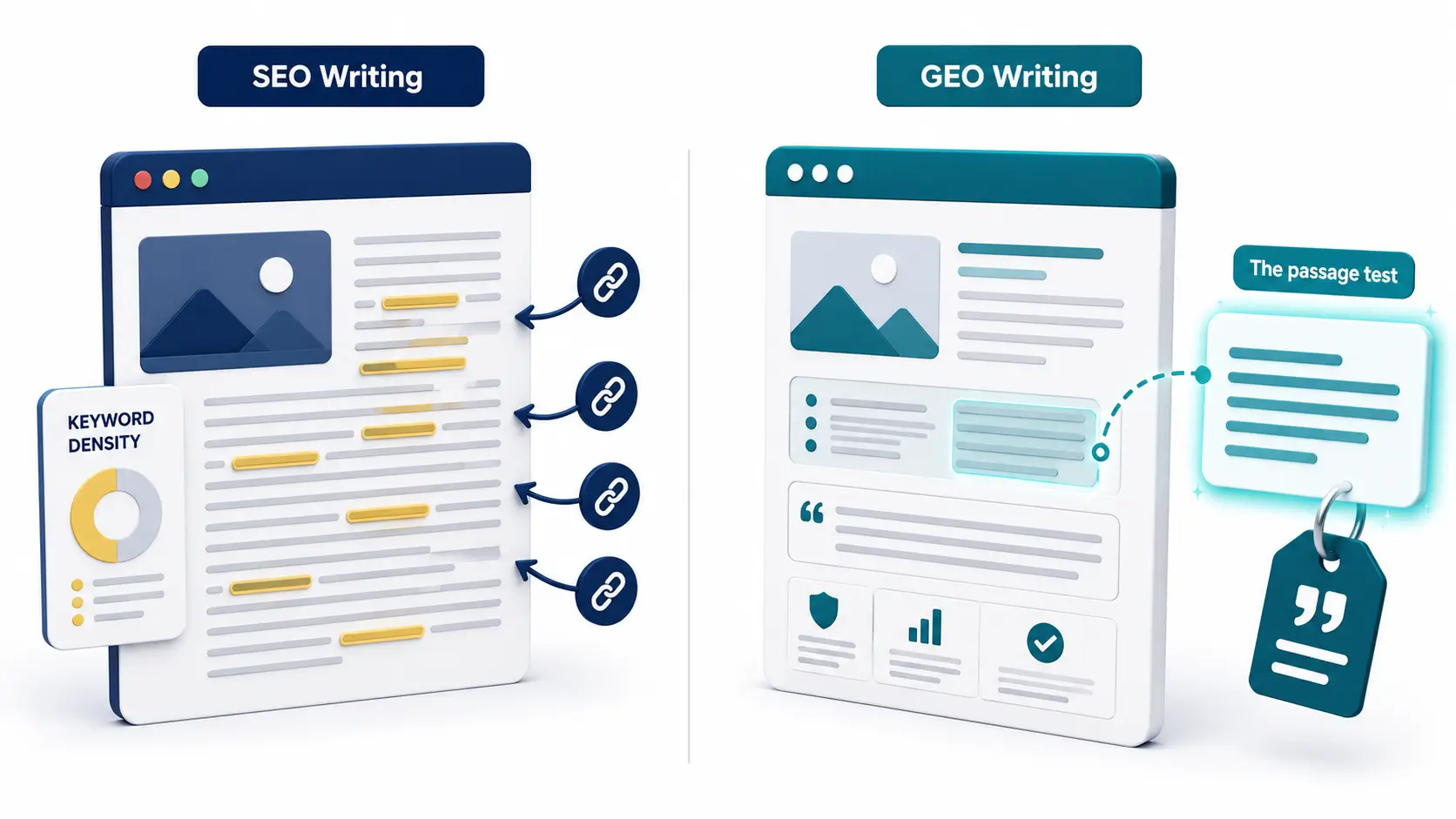
✖ Written for SEO (Keyword-First)
“Looking for the best project management software in 2026? Our comprehensive guide covers everything you need to know about project management software, including features, pricing, and comparisons of the top project management software options available today.”
✔ Written for GEO (Answer-First, Citation-Friendly)
“The best project management software for distributed teams in 2026 depends on team size and integration needs. Based on our analysis of 14 platforms against five criteria — real-time collaboration, API depth, pricing transparency, mobile parity, and uptime SLA — three platforms led across most use cases.”
The first version is written to rank for “best project management software” — keyword repeated, broad promise, no information yet delivered. The second version front-loads an actual answer, references original methodology (a GEO-favored “citation bait” pattern), and gives an AI system something concrete and specific to extract and attribute. The SEO version isn’t wrong for its purpose — it may still rank reasonably well. But it gives an AI system nothing distinctive to cite over a dozen similar pages making the same broad promise.
📋 Section Summary
- SEO-optimized openings often prioritize keyword presence and broad promises; GEO-optimized openings prioritize a specific, citable answer with original methodology or data.
- Original analysis (e.g., “14 platforms against five criteria”) functions as both differentiated content and inherently more citable material — generic claims have many equally generic competitors; specific original analysis has none.
- The two versions are not mutually exclusive — a well-built page can rank for the keyword AND be structured for citation, but it requires deliberate GEO-specific writing choices beyond standard SEO keyword practice.
GEO Readiness Checklist (Building on Your SEO Foundation)
✓ Confirm SEO Foundation (Prerequisite)
- ★ Page ranks reasonably well in traditional search for its core topic (per the compounding-advantage finding in Section 5)
- ★ Technical accessibility confirmed: crawlable, fast-loading, mobile-first, AI crawlers not blocked
- Domain has baseline topical authority — not necessarily #1 rankings, but credible presence
✓ GEO-Specific Content Structure
- ★ Answer front-loaded in the first ~200 words; conclusion before explanation[10]
- Content structured for extraction: clear headings, short paragraphs, lists, tables, explicit Q&A
- Schema/structured data implemented so machines can parse facts reliably
- Original data, statistics, or analysis included — not just synthesis of existing public information
✓ Earned Media & Trust Signals
- ★ Active digital PR effort to get original research or data cited by third-party publications
- Author bylines with verifiable credentials on all content (E-E-A-T signal AI systems weight)
- Citations to primary sources within your own content (signals research rigor)
- Brand actively monitored for AI citation using a dedicated tracking tool (Ahrefs Brand Radar, Semrush Enterprise AIO, or manual prompt testing)
Frequently Asked Questions
What is the core difference between GEO and SEO?
SEO optimizes content to rank in a list of search results, measured by position and click-through traffic. GEO optimizes content to be retrieved, synthesized, and cited inside AI-generated answers, measured by citation frequency and brand mention rather than ranking position. A page can rank #1 on Google and receive zero AI citations, because AI systems evaluate source credibility and extractability using different criteria than traditional ranking algorithms.
Does GEO replace SEO?
No. Every available 2026 industry source agrees GEO builds on SEO rather than replacing it.[1] Traditional SEO creates the technical accessibility, domain authority, and content quality foundation that AI systems rely on when evaluating which sources to cite. Google’s AI Overviews in particular show a pronounced bias toward content that already ranks well in traditional search, creating a compounding advantage for sites with strong existing SEO foundations.[14]
What is earned media bias in GEO?
Earned media bias is a documented pattern showing that AI search systems systematically favor third-party, independently published sources over brand-owned content when selecting citations.[7] This means a company’s own website content is structurally disadvantaged compared to the same information published by an independent journalist, researcher, or industry publication — making digital PR and third-party coverage a more central GEO strategy than it ever was for traditional SEO.
How rare is it for a business to be recommended by AI search?
Very rare relative to traditional search visibility. SOCi’s 2026 Local Visibility Index found that only 1.2% of businesses are recommended on ChatGPT,[4] even though Google AI Overviews now appear on 35-40% of all search queries. This combination — high AI answer prevalence but extremely selective citation — is why GEO requires more deliberate strategy than simply applying existing SEO content to a new channel.
What SEO factors stop mattering for GEO and what new factors appear?
Backlink volume, keyword density, and exact-match domain signals carry less weight in GEO than in traditional SEO ranking. What gains importance: entity clarity (consistent, structured information about who you are), citation-worthy original data, third-party earned media coverage, and content structured for extraction (clear headings, self-contained statistics, lists, and tables). The shift is from link-based authority signals to structure-and-trust-based citation signals.

Conclusion: Use SEO to Earn the Right to Compete for GEO
The data throughout this article supports one consistent framing: SEO and GEO are sequential, not competing. SEO earns your content the technical accessibility and domain credibility that makes it eligible for AI citation in the first place. GEO determines whether, among all the eligible content covering a topic, an AI system chooses yours.
The strategic priority for most teams in 2026 is not “should we do SEO or GEO” — it’s recognizing that GEO introduces genuinely new requirements (earned media cultivation, entity structuring, citation-worthy original data) that a pure SEO content calendar does not naturally produce. The 1.2% ChatGPT recommendation rate is not a reason to panic; it’s a reason to treat GEO as a deliberate, separate workstream layered on top of SEO fundamentals that are already working.
💬 According to EverydayOnAI
If you take one action from this article, audit your last six months of content for the earned-vs-owned split. Most teams find the number is close to 100% owned — every piece published on the company blog, none of it earning third-party pickup. That imbalance, more than any technical GEO fix, is probably the single biggest reason a strong-ranking site sees weak AI citation. Fixing it doesn’t mean writing less owned content — it means dedicating a deliberate portion of effort to making that content citable enough, and newsworthy enough, that someone else chooses to write about it too.
📚 References and Sources
- Pimberly, “GEO vs. SEO: A Comparison for 2026,” January 2026. SEO and GEO definitions; GEO complements rather than replaces SEO; brands that centralize product information are better positioned for both. pimberly.com
- JDM Web Technologies, “GEO vs SEO in 2026: Rank in ChatGPT, Perplexity & Google AI Overviews,” June 2026. “SEO says rank #1; GEO says become the trusted source” framing; Google AI Overviews appear on 35-40% of queries; SOCi 2026 Local Visibility Index — only 1.2% of businesses recommended on ChatGPT. jdmwebtechnologies.com
- WordStream, “GEO vs. SEO: Everything to Know in 2026,” April 2026. Citations have replaced links in generative AI answers; Google search is 373x bigger than ChatGPT search by volume; “citation bait” content strategy recommendations. wordstream.com
- JDM Web Technologies (same source), citing SOCi 2026 Local Visibility Index. 1.2% business recommendation rate on ChatGPT; AI Overview query coverage figures. jdmwebtechnologies.com
- TheeDigital, “GEO vs SEO: Generative Engine Optimization Services in 2026,” ~May 2026, citing Search Engine Journal. Brands optimized for GEO see up to 3x more citations in AI answers vs. SEO-only sites; Technical GEO Readiness components (schema, load times, mobile-first, AI-friendly formatting). theedigital.com
- TheeDigital (same source), citing Gartner. 35% higher brand visibility in AI-generated answers for GEO-service users vs. traditional-SEO-only; Gartner’s predicted 25% drop in traditional search volume due to AI chatbots and virtual agents. theedigital.com
- Chen, M. et al., “Source Coverage and Citation Bias in LLM-based vs. Traditional Search Engines,” 2025 (arXiv). Identification of systematic earned media bias in AI search citation patterns, contrasted with Google’s more balanced source mix. arxiv.org
- “The End of Rented Discovery: How AI Search Redistributes Power Between Hotels and Intermediaries,” 2026 (arXiv). Domain-specific study suggesting earned media bias may partly be a query-intent-distribution artifact; AI search cites whichever content type best answers specific query intent. arxiv.org
- Frase.io, “Mastering AI Citations: The Ultimate GEO Playbook,” March 2026. Original research as “GEO gold”; E-E-A-T as an AI platform credibility signal; author credential and credibility tactics. frase.io
- TechTimes, “Generative Engine Optimization (GEO) in 2026: How to Get Your Content Cited by ChatGPT and AI Overviews,” June 2026. Front-load answer in first ~200 words; structure for extraction (headings, short paragraphs, lists, tables, Q&A); strengthen E-E-A-T with bylines and primary source citations. techtimes.com
- TechTimes (same source). Ahrefs Brand Radar (launched March 2025) tracks brand mentions across six AI indexes — Google AI Overviews, AI Mode, ChatGPT, Perplexity, Gemini, Microsoft Copilot — using prompts derived from real search behavior. techtimes.com
- “Generative Reputation Intelligence: GEO Strategies for Corporate, Executive, and Specialist Online Reputation,” ResearchGate, March 2026. Google’s AI Overviews show pronounced bias toward content that already ranks well in traditional search, creating compounding advantage for entities with strong existing SEO foundations. researchgate.net
- Barrett, J., “Generative Engine Optimization (GEO): How to Win in AI Search Results,” Substack, 2025-2026. GEO optimizes for semantic richness and predictability rather than keyword density; content freshness and domain diversity as additional GEO selection factors. barrettrestore.substack.com
Sources verified June 16, 2026. Earned media bias research is an active and evolving academic area — the nuanced 2026 finding on query-intent dependency suggests this is not yet a fully settled question. AI Overview coverage percentages vary by query sampling methodology. This article does not constitute professional SEO advice and does not guarantee ranking or AI citation outcomes.
📚 Go Deeper: Complete AI SEO Hub on EverydayOnAI
-
→ What is AI SEO? The Complete Guide to GEO, AEO & LLMO
The pillar guide — the full AI SEO stack and how GEO fits within it. -
→ GEO Complete Guide: How to Get Cited by ChatGPT, Perplexity & Google AI
The GEO sub-pillar — full structural and platform-specific citation strategy. -
→ GEO vs AEO: Key Differences Explained
A different comparison — this article covers GEO vs traditional SEO; that one covers GEO vs the AEO discipline specifically. -
→ AEO vs SEO: What Changes and What Stays
The companion comparison for the AEO side of the AI SEO stack, including the Ahrefs schema markup finding. -
→ How to Optimize Content for ChatGPT Citations
Platform-specific tactics that build directly on the earned media and structure principles from this article.
Audit Your Earned vs. Owned Content Split
Download our free Earned Media Audit Template — log your last 6 months of published content, mark owned vs. earned, and identify your highest-potential candidates for digital PR outreach and original research development.
Share this article