GEO (Generative Engine Optimization): How to Get Cited by ChatGPT, Perplexity & Google AI


You published a comprehensive, well-researched article. You optimized the metadata. You built a few backlinks. It ranks on page one of Google.
Then a potential customer asks ChatGPT the exact question your article answers. Your competitor’s name appears in the response. Yours doesn’t.
This scenario is playing out millions of times a day in 2026 — and it signals a structural shift that traditional SEO alone cannot address. ChatGPT now serves over 800 million weekly active users. Perplexity processes roughly 780 million queries monthly. Google AI Overviews appear in 50–60% of search results pages.[1] These aren’t fringe tools anymore. They’re where a growing share of your audience forms opinions, discovers solutions, and makes decisions.
The critical data point: the overlap between top Google links and sources cited by AI has dropped from 70% to below 20%.[2] Ranking on Google no longer guarantees visibility where AI answers questions. And the reverse is also true — appearing in AI answers doesn’t require ranking on page one. A new discipline has emerged to address exactly this gap: Generative Engine Optimization (GEO).
This is the complete guide.
What Is Generative Engine Optimization?
Generative Engine Optimization (GEO) is the discipline of structuring your brand’s digital presence so that AI-powered search platforms — ChatGPT, Perplexity, Google AI Overviews, Claude, and Gemini — cite, reference, or recommend your content when users ask questions.[1]
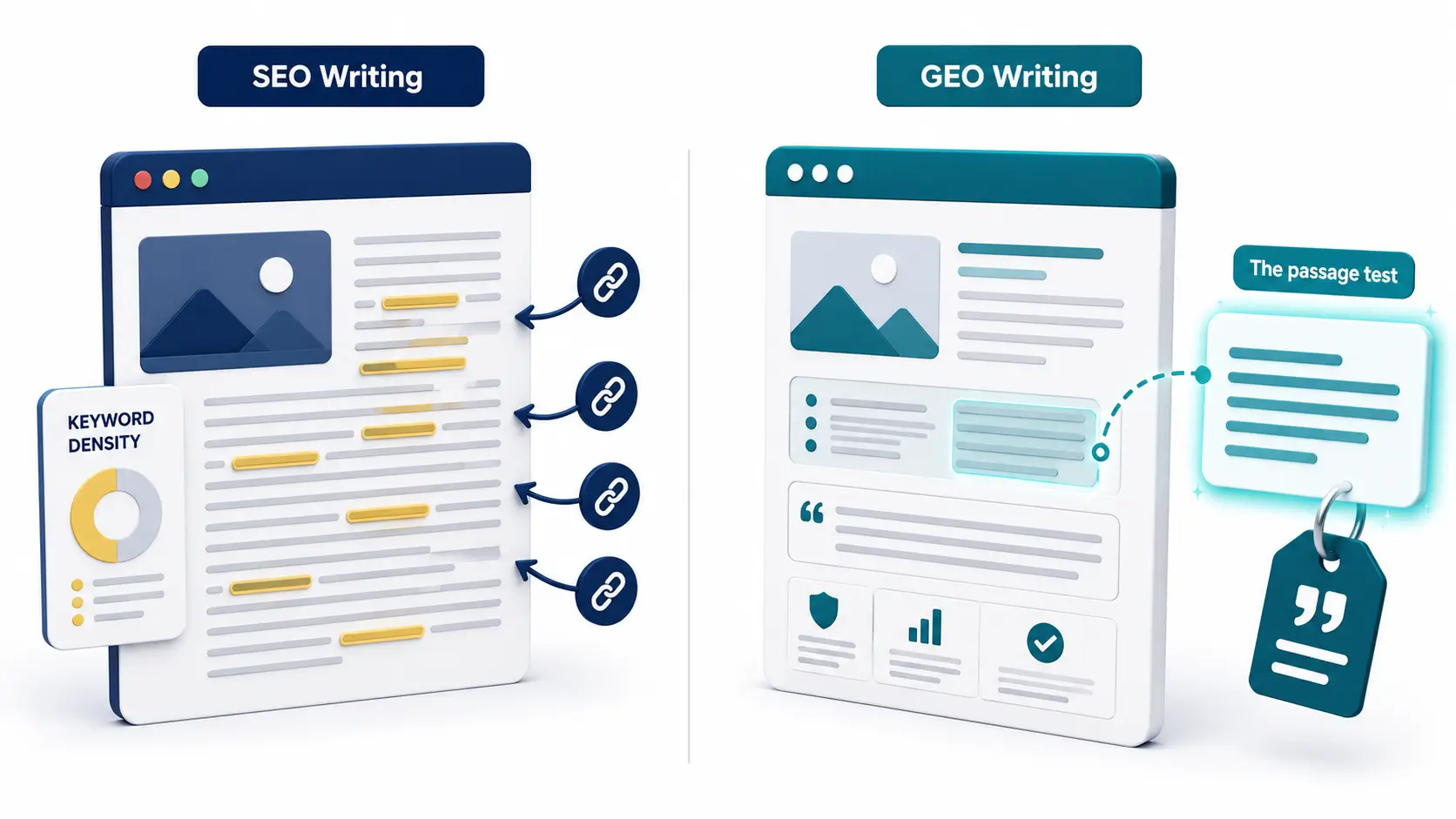
Unlike traditional SEO, which targets ranked links on a results page, GEO focuses on getting your brand named inside the AI-generated answer itself. The distinction is precise: SEO gets you clicked. GEO gets you quoted.
The discipline goes by several names across the industry — Answer Engine Optimization (AEO), Large Language Model Optimization (LLMO), Generative Search Optimization (GSO), and AI Optimization (AIO). The industry hasn’t settled on a single term. They all describe the same goal: get your content cited by AI.[3]
GEO is not a replacement for SEO — it’s a layer that sits on top of it, extending your content strategy into an AI-driven discovery layer that operates by different rules and rewards different signals. Content that excels at traditional SEO but ignores GEO will increasingly lose visibility in the conversations where brand preferences are formed.
Why GEO Matters in 2026: The Numbers
The case for GEO investment starts with scale and shifts to conversion quality.
On scale: ChatGPT reached over 800 million weekly active users in early 2026. Google’s Gemini app surpassed 750 million monthly active users, with an additional 2 billion users encountering Gemini through AI Overviews embedded in Google Search. Perplexity processes over 780 million queries monthly.[1] These aren’t niche products. They’re mainstream information infrastructure.
“The window is open, and closing. Most companies still run a 2020 SEO playbook. The ones optimizing for AI citation now are establishing authority before competitors even realize the game changed.”
— The VC Corner, “GEO & AEO: How to Get Cited by AI Search in 2026,” February 2026[5]
On conversion quality: users who click through from AI citations are more likely to convert than traditional organic visitors. They’ve already received a recommendation from the AI — they arrive pre-qualified, with context and trust that a cold organic click doesn’t carry. Early data from Vercel shows that 10% of new signups come from ChatGPT referrals, suggesting AI-referred visitors are already behaving differently from standard organic traffic.[2]
On compounding advantage: AI models develop citation habits. Once a source proves reliable and useful on a topic, the model tends to favor it for related queries — what researchers call “source preference bias.” Citation authority built now becomes progressively harder for competitors to displace. Early movers in GEO are building citation moats.[3]
| Platform | Monthly Scale | Citation Behavior | Primary Index |
|---|---|---|---|
| ChatGPT Search | 800M+ weekly users | Synthesizes from multiple sources; cites inline | Bing index |
| Perplexity | 780M+ monthly queries | Real-time RAG; citation-first; most transparent | Live web search |
| Google AI Overviews | 2B+ users via Google Search | Appears in 50–60% of informational queries | Google’s index |
| Gemini (standalone) | 750M+ monthly users | Deep integration with Google knowledge graph | Google index + knowledge graph |
| Claude (Search mode) | Growing enterprise adoption | Strong preference for structured, sourced content | Web search integration |
GEO vs. SEO: How They Work Together
The most important thing to understand about GEO and SEO is that they are complementary, not competing. Traditional SEO is the foundation that GEO builds on — without it, GEO efforts have nothing reliable for AI systems to ingest, understand, or cite.
| Dimension | Traditional SEO | Generative Engine Optimization |
|---|---|---|
| Goal | Rank in search results pages | Get cited in AI-generated answers |
| Primary signal | Keywords, backlinks, technical factors | Content extractability, E-E-A-T, factual specificity |
| Success metric | Ranking position, organic traffic | Citation rate, share of voice in AI responses |
| User action | Click through to website | Brand named in AI answer (with or without click) |
| Content format | Keyword-optimized pages | Answer-first, extractable, claim-evidence structure |
| Authority signal | Domain authority, backlink profile | Cross-platform brand presence, expert citations |
| Timeline | 3–12 months for new domains | 4–8 weeks for ChatGPT; days for Perplexity |
The brands performing best in AI search in 2026 are those combining strong traditional rankings with generative engine optimization — treating them as two layers of the same visibility strategy.[1]
One critical data point: only 11% of domains are cited by both ChatGPT and Perplexity, according to analysis of 680 million citations by The Digital Bloom (2025).[6] Each platform has distinct selection logic. A strategy built entirely around one platform leaves the majority of AI-driven discovery on the table.
How AI Search Engines Select What to Cite
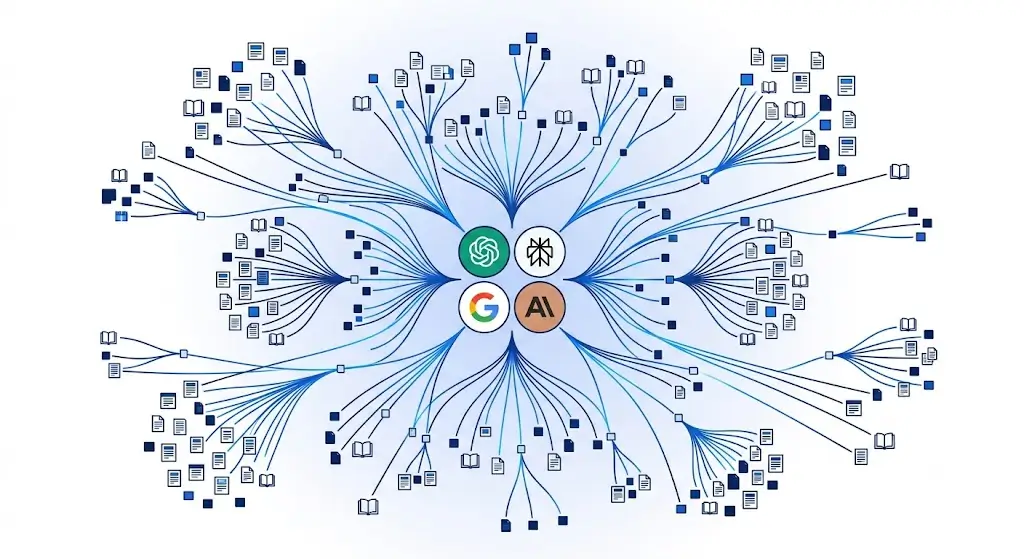
Understanding why AI engines cite what they cite is the foundation of effective GEO. The mechanism is RAG — Retrieval-Augmented Generation. When a user submits a query, the AI doesn’t answer purely from training data. It first retrieves relevant documents from the web (or from its index), then generates a response that synthesizes and cites those retrieved sources.[7]
The selection criteria for which documents get retrieved and cited:
Content comprehensiveness. AI engines favor pages that answer a question completely — providing definition, context, examples, data points, and edge cases — over pages that answer partially and hope the user clicks for more. An AI synthesizing an answer needs extractable components, not teasers.
Structural clarity. Content organized as clear claims with supporting evidence, using headings, short paragraphs, tables, and Q&A formats is significantly more extractable than dense narrative prose. AI systems are essentially doing extraction — they need structure to extract from.
Factual specificity with verifiable data. Generic claims (“AI can save companies money”) are ignored. Specific claims with verifiable sources (“organizations using AI agents report cost savings of 26–31% in supply chain and finance operations, according to McKinsey”) are extracted and cited. The more specific and sourced your claims, the more citation-worthy the content.
Source credibility signals. Named authors with visible credentials, publication dates, update dates, inline citations, and organizational affiliations all signal to AI systems that content is trustworthy. Wikipedia accounts for 47.9% of ChatGPT’s top cited sources for factual questions — not because it ranks well in SEO, but because it has strong credibility signals and structured, extractable content.[3]
Freshness signals. Perplexity has a particularly strong preference for recent content. All platforms weight recency for topics where information changes. Dates, update notices, and “as of [year]” markers improve citation probability for time-sensitive topics.
Cross-platform brand consistency. AI systems assess whether a brand or domain is consistently mentioned and positively referenced across multiple platforms — Reddit, LinkedIn, industry publications, news sites. A brand mentioned only on its own website has weaker citation authority than one referenced consistently across trusted third-party sources.
Platform Guide: ChatGPT, Perplexity, and Google AI Overviews
Each major AI search platform has distinct citation behavior. Applying the same strategy across all three without understanding their individual mechanics is how content teams produce content that nobody — human or AI — cites.[6]
🤖 ChatGPT Search — Largest reach, Bing-indexed
ChatGPT dominates with approximately 80% of the AI chatbot market and 800M+ weekly active users. Its browsing-enabled modes use Bing’s index, not Google’s — this is the most important operational implication for GEO practitioners. To improve ChatGPT citation probability: submit your sitemap to Bing Webmaster Tools immediately. ChatGPT favors comprehensive content with strong E-E-A-T signals — named authors with visible bios, publication and update dates, inline citations, and domain credibility. ChatGPT heavily favors Wikipedia and encyclopedic sources; building brand mentions in AI-focused communities (Reddit, industry forums) corroborates your authority outside your own domain. Expect a 4–8 week lag between publishing and appearing in ChatGPT answers.[8]
🔍 Perplexity — Citation-first, real-time, fastest path
Perplexity functions as a citation-first AI search engine that attributes every claim to a specific source — making its citation behavior more transparent and traceable than ChatGPT’s. It uses real-time web search (not a static index), with a strong preference for recent, up-to-date content. Perplexity leans toward Reddit, news sources, and recency signals. Well-optimized new content can appear in Perplexity citations within days of being indexed — the fastest citation pathway for new domains. Perplexity is the only major AI engine that generates directly trackable referral traffic in GA4, making it the best starting point for GEO measurement.[6]
🌎 Google AI Overviews — Most reach, SEO-dependent
Google AI Overviews — powered by Gemini 3 since January 2026 — draw from Google’s own search index and entity graph. Traditional SEO remains load-bearing here: 92% of AI Overview citations come from domains ranking in the top 10. However, only 4.5% of cited URLs directly match a page-one result, meaning there’s opportunity for well-optimized content that doesn’t hold #1 rankings.[6] Schema markup (FAQPage, Article, HowTo) and structured data influence selection. The average AI Overview response cites 5–6 sources from 4 unique domains — meaning your content competes in a small citation pool per query.
7 GEO Techniques That Boost Citation Rates by Up to 40%
Research from Princeton’s GEO paper — the foundational academic study on generative engine optimization — identified which content optimization strategies measurably improve AI citation rates. The following seven techniques are derived from that research and validated by practitioner data from 2025–2026.[5]
Technique 1: Answer-First Structure (TL;DR at the top)
Open every article with a direct, complete answer to the query in 2–3 sentences before any background, context, or narrative. AI engines performing query fan-out — breaking your query into sub-queries and searching for each — need an extractable answer early in the document. A TL;DR summary block, a bolded definition sentence, or a direct answer paragraph in the first 100 words dramatically improves citation probability for the article’s primary keyword.
Technique 2: Claim-Evidence-Source Structure
Every factual claim should immediately follow with supporting evidence and a verifiable source. “AI can improve customer service” is a generic claim that AI engines ignore. “AI-powered customer service reduces cost-to-serve by 20–30% and raises customer satisfaction by 15–20%, according to McKinsey” is a specific, sourced claim that gets extracted. Rewrite your content’s key paragraphs in claim-evidence-source structure throughout — not just in the introduction.
Technique 3: Explicit Q&A Sections
AI engines are very effective at extracting content structured as explicit questions and direct answers. FAQ sections with FAQPage schema markup are particularly well-suited for citation — they create clean extraction boundaries. Write 4–6 genuine questions your target audience asks, answer each in 3–5 sentences using the claim-evidence structure, implement FAQPage schema, and treat these as primary GEO targets, not supplementary content.
Technique 4: Named Author + Visible E-E-A-T Signals
Every piece of content should have: a named author with a visible bio that includes relevant credentials, a clear publication date and last-updated date visible on the page, inline citations linking to primary sources (not just a reference list at the bottom), and organizational affiliation context. These signals directly mirror what Wikipedia has — the most-cited source in AI search — and address the core credibility question AI systems ask about every source they consider citing.
Technique 5: Data Tables for Comparisons and Benchmarks
Structured data in table format is among the most extractable content types for AI engines. When covering comparisons, benchmarks, timelines, or lists of options, convert narrative prose to tables where possible. Tables with clear headers, specific data points, and source citations are extracted and cited at higher rates than equivalent information written as paragraphs — particularly by Perplexity, which favors structured, scannable formats.
Technique 6: Regular Content Freshness Updates
Outdated content creates a specific GEO problem: AI models that have learned to prefer your source will stop citing it as the information decays. For high-performing GEO content, establish a quarterly refresh schedule — updating statistics, adding new research, revising recommendations for current platform behavior, and updating the “last updated” date visibly on the page. Content published in 2024 and never updated is losing citation share to refreshed 2026 content on the same topic.
Technique 7: Cross-Platform Brand Corroboration
AI systems assess brand credibility not just from your website, but from your brand’s presence across the broader web. Mentions on Reddit, LinkedIn, industry publications, news sites, and authoritative forums corroborate your expertise and make AI systems more confident citing your content. Build cross-platform presence through: genuine expert participation in relevant communities, bylined articles in industry publications, being cited or quoted by other content creators, and ensuring your brand is mentioned in context beyond your own domain.
How to Measure GEO Success
Measuring GEO requires a combination of new tools and adapted analytics — traditional SEO metrics capture only part of the picture.
Citation rate audit (manual baseline). The most accessible measurement method: identify the 20–30 most important queries for your content, then ask ChatGPT, Perplexity, Claude, and Gemini each query and document whether your brand or domain appears in the response. Run this audit monthly and track delta over time. This is free and produces the most direct evidence of GEO progress.[7]
GA4 AI referral traffic. Configure GA4 with custom dimensions to capture referral traffic from AI platforms. Perplexity generates directly trackable referral traffic. ChatGPT referrals appear with utm_source=chatgpt.com in some cases. Track these segments separately from organic traffic — AI-referred visitors typically have different engagement behavior (shorter sessions but higher conversion rates).[1]
GEO tracking tools (2026). The tooling market has matured significantly. Key platforms worth evaluating: Otterly.ai (monitors brand mentions across multiple AI platforms), Semrush AI Toolkit / Enterprise AIO (tracks visibility across ChatGPT, Google AI Mode, Perplexity), Ahrefs Brand Radar (tracks brand mentions in AI Overviews), Rankability, and Profound. For organizations prioritizing GEO seriously, one of these platforms combined with the manual audit provides comprehensive measurement coverage.
Share of voice. The most strategic GEO metric: for your top target queries, what percentage of AI responses mention your brand vs. competitors? Track this quarterly. A rising share of voice across key queries is the leading indicator of GEO compounding — it precedes measurable traffic and conversion improvements by 4–8 weeks.
🆕 Interactive Tool — EverydayOnAI
GEO Readiness Audit: Is Your Content Ready to Be Cited by AI?
Check every item that applies to your page. See your GEO readiness score instantly.
0 / 12 — GEO Score: 0%
💡 Our Take at EverydayOnAI
GEO in 2026: Direct Experience — And What Other Guides Don’t Tell You
EverydayOnAI.com is itself a live GEO experiment. New domain, structured content, zero backlinks at launch. The single strongest early observation: Perplexity indexes and cites well-structured content faster than Google indexes the same page — something we didn’t expect but found consistent across our first articles.
The data that changed our thinking: only 11% of domains are cited by both ChatGPT and Perplexity. That means even established domains have limited cross-platform coverage. The implication for new domains: focusing on one platform first (Perplexity) is far more effective than trying to optimize all platforms simultaneously.
One conviction based on direct observation: GEO is not about “writing for AI” in the sense of making content sound encyclopedic. The content AI engines cite most is content with specific, verifiable, surprising data points — counterintuitive numbers, verified contradictions, insights absent from the first 10 Google results.
Our prediction for 2027:
GEO will matter more than SEO for informational and B2B enterprise content — because the B2B buying consideration stage increasingly happens inside AI conversations, not on search results pages. Brands not cited in those conversations don’t exist at the most critical stage of the buyer journey.
Your 90-Day GEO Action Plan
90-Day GEO Launch Plan
Days 1–14: Foundation and Baseline
- Submit sitemap to Bing Webmaster Tools (critical for ChatGPT indexing)
- Run baseline citation audit: 20–30 target queries across ChatGPT, Perplexity, Gemini, Claude
- Document where competitors are cited vs. where you are cited — this is your benchmark
- Audit top 20 existing pages for E-E-A-T signals: named author, visible dates, inline citations
- Implement FAQPage and Article schema markup across key pages
Days 15–45: On-Page GEO Optimization
- Add TL;DR answer-first summaries to top 10 pages
- Restructure key paragraphs as claim-evidence-source
- Convert 3–5 comparison/benchmark sections to data tables
- Add or expand Q&A sections with FAQPage schema
- Ensure every page has named author bio with credentials visible
Days 46–90: Brand Signal Expansion and Measurement
- Identify 5–8 relevant industry publications or communities for genuine expert participation
- Begin contributing substantive content in relevant Reddit communities, LinkedIn, and industry forums
- Pursue 2–3 bylined articles or guest posts on authoritative industry sites
- Re-run citation audit at day 60 and day 90 — document delta from baseline
- Set up GA4 custom dimensions for AI referral traffic tracking
Continue reading: GEO deep dives
- → GEO vs. SEO: What’s the Difference and Do You Need Both?
- → How to Get Your Content Cited by ChatGPT: Step-by-Step
- → Perplexity SEO: How to Rank and Get Cited in Perplexity Answers
- → Google AI Overviews Optimization: How to Appear in AI Answers
- → GEO Content Strategy: How to Write Content AI Wants to Cite
- → Best GEO Tools 2026: Track Your AI Search Visibility
- → How to Measure GEO: Citation Rate, Share of Voice, and AI Traffic
Frequently Asked Questions
What is Generative Engine Optimization (GEO)?
GEO is the discipline of structuring your content and digital presence so AI-powered search engines — ChatGPT, Perplexity, Google AI Overviews — cite your brand in their generated answers. Also called AEO, LLMO, or AIO. The goal: get quoted by AI, not just ranked by Google. AI-referred visitors arrive pre-qualified and convert at higher rates than standard organic visitors — making GEO increasingly valuable even when it doesn’t drive direct click-through traffic.
How is GEO different from SEO?
SEO targets ranked links; GEO targets citations inside AI-generated answers. A page can rank #1 in Google but never appear in ChatGPT responses if it lacks the structural elements AI engines prioritize — answer-first structure, claim-evidence-source format, visible E-E-A-T signals. The overlap between top Google results and AI-cited sources has dropped from 70% to below 20% in 2026.[2] Both strategies are necessary — they target different discovery behaviors that increasingly diverge.
Does GEO replace SEO?
No — GEO is a layer on top of SEO, not a replacement. Traditional organic search still delivers significantly more total traffic than AI search combined. But AI-driven traffic is growing fast and converts better. Effective visibility in 2026 combines both: SEO for traffic volume, GEO for high-intent AI-referred traffic and brand presence in the conversations where preferences form. Without the SEO foundation (clean technicals, quality content, domain credibility), GEO optimization has nothing for AI systems to retrieve and cite.[8]
How long does it take to see GEO results?
It depends on the platform. Perplexity is fastest — well-optimized content can appear in Perplexity citations within days of being indexed, because it uses real-time search. ChatGPT requires 4–8 weeks after Bing indexing. Google AI Overviews take longer because they depend on Google’s established ranking signals.[8] For new domains, the recommended sequence: start with Perplexity (fastest returns), then ChatGPT via Bing Webmaster Tools submission, then build toward Google AI Overviews through traditional SEO alongside GEO content optimization.
📚 References and Sources
- COSEOM, “Generative Engine Optimization (GEO): Learn How to Get Your B2B Brand Cited in ChatGPT, Perplexity & AI Overviews,” February 2026. ChatGPT 800M weekly users; Gemini 750M monthly; Perplexity 780M monthly queries; brands performing best combine traditional rankings with GEO; GA4 measurement. coseom.com
- LLMrefs, “Generative Engine Optimization (GEO): The 2026 Guide to AI Search Visibility,” March 2026. Overlap between top Google links and AI-cited sources dropped 70% to below 20%; Vercel 10% new signups from ChatGPT; citation-focused brands capturing referral traffic. llmrefs.com
- Frase.io, “What is Generative Engine Optimization (GEO)? 2026 Guide.” GEO also called AEO, LLMO, GSO, AIO; Wikipedia accounts for 47.9% of ChatGPT’s top cited sources; AI-referred sessions jumped 527% YoY in first five months of 2025; source preference bias; citation moats. frase.io
- AI Magicx, “Generative Engine Optimization: Getting Cited in ChatGPT, Claude, and Perplexity in 2026,” April 2026. AI search engines handle 12–18% of English-language informational queries Q1 2026, up from under 2% a year ago; GEO playbook timeline. aimagicx.com
- The VC Corner, “GEO & AEO: How to Get Cited by AI Search in 2026,” February 2026. Window of opportunity; Princeton GEO paper citation triggers; compounding citation authority; 12-point AEO checklist. thevccorner.com
- Pixis, “ChatGPT vs. Perplexity vs. Gemini: Platform-Specific GEO Optimization Guide (2026),” April 2026. Only 11% of domains cited by both ChatGPT and Perplexity (Digital Bloom, 680M+ citations); ChatGPT favors encyclopedic sources; Perplexity leans toward Reddit and recency; Google AI Overviews: 92% citations from top-10 domains, only 4.5% directly match page-one results. pixis.ai
- Geoptie, “Generative Engine Optimization (GEO): The Definitive Guide [2026].” RAG mechanism explained; citation selection criteria; measurement methodology; monthly query audit approach. geoptie.com
- Heeya.fr, “Generative Engine Optimization (GEO): The 2026 Guide to AI Search Visibility,” (updated May 2026). ChatGPT: submit sitemap to Bing Webmaster Tools; E-E-A-T strengthening; 4–8 week lag; platform-specific citation pathways. heeya.fr
- Position.digital, “150+ AI SEO Statistics for 2026 (Updated May).” Top 10 domains take 46% of all ChatGPT citations; listicles most common citation type; content depth and readability matter most for AI citations; traditional metrics have little impact. position.digital
Sources verified May 2026. GEO is a fast-moving field — platform citation behavior and tooling evolve rapidly. This guide is updated quarterly.
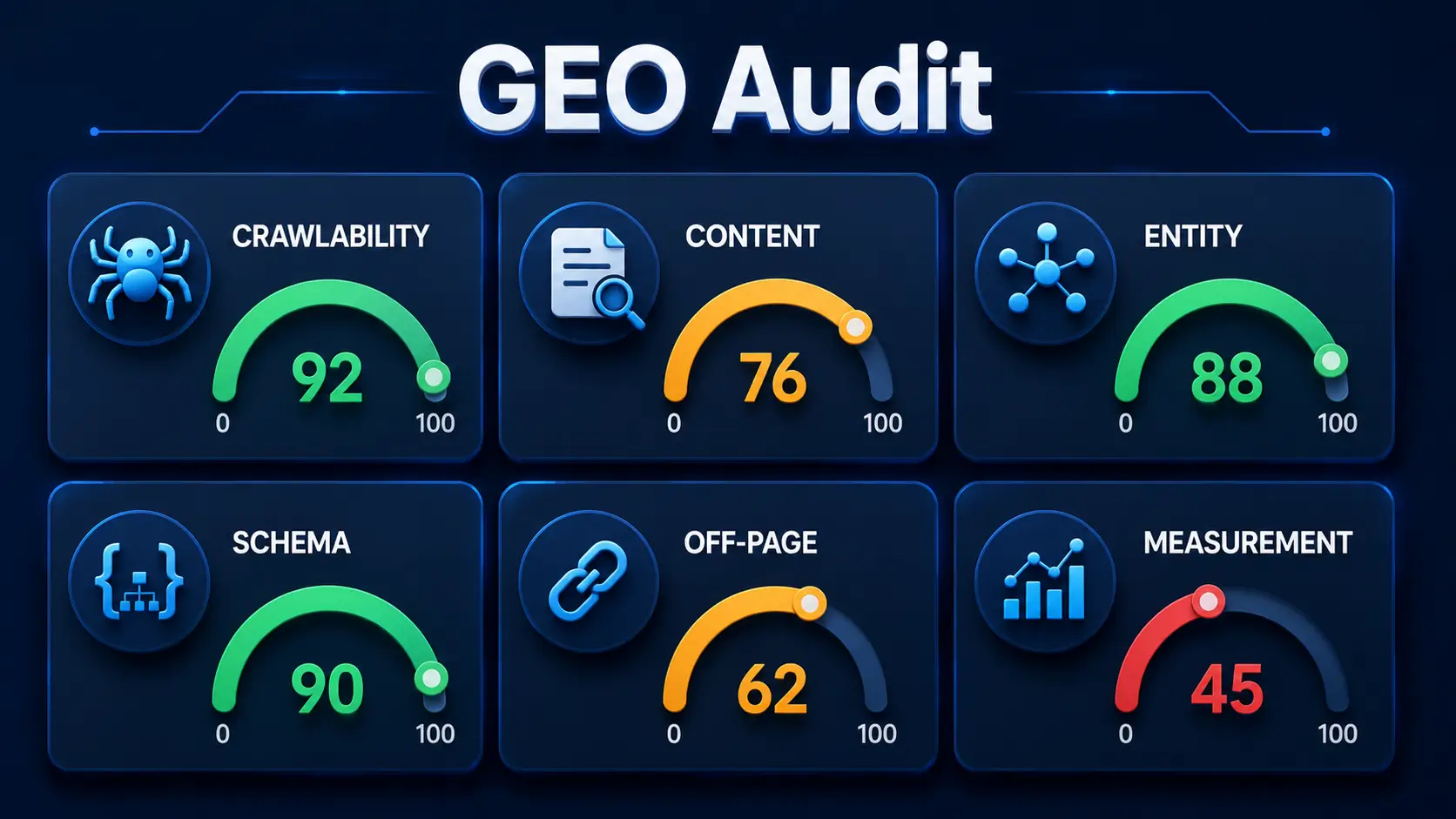
Download the GEO Audit Checklist
A complete GEO audit checklist — 47 checks across content structure, E-E-A-T signals, platform-specific optimization, schema markup, and measurement setup. Run it on your top 20 pages and identify every citation gap in under two hours.
Share this article