AEO Keyword Research: Finding Answer-Intent Queries (2026 Guide)



📌 Key Takeaways
- AEO keyword research prioritizes three criteria over search volume: whether the query triggers a direct-answer surface (snippet, AI Overview, PAA), whether you already have page-one ranking authority for it, and whether the query is phrased in the conversational, full-sentence format that AI systems process.
- Query fan-out — Google’s internal technique of expanding a single user query into multiple related sub-queries — is the core principle driving AI Overview content selection, and the same principle should drive how you build your AEO keyword list: start with a seed question and map its natural follow-up chain, not just the head term alone.
- Google Search Console is the highest-leverage free AEO keyword tool for most sites — it surfaces question-based queries your pages already nearly rank for, where AEO formatting changes (not more link building) are the remaining gap.
- An effective AEO keyword tool stack for 2026: GSC (free, highest ROI) + AlsoAsked ($47/month) + AnswerThePublic for question mapping + Semrush for question-type filtering + direct AI platform testing as the validation layer.
- TRM Agency documented 2,600 AI citations in a single 28-day window using a question-cluster content strategy built on query fan-out mapping — with the site already having meaningful page-one visibility as the starting prerequisite.
📋 Table of Contents
- How AEO Keyword Research Differs from SEO Keyword Research~ 3 min
- Query Fan-Out: The Framework Behind AI Keyword Selection~ 3 min
- Case Study: 2,600 AI Citations in 30 Days from Question-Cluster Strategy~ 3 min
- The 5-Step AEO Keyword Research Process~ 4 min
- Tool Stack: What to Use, When, and What It Costs~ 4 min
- AEO Keyword Priority Scoring System~ 3 min
- Before & After: SEO Keyword List vs. AEO Keyword List~ 2 min
- AEO Keyword Research Checklist~ 2 min
- Frequently Asked Questions~ 2 min
- Conclusion~ 1 min
How AEO Keyword Research Differs from SEO Keyword Research
Traditional SEO keyword research is built around three metrics: search volume, keyword difficulty, and ranking potential. You find terms with high enough monthly searches to be worth targeting and low enough competition to be winnable, then you build content around them.
AEO keyword research keeps those metrics as context but replaces them as the primary selection criteria. The three criteria that actually drive AEO prioritization are different:
1. Does the query trigger a direct-answer surface? A keyword is an AEO keyword when searching it in Google produces a featured snippet, an AI Overview, or a People Also Ask box — not just a standard list of ranked pages. A query with 50 monthly searches that reliably triggers an AI Overview is a higher-value AEO target than a query with 5,000 monthly searches that returns only blue links.[1]
2. Is the query phrased in conversational, full-sentence format? Traditional keyword research optimizes for short fragments (“best project management tool”). AEO keyword research targets the full-sentence phrasing that users apply when prompting AI systems — “what’s the best project management tool for remote teams in 2026?” — because that’s the format AI systems process, and the format that PAA boxes, voice assistants, and AI Overviews are built to answer.[2]
3. Does your page already have ranking authority to be in contention? As established in our AEO vs SEO guide, AEO formatting only produces results for pages that already rank on page one. AEO keyword research should begin with queries where this authority already exists — not with building new authority from scratch.[1]
📋 Section Summary
- AEO keyword selection criteria: (1) query triggers a direct-answer surface, (2) query uses conversational/full-sentence phrasing, (3) your page already has page-one ranking authority for it.
- Search volume is context, not the primary criterion — a low-volume question that triggers AI citations can outperform a high-volume head term that only returns blue links in AEO value.
- Starting with existing ranking pages (via GSC) is more efficient than building AEO keyword lists from scratch, because authority is the prerequisite the other criteria build on.
Query Fan-Out: The Framework Behind AI Keyword Selection
Query fan-out is the name Google Search Central gives to the internal process AI systems use when generating answers: a single user query is expanded into multiple related sub-queries, and the system retrieves and synthesizes answers from pages that collectively address the full question chain.[3]
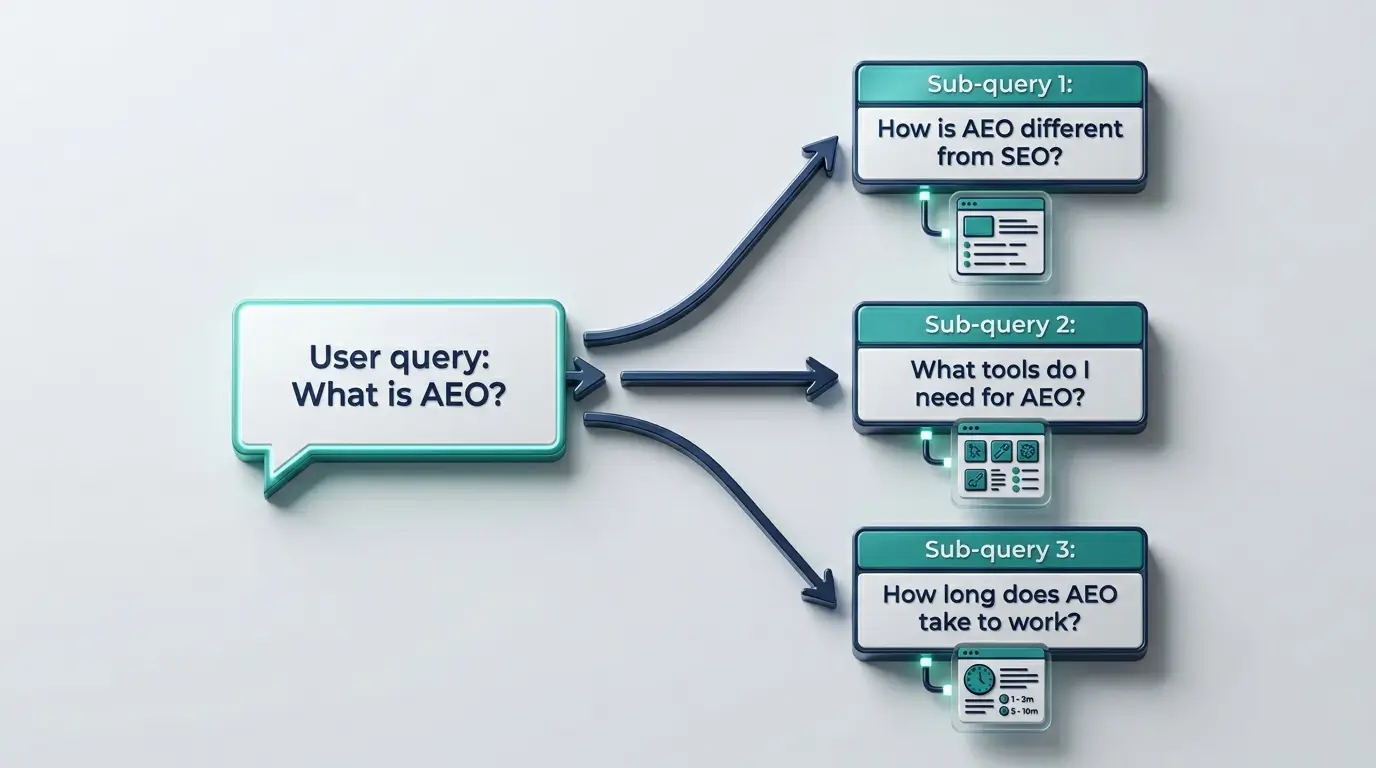
This has a direct implication for keyword research: a page that only answers its exact target keyword will be a weaker AEO candidate than a page that answers the target keyword and the three or four questions that logically follow from it. The high-performing AEO content is not the page that perfectly answers one question — it’s the page that AI systems can mine for an answer to the initial query and multiple follow-up sub-queries from the same source.
The practical application is a “question chain” methodology: instead of researching individual AEO keywords in isolation, you map them in sequences. For any seed question, the research question is: what does a user who just got the answer to this typically ask next? That next question is your first fan-out node, and the question after that is the second — typically three to four levels deep before the chain becomes too specific to cover in a single piece.
💬 According to EverydayOnAI
The fan-out principle reshapes how we think about content planning for AI SEO. Traditional keyword research says: “Here are 20 keywords, each needs its own page.” Fan-out mapping says: “Here are 5 seed questions, each with a 3-4 question chain — build content that covers the chains, and you become the page AI systems mine for the whole topic, not just one query.” The difference in citation volume between these two approaches is roughly the difference between being one of many cited sources and being the primary cited source. The TRM Agency case study below shows what this looks like when executed with existing page-one authority as the starting point.
📋 Section Summary
- Query fan-out is Google’s documented internal technique for expanding a user query into related sub-queries during AI answer generation — directly explaining why pages covering full question chains outperform single-question pages in AI citation.
- AEO keyword research built around fan-out mapping produces question chains (seed → follow-up 1 → follow-up 2 → follow-up 3) rather than isolated keyword lists.
- The research question for each fan-out node: “What does a user who just got the answer to [current question] typically ask next?” — answerable directly with PAA chains from AlsoAsked and AnswerThePublic.
Case Study: 2,600 AI Citations in 30 Days from Question-Cluster Strategy
TRM Agency documented a 28-day content strategy execution in early 2026 that produced 2,600 AI citations — measured directly through Google Search Console’s AI Overview impression data.[3]
📋 Case Study: Question-Cluster Strategy for AI Citation Volume
TRM Agency — Own Site (28-Day Window, Early 2026)
Starting point: The site already had meaningful page-one visibility across several target topics — establishing the prerequisite per the AEO vs SEO guide. The strategy was not about building new ranking authority but about maximizing AI citation capture from existing authority.[3]
Methodology: Content was organized around question clusters aligned with the query fan-out principle — mapping the natural follow-up question chains from core topic queries and ensuring each cluster page answered both the seed question and its logical follow-up sub-queries. Google Search Central’s documentation on query fan-out was explicitly cited as a framework reference.[3]
Results in 28 days:
- 2,600 AI citations captured within a single GSC 28-day analysis window
- Simultaneous growth in organic impressions alongside AI citation growth — confirming that optimizing for AI citation did not cannibalize traditional search visibility
- GSC data showed AI Overviews and AI Mode surfacing supporting links from pages that had not previously been primary ranking targets — the fan-out mechanism pulling in adjacent content
Why it worked: The existing page-one authority gave the content credibility eligibility. The question-cluster structure aligned with how AI systems fan out from user queries — giving AI Overview generation multiple adjacent questions it could pull from the same domain, compounding the citation count rather than spreading it across many unrelated sources.
The 2,600 citation figure is notable, but the structural principle is more important: citation volume scales with question-chain coverage, not just individual page authority. A domain with five well-structured question-cluster pages covering complete fan-out chains can out-cite a domain with fifty isolated pages of equal individual quality, because AI systems are pulling from chains, not from a ranked list of pages.
📋 Section Summary
- TRM Agency’s 28-day case study produced 2,600 AI citations using a question-cluster strategy aligned with the query fan-out principle, starting from existing page-one authority.
- AI citation growth occurred simultaneously with organic impression growth — no evidence of traditional search cannibalization.
- Citation volume scales with question-chain coverage: AI systems pull from the full fan-out chain, rewarding pages that answer seed questions plus logical follow-ups over isolated single-question pages.
The 5-Step AEO Keyword Research Process
This process runs in sequence. Steps 1 and 2 identify quick-win existing opportunities; Steps 3-5 build out the full question-cluster map for new content.
Step 1: Mine GSC for Existing Answer-Intent Queries
Google Search Console is the highest-ROI starting point for AEO keyword research because it surfaces queries your pages already rank for — where the authority prerequisite is already met and AEO formatting changes alone can unlock snippet or AI citation wins.[1]
The specific GSC filter for AEO opportunity: export all queries with average position between 2.0 and 15.0 (page one and close-to-page-one) and impressions above 100 over 90 days. Filter this list for queries containing question words — “what”, “how”, “why”, “when”, “which”, “can”, “does”, “is”, “are”. These are your highest-priority AEO targets: question-format queries where you have existing authority but haven’t yet structured the content for direct extraction.[4]
Step 2: Check Which Queries Already Trigger Answer Surfaces
For each question-format query identified in Step 1, run the SERP check from the GEO vs AEO decision framework — search the query in an incognito window and note whether it triggers a featured snippet, an AI Overview, or a PAA box. Queries that already trigger an answer surface are your confirmed AEO keywords. Queries that don’t trigger any answer surface are lower-priority for AEO formatting and better left to standard content improvement or SEO work first.
Step 3: Build Fan-Out Chains with AlsoAsked
For each confirmed AEO keyword from Step 2, run it through AlsoAsked to visualize the PAA chain. AlsoAsked provides real-time PAA data and semantic question clustering — showing not just the first-level PAA questions but the follow-up questions that appear when each PAA entry is clicked, giving you a two-to-three-level question tree per seed query.[5] This is the fan-out map for that keyword — the complete question chain your content should cover.
Step 4: Expand Vocabulary with AnswerThePublic
For each seed keyword, run AnswerThePublic to capture the full vocabulary range of how users phrase questions about that topic — organized by interrogative format (who, what, when, where, why, how), preposition-based phrasing, and comparison queries.[2] This step ensures your H3 headings mirror the exact natural-language phrasing users apply — not an SEO-cleaned version of it. A heading that reads exactly as a user would type or speak the question is more likely to match PAA extraction and voice search phrasing than one reworded for keyword optimization.
Step 5: Validate with Direct AI Platform Testing
For your highest-priority AEO keywords, search them directly in ChatGPT Search and Perplexity AI. Note which sources are currently being cited for each query.[6] This validation step answers three questions: Is an AI answer already being generated for this query? Who is currently cited, and why (what content structure do those pages use)? Is your domain present, and if not, what’s the structural gap between your page and the pages currently cited? This is your competitive benchmark and your content brief simultaneously.
📋 Section Summary
- The 5-step process runs: GSC mining for existing question queries → SERP check for answer surface triggers → AlsoAsked fan-out chain mapping → AnswerThePublic vocabulary expansion → AI platform validation testing.
- Steps 1-2 identify quick wins from existing authority (AEO formatting changes only needed); Steps 3-5 build new content maps for topics not yet covered.
- AI platform testing (Step 5) is both a competitive benchmark and a content brief — it shows who is currently cited, in what format, and what gap your page needs to close to be cited instead.
Tool Stack: What to Use, When, and What It Costs
No single tool covers all five steps above. The effective AEO keyword research stack in 2026 uses different tools for different stages of the process.
Google Search Console
The highest-ROI AEO keyword tool for most sites — it surfaces the question-based queries your pages already rank for, which are the highest-priority AEO targets (authority prerequisite already met). Filter queries by question words and position range 2-15 to find pages where AEO formatting changes alone can unlock answer-surface wins.
💡 Pro tip: Export 90-day query data and add a column for “triggers answer surface?” — then run Step 2’s SERP check on the top 20 question queries by impression count. This two-column check is your entire quick-win AEO keyword list.
AlsoAsked
The most purpose-built AEO keyword research tool in the stack. AlsoAsked visualizes the full PAA question chain — seed question → follow-up questions → follow-up follow-ups — giving you the fan-out map for any topic. The semantic question clustering helps identify which sub-questions belong in the same piece versus which warrant separate pages.
💡 Pro tip: For each confirmed AEO keyword, export the full AlsoAsked tree and group questions into two categories — “answer in same section” (closely related) and “answer in separate H2” (distinct enough to need their own heading and direct-answer paragraph). This becomes the section outline for that page.
AnswerThePublic
Best used for vocabulary — the exact natural-language phrasings users apply across interrogative formats (who, what, when, where, why, how), prepositions, and comparisons. The structured groupings mirror the content format AEO rewards: each question type maps directly to a heading format (how → numbered steps, what → definition, compare → table).
💡 Pro tip: Use the free tier for initial research — three strategically planned searches cover your top three AEO topic clusters. Upgrade only if you need breadth across many topic areas with no search limits.
Semrush Keyword Magic Tool
Most useful for filtering your seed topic into question-type queries at scale and identifying competitive gaps — which questions competitors rank for that you don’t. The Topic Research feature surfaces semantically related questions and subtopics in a visual card format, useful for spotting AEO content gaps in your cluster.
💡 Pro tip: Export Semrush’s “Questions” filter results for your top 5-10 seed keywords. Cross-reference this list against your AlsoAsked fan-out map to identify questions that have both PAA presence (high AEO value) and search volume (traditional SEO value).
ChatGPT / Perplexity AI (Direct Testing)
The validation layer that no keyword tool replicates — directly testing whether a query triggers an AI-generated answer and who currently gets cited. This is how you identify the content structural patterns that are actually winning citations for your specific keywords, not just patterns that theoretically should work.
💡 Pro tip: After testing your query in ChatGPT and Perplexity, note the structure of every cited source — paragraph length, use of lists, presence of Section Summary-style blocks, inline source attribution. These are your specific content structure targets for that keyword, drawn from what’s actually working right now.
📋 Section Summary
- The 2026 AEO keyword tool stack: GSC (free) for existing query discovery → AlsoAsked ($47/month) for fan-out chain mapping → AnswerThePublic for vocabulary expansion → Semrush for question-type filtering → direct AI platform testing for citation validation.
- The free tier of the stack (GSC + AnswerThePublic 3 searches/day + direct ChatGPT/Perplexity testing) covers the five-step process for most small and mid-size sites without any paid subscription.
- AlsoAsked at $47/month with unlimited users is the highest-value paid addition for teams that need to map question chains at scale across multiple topic clusters.
AEO Keyword Priority Scoring System
Use this scoring system to prioritize your AEO keyword list when you have more targets than you can address immediately. Score each keyword on four criteria (0-3 per criterion), then sum for a total out of 12.
| Criterion | 0 — Not present | 1 — Partial | 2 — Present | 3 — Strong |
|---|---|---|---|---|
| Answer surface trigger | No snippet, PAA, or AI Overview | PAA only (inconsistent) | Consistent featured snippet or PAA | AI Overview present |
| Your current ranking authority | Page 3+ or not indexed | Page 2 (positions 11-20) | Bottom of page 1 (positions 6-10) | Top of page 1 (positions 1-5) |
| Conversational phrasing fit | Head term only (“AEO”) | Short question (“what is AEO?”) | Full question with context (“how is AEO different from SEO for B2B?”) | Multi-turn prompt chain (seed + 3 follow-ups mapped) |
| Your current answer-surface presence | Not cited anywhere in AI or snippets | Cited in one platform only | Snippet held OR cited in 1+ AI platform | Both snippet and AI citation held |
Scoring interpretation: 10-12 = immediately actionable (existing win to extend or defend); 7-9 = high priority (one or two gaps to close); 4-6 = medium priority (authority or content structure work needed first); 0-3 = deprioritize (either no answer surface exists yet or authority prerequisite not met).
📋 Section Summary
- The 4-criterion AEO priority scoring system (answer surface trigger + current ranking authority + conversational phrasing fit + current answer-surface presence) produces a 0-12 score per keyword.
- Keywords scoring 10-12 are immediate wins (authority exists, answer surface exists, formatting changes are the remaining gap); keywords scoring 0-3 should be deprioritized until authority or answer surface prerequisites are met.
- The scoring system replaces search-volume-based prioritization with a framework that reflects the actual preconditions for AEO success.
Before & After: SEO Keyword List vs. AEO Keyword List
The same topic — “answer engine optimization” — researched with a traditional SEO approach versus an AEO approach, for the same site.
✖ Traditional SEO Keyword List
answer engine optimization (3,600/mo), aeo seo (1,200/mo), what is aeo (880/mo), aeo meaning (590/mo), answer engine optimization tools (320/mo), aeo vs seo (210/mo) — prioritized by volume, targeting one keyword per page.
✔ AEO Keyword Research Output
Seed: “What is answer engine optimization?” → Chain: “How is AEO different from SEO?” → “Which AEO tools work best for small sites?” → “How long does AEO take to show results?” → “What schema markup does AEO require?” — one page covers the full chain, structured with H3s matching each question exactly, Answer-first paragraphs per section.
The traditional list produces six separate page targets. The AEO approach produces one page that covers the full question chain — designed for AI systems to mine across multiple related sub-queries, and structured so a user who searches any question in the chain lands on content that answers not just that question but the next two they’re likely to ask.
AEO Keyword Research Checklist
✓ Discovery Phase
- ★ GSC query export filtered for question words + positions 2-15 + impressions 100+ over 90 days
- ★ Each question query checked: does it trigger a featured snippet, AI Overview, or PAA box?
- Queries that trigger answer surfaces marked as confirmed AEO keywords, scored 0-12 using the priority scoring system above
- Queries that don’t trigger answer surfaces deprioritized or queued for future re-check as AI Overview coverage expands
✓ Fan-Out Mapping Phase
- ★ AlsoAsked run on each confirmed AEO keyword to map PAA chain (2-3 levels deep)
- AnswerThePublic run on each seed keyword to capture full vocabulary range across interrogative formats
- Questions clustered into “same H2 section” vs. “separate H2” based on semantic proximity
- Full question chain documented per target page: seed question + 3-4 fan-out follow-ups
✓ Validation Phase
- ★ Each high-priority AEO keyword tested directly in ChatGPT Search and Perplexity
- Currently cited sources documented: content structure, paragraph length, presence of lists/tables/summaries
- Your content’s current presence noted: if absent, gap identified (authority, structure, or depth?)
- Quarterly re-check scheduled: PAA chains, AI Overview coverage, and competitor citation status all shift
Frequently Asked Questions
What makes a keyword an ‘AEO keyword’ versus a regular SEO keyword?
An AEO keyword is a query that triggers a direct-answer surface — a featured snippet, People Also Ask box, voice search result, or AI Overview — rather than only a standard ranked list of links. AEO keywords are typically phrased as full questions or comparisons and reflect how users prompt AI systems rather than how they type short keyword fragments into traditional search. High search volume is not a primary AEO keyword criterion — a low-volume question that consistently triggers a featured snippet is more valuable for AEO than a high-volume head term that only returns blue links.[1]
What is query fan-out and why does it matter for AEO?
Query fan-out is a technique, documented by Google Search Central, where a single user query is expanded into multiple related sub-queries to retrieve a more comprehensive AI-generated answer. For AEO keyword research, this means a page targeting “what is AEO” should also answer the follow-up questions users naturally ask after that — “how is AEO different from SEO”, “what tools do I need” — because AI systems are themselves fanning out from the user’s original query and pulling from pages that cover the full question chain.[3]
Should I prioritize high-volume or low-volume keywords for AEO?
Neither metric alone should drive AEO prioritization. The better criterion is whether the keyword consistently triggers a direct-answer surface and whether your page already has ranking authority to be in contention for it. A 50-monthly-search question that reliably triggers an AI Overview and converts AI-referred visitors at 4.4x the organic rate (Semrush, 2026) can outperform a 5,000-monthly-search head term that only returns blue links in AEO terms.
Which tools are best for AEO keyword research in 2026?
The most effective approach uses a tool stack: Google Search Console (free) + AlsoAsked ($47/month) + AnswerThePublic + Semrush for question-type filtering + direct AI platform testing. GSC identifies existing ranking queries where authority prerequisites are already met. AlsoAsked maps PAA chains for fan-out structuring. AnswerThePublic expands vocabulary range. Direct AI testing validates whether a query triggers AI-generated answers and who currently gets cited — no keyword tool replicates this last step.[5]
How often should I refresh my AEO keyword research?
Quarterly, at minimum — more frequently in fast-moving industries. AI Overview coverage grew from 31% to 48% of queries between February 2025 and February 2026 (BrightEdge), and PAA chains update as new content is indexed. A keyword that didn’t trigger an answer surface six months ago may trigger one today — and vice versa. Build this re-check into your existing quarterly content refresh cycle.
Conclusion: Start with GSC, End with AI Platform Testing
AEO keyword research is not a different version of SEO keyword research with question marks added. It’s a different process — starting from where authority already exists (GSC), mapping the question chains AI systems follow (fan-out via AlsoAsked), and validating against what AI systems are actually citing today (direct platform testing). Volume metrics come last, as context, not as the driver.
The fastest path to an actionable AEO keyword list is: export your GSC queries for the last 90 days, filter for question words and positions 2-15, check each of the top 20 against your SERP to see which triggers an answer surface, then score those that do using the 0-12 priority system above. That’s one to two hours of work, and the resulting list is higher-value for AEO purposes than any keyword tool output built around volume-based prioritization.
💬 According to EverydayOnAI
The GSC-first approach is also the easiest to defend to a stakeholder who’s skeptical about “all this AEO stuff.” You’re not proposing new content, new link building, or new tooling investment to start — you’re proposing AEO formatting changes to pages that are already ranking and already generating impressions. That’s the lowest-friction, highest-credibility pitch for AEO work, and it happens to also be the highest-ROI starting point per the process above. Start there, document what moves, and the data you generate becomes the argument for the rest of the keyword research investment.
📚 References and Sources
- Stackmatix, “AEO Keyword Research: Find Keywords for AI Search & Answer Engines,” 2026. AEO keyword research prioritizes question-based queries, conversational phrasing, and intent clusters over individual keyword volume; GSC described as most reliable free source for discovering AEO keyword opportunities. stackmatix.com
- HubSpot, “Keyword Research for AEO: A Guide for Winning Answer Engine Traffic in 2026,” June 2026. Conversational phrasing mirrors how users interact with AI systems; AnswerThePublic surfaces real conversational queries across interrogative formats; no single AEO keyword tool covers the full process. blog.hubspot.com
- TheRankMasters, “TRM AEO Case Study: 2.6K AI Citations in 30 Days,” Early 2026. 2,600 AI citations in a 28-day GSC window; content organized around query fan-out question clusters; Google Search Central’s query fan-out documentation cited as framework reference; AI citation growth occurred simultaneously with organic impression growth. therankmasters.com
- Stackmatix, “AEO Keyword Research” (same source), 2026. Specific GSC filter methodology: question-based queries, positions 2-15, impressions 100+ over 90 days for AEO opportunity identification. stackmatix.com
- CheckThat.ai, “Best AEO Keyword Research Tools 2026,” February 2026. Tool pricing and data refresh cadence: AlsoAsked $47/month unlimited users (real-time PAA data); AnswerThePublic $199/month Expert (unlimited users, monthly data refresh); Semrush daily updates; Frase, Clearscope, Surfer SEO integration capabilities. checkthat.ai
- Stackmatix, “Best Free AI Keyword Research Tools (2026): 15+ Compared,” March 2026. Direct AI platform testing in ChatGPT and Perplexity recommended to identify queries that trigger AI-generated answers and discover which content structures are being cited. stackmatix.com
- Google Search Central, Query Fan-Out Documentation (referenced via TheRankMasters 2026). AI Overviews and AI Mode use query fan-out to explore related subtopics and data sources when generating answers, surfacing supporting links from a wider and more diverse set of pages than classic web search. developers.google.com
Sources verified June 15, 2026. Tool pricing changes frequently — verify current pricing at each vendor’s site before subscribing. AEO keyword research data (PAA chains, AI Overview triggers) is dynamic; treat any keyword classification as a current snapshot requiring quarterly re-validation. This article does not constitute professional SEO advice.
📚 Go Deeper: Complete AI SEO Hub on EverydayOnAI
-
→ What is AI SEO? The Complete Guide to GEO, AEO & LLMO
The pillar guide — where AEO keyword research fits within the full AI SEO stack. -
→ What is AEO? The Complete Answer Engine Optimization Guide
The AEO sub-pillar — once you have your keyword list from this article, this guide covers how to structure content around it. -
→ AEO vs SEO: What Changes and What Stays
The foundation audit — confirms which target pages have the authority prerequisite needed before AEO keyword research applies. -
→ GEO vs AEO: Key Differences Explained
Step 2 of the keyword research process (checking which SERP surface a query triggers) follows the framework in this guide. -
→ AEO Checklist: Is Your Content Answer-Ready?
The implementation checklist for applying AEO formatting to the keyword targets this research process identifies.
Build Your AEO Keyword List This Week
Download our free AEO Keyword Research Template — a spreadsheet version of the 5-step process and 0-12 priority scoring system from this article, with pre-built GSC export filters and question-chain mapping columns.
Share this article