AEO vs SEO: What Changes and What Stays (2026)



📌 Key Takeaways
- Backlink authority, E-E-A-T, Core Web Vitals, and crawlability remain unchanged in importance — Backlinko’s analysis of 11.8 million search results found the #1 position has roughly 3.8x more backlinks than positions 2-10, and this advantage extends to AI citation frequency, not just rankings.
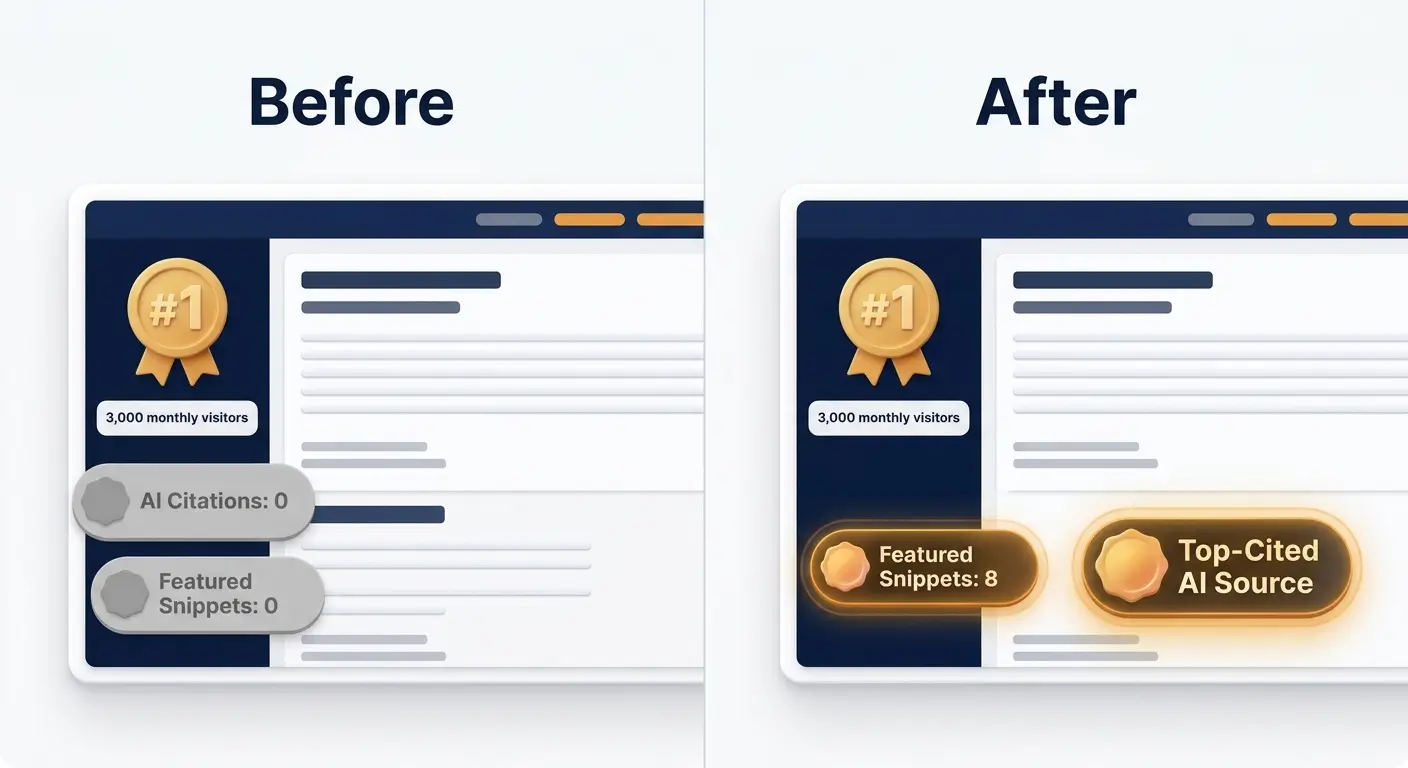
- A documented 2026 case showed a page ranking #1 organically (3,000 monthly visitors) with zero featured snippets and zero AI citations — until AEO formatting changes produced 8 featured snippets and top-cited status in AI answers, with the underlying SEO ranking unchanged throughout.
- Schema markup’s role bifurcates sharply: Ahrefs’ May 2026 difference-in-differences study (1,885 test pages vs. 4,000 controls) found schema produced no significant change in ChatGPT/AI Mode citations and a 4.6% decrease in Google AI Overview citations — yet schema remains essential for featured snippets, PAA, and voice answers.
- The single new structural requirement AEO adds that SEO never had: answer-first content placement — a direct, extractable answer in a specific position and format, independent of overall topic comprehensiveness.
- Brand mentions — even unlinked ones — are increasingly cited as a top AI visibility factor, a signal type traditional link-based SEO never weighted as heavily.
📋 Table of Contents
- The Core Question: New Game, or New Rules?~ 2 min
- What Stays the Same: The SEO Foundation~ 3 min
- Case Study: #1 Ranking, Zero AI Citations — Then 8 Snippets~ 3 min
- What Changes: The New Layer AEO Adds~ 3 min
- The Schema Markup Paradox~ 3 min
- Side-by-Side: What’s Shared vs. What’s New~ 2 min
- Two Checklists: Foundation Audit + New-Layer Audit~ 3 min
- Frequently Asked Questions~ 2 min
- Conclusion~ 1 min
The Core Question: New Game, or New Rules?
Every “AEO vs SEO” discussion eventually runs into the same unresolved tension. One camp says SEO is dead — that ranking position no longer matters when AI answers the question before anyone clicks. The other camp says nothing has changed — that the same fundamentals (links, authority, content quality) that always drove rankings now drive AI citations too, so “AEO” is just SEO with extra branding.
Both camps are half right, and the data points to a more useful framing: AEO is new rules layered on top of the old game, not a new game. The SEO foundation — the signals that determine whether a page is even in the running — has not changed in any way the data supports. What’s changed is what happens above that floor: a new set of structural and formatting requirements that determine whether an eligible page actually wins a featured snippet, a PAA answer, or an AI citation.
This article works through that floor-and-new-layer model concretely — what specifically stays the same (with the evidence), what specifically changes (with a real before/after case), and one finding that surprises almost everyone who assumes schema markup is the bridge between the two.
📋 Section Summary
- “SEO is dead” and “nothing has changed” are both oversimplifications — the evidence supports a floor-and-new-layer model instead.
- The SEO foundation (backlinks, E-E-A-T, technical health) determines eligibility; AEO formatting determines whether an eligible page wins the answer surface.
- This article separates the two with evidence for each, plus one finding (on schema markup) that cuts across both.
What Stays the Same: The SEO Foundation
Three categories of SEO fundamentals show no meaningful change in 2026 — if anything, the data suggests they matter for a wider set of outcomes than before, because they now influence AI citation as well as traditional ranking.
Backlink Authority
Backlinko’s analysis of 11.8 million Google search results found that the #1 ranking position has approximately 3.8 times more backlinks than positions 2 through 10 combined.[1] That correlation between link authority and top rankings is unchanged from the pre-AI-search era. What’s new is that the same authority signal now extends into AI visibility: a Semrush study examining backlinks and AI search found that domains with stronger backlink authority — measured by Semrush’s Authority Score — are mentioned more often in AI-generated answers, with quality and topical relevance mattering more than raw link volume in both contexts.[2]
E-E-A-T, Core Web Vitals, and Crawlability
E-E-A-T (Experience, Expertise, Authoritativeness, Trustworthiness) remains essential for content trust and long-term ranking stability, and Core Web Vitals — particularly LCP, INP, and CLS — continue to shape performance-based ranking outcomes.[4] Crawlability remains the absolute prerequisite underneath all of this — a page that cannot be crawled or interpreted does not rank, regardless of content quality, a point that applies identically to AI crawlers (GPTBot, PerplexityBot) as it does to Googlebot.[4]
Google’s Own Evidence That Links Still Matter
Perhaps the most concrete evidence comes from Google itself. According to industry reporting, when Google internally experimented with removing links from its ranking algorithm entirely, search quality became significantly worse — an experiment referenced in Google Search Central content and widely cited since.[3] Separately, Google’s spam policy documentation was updated in March 2024 to remove the word “important” from its description of links as a ranking factor — a subtle public-messaging shift that, notably, did not come with any corresponding algorithmic de-emphasis in observed ranking correlations.[3]
3.8×
more backlinks at position #1 vs. positions 2-10, across 11.8 million search results[1]
Quality > Volume
backlink authority (not raw count) correlates with AI-generated answer mention frequency[2]
LCP / INP / CLS
Core Web Vitals continue to directly shape performance-based ranking outcomes[4]
Crawl First
applies identically to Googlebot and AI crawlers (GPTBot, PerplexityBot) — uncrawlable pages don’t exist to either[4]
📋 Section Summary
- Backlink authority remains a top ranking factor (#1 position has 3.8x more backlinks than 2-10) and now also correlates with AI citation frequency — the same signal serves both purposes.
- E-E-A-T, Core Web Vitals, and crawlability are unchanged in importance and apply identically to AI crawlers as to Googlebot.
- Google’s own internal testing (links removed → search quality dropped significantly) is the strongest available evidence that link-based authority signals remain structurally load-bearing, despite softer public messaging since March 2024.
Case Study: #1 Ranking, Zero AI Citations — Then 8 Snippets
The clearest illustration of “what stays vs. what changes” isn’t a statistic — it’s a single documented before/after, reported in a 2026 AEO implementation guide.[5]
📋 Case Study: When #1 Isn’t Enough
B2B Software Review Site — “Best Project Management Software” (2026)
Before: The page held the #1 organic ranking for “best project management software,” generating approximately 3,000 monthly visitors. By every traditional SEO metric, the page was a success. But it appeared in zero AI search citations across ChatGPT and Perplexity, and held zero featured snippets — despite being, by the site’s own assessment, the most comprehensive guide on the topic.[5]
What changed: The team implemented AEO-specific changes — conversational, question-and-answer-format content restructuring; schema markup targeting featured snippets; and content rewritten to align with how AI systems parse and extract direct answers (NLP-aligned phrasing).[5]
After: The page captured 8 featured snippets and became a top-cited source in AI-generated answers for the topic.[5] Notably, the case is reported without any claimed change to the underlying #1 ranking or organic traffic — the SEO outcome stayed where it was; an entirely separate visibility layer was added on top of it.
What makes this case study useful isn’t the headline number — it’s what didn’t change alongside it. The page didn’t need new backlinks, a content rewrite for “more comprehensiveness,” or a ranking improvement to unlock 8 featured snippets. The SEO foundation was already sufficient; what was missing was the answer-format layer this article’s “What Changes” section covers next.
📋 Section Summary
- A documented case shows a #1-ranked page with 3,000 monthly visitors and zero AI citations or featured snippets — a combination that is common, not exceptional, in 2026.
- AEO-specific changes (Q&A restructuring, snippet-targeted schema, NLP-aligned phrasing) produced 8 featured snippets and top-cited AI status, with no reported change to the underlying ranking or traffic.
- The SEO foundation (sufficient to hold #1) and the AEO layer (needed for snippet/citation visibility) operated as genuinely separate variables in this case — confirming the floor-and-new-layer model from Section 1.
What Changes: The New Layer AEO Adds
Three things make up the “new floor” that the case study above illustrates — requirements that traditional pre-2014 SEO had no real equivalent for.
Answer-First Content Placement
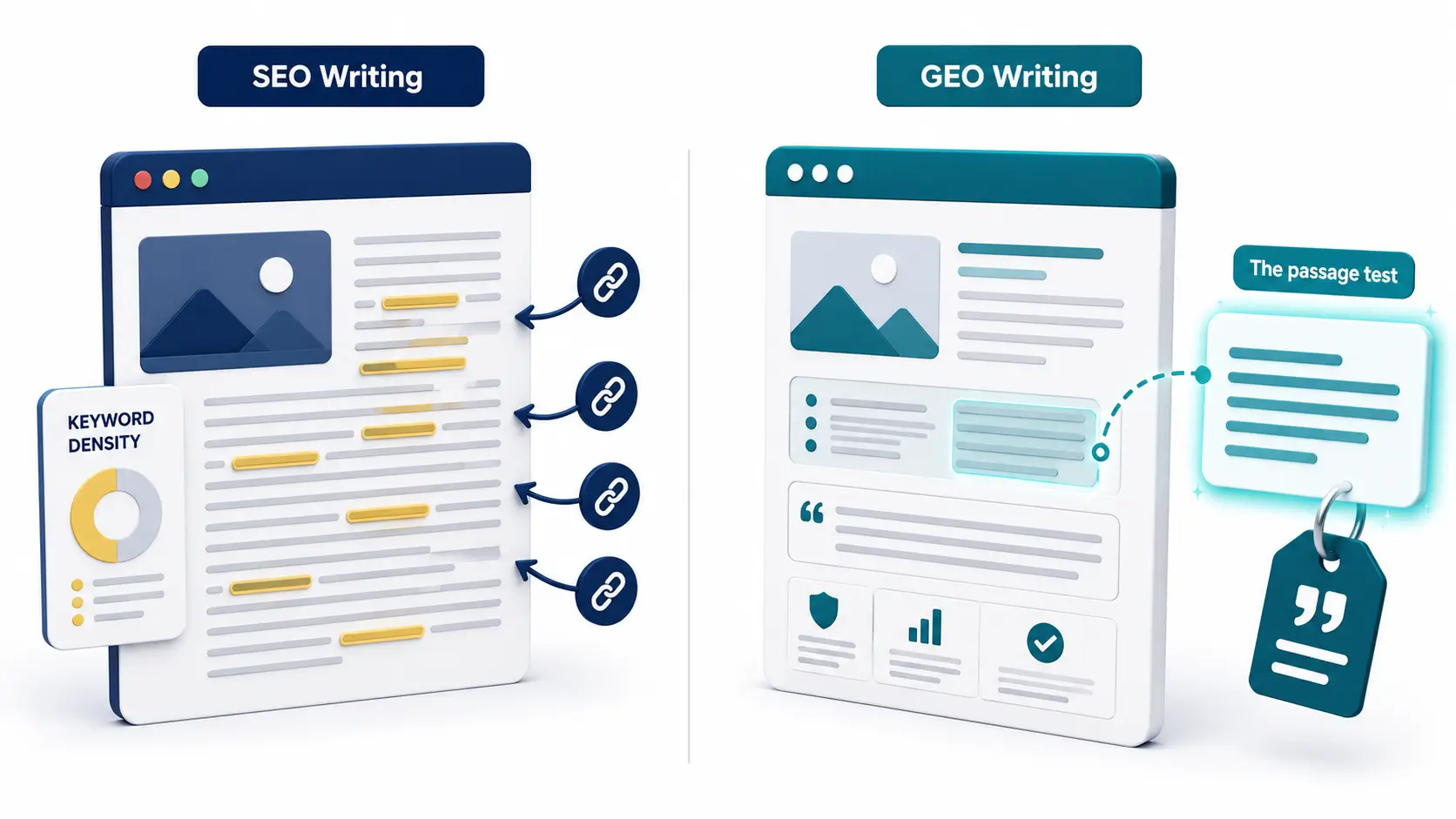
Traditional SEO rewarded comprehensive topic coverage, largely regardless of where in the page that coverage appeared — a thorough article could bury its best definition in paragraph six and still rank well if the overall page demonstrated topical depth. AEO specifically rewards content where a direct, self-contained answer to a likely query appears in a position and format — typically a 40-60 word paragraph, list, or table — that extraction systems can lift independently of surrounding context.[9] This is a genuinely new structural requirement, not a restatement of “write good content.”
Brand Mentions as a Citation Signal
One AI SEO ranking factor analysis goes as far as describing brand mentions on AI-trusted sources as the top factor for AI search visibility specifically — including unlinked mentions, which traditional link-based SEO never weighted as a primary signal.[8] Earned media, podcast mentions, and industry citations that never include a hyperlink were, for most of SEO’s history, treated as having limited direct ranking value. Under AEO/GEO, these mentions function as corroborating signals that an AI system can use to assess whether a brand is a credible source — independent of whether any individual mention links back.
Content Characteristics, Independent of Links
Analysis updated as of April 2026 found that articles covering more facts and running longer tend to earn more AI citations — a content-level finding that holds independent of the page’s backlink profile.[21] This aligns with the 20,000-character depth threshold covered in our GEO Guide — but the point worth isolating here is that this is a content lever, not a link-building or technical lever, and it’s one where a page with modest backlink authority can still compete on AI citation if the content itself meets the depth and density bar.
📋 Section Summary
- Answer-first content placement — a direct answer in a specific position and format immediately after a relevant heading — is the primary structural requirement AEO adds with no real pre-2014 SEO equivalent.
- Brand mentions, including unlinked ones, function as AI citation signals in a way traditional link-based SEO never formally credited.
- Content depth and factual density independently predict AI citation likelihood, separate from backlink authority — giving lower-authority sites a content-driven path to AI visibility that doesn’t exist in traditional competitive ranking for the same terms.
The Schema Markup Paradox
This is the finding most likely to contradict what you’ve read elsewhere — including, in part, our own AEO Guide and AI SEO Guide, which recommend schema markup as part of the AEO/GEO toolkit. The nuance matters enough to isolate here.
Ahrefs ran a difference-in-differences study — a methodology that compares outcomes for a test group against a control group before and after an intervention — across 1,885 pages that added schema markup versus 4,000 control pages that didn’t, published May 11, 2026.[6] The result: schema markup produced no statistically significant change in ChatGPT or AI Mode citations — and was associated with a 4.6% decrease in Google AI Overview citations for the pages that added it.[6]
▲ Where Schema Still Works
Schema markup remains directly useful for AEO surfaces — FAQPage and HowTo schema target featured snippets, PAA boxes, and voice answers, and Speakable schema helps voice assistants identify readable sections. A separate analysis confirms this split explicitly: schema helps for voice and featured snippet AEO surfaces, but not for direct LLM citation.[7]
▼ Where It Doesn’t Transfer
For GEO — citation inside ChatGPT, AI Mode, and (per the Ahrefs data) even Google AI Overviews specifically — schema markup is not the lever. The -4.6% finding doesn’t mean schema is harmful broadly; it means the effort-to-outcome ratio for GEO citation is better spent on content structure (depth, self-contained statistics, section organization) than on expanding schema coverage.
💬 According to EverydayOnAI
This finding is the one most likely to be misread as “stop adding schema.” It shouldn’t be. FAQPage and HowTo schema remain genuinely useful for the AEO surfaces our sibling guide covers — featured snippets, PAA, and voice. What the Ahrefs data narrows is specifically the GEO claim: if your goal is ChatGPT or AI Overview citation, the -4.6% finding suggests that hours spent expanding schema coverage are better spent on the content structure changes in our GEO Guide. Same toolkit, two different goals, and now — for the first time — data showing they don’t pull the same lever.
📋 Section Summary
- Ahrefs’ May 2026 difference-in-differences study (1,885 vs. 4,000 pages) found schema markup produced no significant change in ChatGPT/AI Mode citations and a 4.6% decrease in Google AI Overview citations.
- Schema markup remains directly useful for AEO surfaces (featured snippets, PAA, voice via FAQPage/HowTo/Speakable) — the finding is specific to GEO/LLM citation, not AEO broadly.
- For GEO citation specifically, content structure and depth are the higher-leverage investment compared to schema expansion — a genuinely new piece of nuance for 2026 AI SEO planning.
Side-by-Side: What’s Shared vs. What’s New
| Factor | SEO Status | AEO Status | Verdict |
|---|---|---|---|
| Backlink authority | Top ranking factor (3.8x at #1) | Correlates with AI mention frequency too | Stays — and extends |
| E-E-A-T | Core trust/stability signal | No evidence of reduced importance | Stays |
| Core Web Vitals / crawlability | Prerequisite for ranking | Prerequisite for AI crawler access too | Stays |
| Answer-first placement | Not a formal ranking factor | Primary structural requirement | New |
| FAQPage / HowTo / Speakable schema | Minor rich-result benefit | Directly targets snippets/PAA/voice | New (AEO-specific) |
| Schema for GEO/LLM citation | N/A | No significant effect (Ahrefs, 2026) | Doesn’t transfer |
| Unlinked brand mentions | Minimal formal weight historically | Cited as a top AI visibility factor | New emphasis |
| Content depth/density | Supports topical authority | Independently predicts AI citation | Stays — and extends |
📋 Section Summary
- Four factors stay unchanged or extend their relevance into AI visibility: backlink authority, E-E-A-T, Core Web Vitals/crawlability, and content depth.
- Two factors are genuinely new with AEO: answer-first content placement and AEO-specific schema (FAQPage/HowTo/Speakable for snippets, PAA, voice).
- One factor — schema markup for GEO/LLM citation specifically — does not transfer despite being part of the same general “schema markup” toolkit, per Ahrefs’ 2026 data.
Two Checklists: Foundation Audit + New-Layer Audit
Run the foundation audit first. If any item fails, prioritize it before the new-layer audit — per the case study above, the new layer only produces results once the foundation is sufficient.
✓ Foundation Audit (What Stays)
- ★ Backlink profile reviewed for quality and topical relevance — not just raw count (Backlinko: #1 has 3.8x more backlinks than 2-10)
- ★ Author bios and E-E-A-T signals present and verifiable on priority pages
- Core Web Vitals passing: LCP < 2.5s, CLS < 0.1, INP < 200ms
- ★ Crawlability verified for both Googlebot AND AI crawlers (GPTBot, PerplexityBot, ClaudeBot) — check robots.txt and Cloudflare settings
- Page already demonstrates page-one-equivalent topical authority for its target query
✓ New-Layer Audit (What Changes)
- ★ A 40-60 word direct-answer paragraph appears immediately after the primary heading — not buried mid-page
- FAQPage and/or HowTo schema implemented, targeting featured snippets and PAA (not as a GEO citation tactic — see Section 5)
- Brand actively pursuing unlinked mentions in industry publications, podcasts, and earned media — tracked separately from backlink-building
- Content depth and factual density reviewed independently of backlink profile — does the content alone meet a citation-worthy density bar?
- If GEO citation (ChatGPT, AI Mode, AI Overviews) is the goal, effort allocated to content structure (per the GEO Guide) rather than additional schema coverage
📋 Section Summary
- The foundation audit (backlinks, E-E-A-T, Core Web Vitals, crawlability, topical authority) should be run and passed before the new-layer audit — the case study shows the new layer is inert without it.
- The new-layer audit separates AEO-surface schema (still valuable) from GEO citation effort (better spent on content structure per the Ahrefs finding).
- Brand mention tracking and content depth review are treated as independent workstreams from backlink building — they are correlated but not interchangeable levers.
Frequently Asked Questions
Does AEO replace the need for traditional SEO?
No — AEO adds a layer on top of SEO; it does not replace the foundation. Featured snippets, People Also Ask answers, and AI citations are still drawn primarily from pages that already demonstrate ranking authority. Backlinks, E-E-A-T signals, and technical health (crawlability, Core Web Vitals) remain prerequisites — AEO determines whether an already-eligible page wins the answer surface, not whether it’s eligible in the first place.
Do backlinks still matter if I’m optimizing for AEO?
Yes, and they matter for AI visibility too, not just rankings. Backlinko’s analysis of 11.8 million search results found the #1 position has roughly 3.8 times more backlinks than positions 2 through 10.[1] Separately, a Semrush study found that domains with stronger backlink authority (measured by Semrush Authority Score) are mentioned more often in AI-generated answers.[2] Quality and topical relevance matter more than raw volume in both cases.
Does adding schema markup help me get cited by ChatGPT?
Not directly, according to the best available data. Ahrefs ran a difference-in-differences study (1,885 test pages vs. 4,000 control pages, May 2026) and found schema markup produced no statistically significant change in ChatGPT or AI Mode citations, and was associated with a 4.6% decrease in Google AI Overview citations.[6] Schema remains valuable for AEO surfaces — FAQPage and HowTo schema directly target featured snippets, PAA, and voice answers — but for direct LLM citation, content structure and depth matter more than markup.
What ranking factors stay exactly the same between SEO and AEO?
Backlink authority, E-E-A-T signals, Core Web Vitals, and crawlability remain unchanged in importance. These function as the floor: a page needs to clear this bar to be considered for any visibility surface, traditional or AI-driven. What changes is what happens above that floor — AEO adds answer-format content structure and schema requirements that traditional SEO ranking alone never required.
What’s the single biggest new requirement AEO adds that SEO never had?
Answer-first content structure — placing a direct, self-contained answer immediately after a heading that mirrors the query’s phrasing. Traditional SEO rewarded comprehensive topic coverage regardless of where in the page that coverage appeared. AEO specifically rewards content where the answer to a likely query appears in a position and format (40-60 word paragraph, list, or table) that Google’s extraction systems can lift directly — a structural requirement with no real equivalent in pre-2014 SEO practice.
Conclusion: Audit the Floor Before Building the New Layer
The “AEO vs SEO” framing implies a choice. The evidence in this article doesn’t support one. Backlink authority, E-E-A-T, Core Web Vitals, and crawlability are exactly as important as they were — arguably more so, since they now influence AI citation alongside rankings. What’s genuinely new is a structural layer on top: answer-first placement, AEO-specific schema, and brand-mention signals that traditional SEO never formally counted.
The case study in Section 3 is the article’s central evidence, and it’s worth restating plainly: a page can be a complete SEO success — #1 ranking, steady traffic — and simultaneously a complete AEO failure, with zero featured snippets and zero AI citations. Those aren’t two ends of the same spectrum. They’re two different audits, and the schema paradox in Section 5 shows that even within the “AEO toolkit,” not every tool serves both audits equally.
💬 According to EverydayOnAI
The DataEnriche case study is worth sitting with, because the situation it describes — #1 ranking, healthy traffic, zero AI presence — describes a large share of established content sites in 2026, not an edge case. SEO success and AEO/GEO visibility aren’t on the same axis, and a page can max out one while scoring zero on the other. The practical test takes two minutes: search your own #1-ranking pages’ topics in ChatGPT or Perplexity. If your brand doesn’t appear, that’s not a ranking problem — it’s a separate problem, with a separate fix, and the rest of this AI SEO Hub is built around exactly that fix.
Run the Foundation Audit from Section 7 first. If it passes — and for most pages that already rank reasonably well, it will — move directly to the New-Layer Audit. That’s where the actual work, and the actual gap, usually is.
📚 References and Sources
- Backlinko, analysis of 11.8 million Google search results, cited via ezmarketing/Clickrank 2026. The #1 ranking position has approximately 3.8 times more backlinks than positions 2 through 10. ezmarketing.com
- Semrush, “Do Backlinks Still Matter in AI Search? Insights from 1,000 Domains,” with Kevin Indig, October 2025. Domains with stronger backlink authority (Semrush Authority Score) are mentioned more often in AI-generated answers; quality and authority matter more than volume. semrush.com
- wpseoai, “Are Backlinks Still Important in 2026?,” May 2026, citing Ahrefs and Google Search Central. Google’s internal testing of removing links from its algorithm resulted in significantly worse search quality; March 2024 spam policy update removed “important” from the description of links as a ranking factor without corresponding algorithmic de-emphasis. wpseoai.com
- Clickrank, “Google SEO Ranking Factors 2026: The Ultimate Guide,” March 2026. E-E-A-T essential for content trust and long-term stability; Core Web Vitals (LCP, INP, CLS) shape performance rankings; crawlability is the absolute prerequisite for ranking, applying to AI crawlers as well as Googlebot. clickrank.ai
- DataEnriche, “Answer Engine Optimization (AEO): Complete Guide 2026,” April 2026. Case study: a client’s #1-ranked page for “best project management software” (3,000 monthly visitors) had zero AI search citations and zero featured snippets; after implementing AEO (conversational Q&A restructuring, snippet-targeted schema, NLP-aligned content), the page captured 8 featured snippets and became a top-cited AI source. dataenriche.com
- Ahrefs, difference-in-differences study (1,885 test pages vs. 4,000 control pages), cited via TurboAudit, May 11, 2026. Schema markup produced no statistically significant change in ChatGPT or AI Mode citations, and was associated with a 4.6% decrease in Google AI Overview citations. turboaudit.ai
- TurboAudit, “Answer Engine Optimization (AEO): 2026 Guide,” June 2026. Schema markup helps for voice and Featured Snippet AEO surfaces; does not help for direct LLM citation. turboaudit.ai
- JDM Web Technologies, “AI SEO Ranking Factors 2026,” June 2026. Brand mentions on AI-trusted sources — including unlinked mentions — described as the top ranking factor for AI search visibility specifically. jdmwebtechnologies.com
- Arc Intermedia, “SEO vs. AEO vs. GEO: The New Search Landscape for 2026,” April 2026. AEO requires concise, clear answers in the first 1-2 sentences after a question-format heading, distinct from general content comprehensiveness. arcintermedia.com
- wpseoai, “Are Backlinks Still Important in 2026?,” analysis updated April 2026. Articles covering more facts and running longer tend to earn more AI citations, a content-level finding independent of backlink profile. wpseoai.com
Sources verified June 15, 2026. The Ahrefs schema markup finding is based on a single difference-in-differences study; further replication is expected as more AI citation data becomes available. This article does not constitute professional SEO advice and does not guarantee ranking, snippet, or AI citation outcomes.
📚 Go Deeper: Complete AI SEO Hub on EverydayOnAI
This article addresses Step 4 of the GEO vs AEO decision framework — what to do when neither AEO nor GEO formatting will move a keyword yet.
-
→ What is AI SEO? The Complete Guide to GEO, AEO & LLMO
The pillar guide — the full AI SEO stack and the AI Citation Readiness Score tool. -
→ What is AEO? The Complete Answer Engine Optimization Guide
The full AEO surface breakdown and Snippet-Readiness Checker — the “new layer” referenced throughout this article. -
→ GEO Complete Guide: How to Get Cited by ChatGPT, Perplexity & Google AI
Where the schema paradox in Section 5 points: content structure and depth tactics for GEO citation specifically. -
→ GEO vs AEO: Key Differences Explained
The decision framework this article’s Step 4 belongs to — for keywords where neither AEO nor GEO applies yet. -
→ AEO Keyword Research: Finding Answer-Intent Queries
Once the Foundation Audit passes, this is where to find the answer-intent queries the New-Layer Audit applies to.
Run the Two-Minute AI Visibility Test
Download our free Foundation vs. New-Layer Audit checklist — a print-ready version of both checklists from this article, designed to be run on your top 10 ranking pages in under an hour.
Share this article