How to Track AI Search Visibility: GA4, Search Console & Beyond (2026 Setup Guide)

How to Track AI Search Visibility
Data Freshness Note — Reviewed June 30, 2026
According to EverydayOnAI: AI visibility measurement changed materially in June 2026. Google announced dedicated Search Generative AI performance reports in Search Console on June 3, 2026, rolling them out first to a subset of sites.[F1]
Practical implication: use three layers, not one dashboard: Search Console generative AI visibility where available, GA4/referrer tracking for click-through traffic, and manual citation testing for platforms that do not pass clean referral data.
Who Should Read This?
Use this to connect classic ranking work with AI citation visibility.
Use the section structure to brief writers and editors.
Use this to decide where AI-search effort deserves budget.
Use the metrics sections to build a practical visibility baseline.
📌 Key Takeaways
- On June 3, 2026, Google launched dedicated Generative AI performance reports in Search Console — the first isolated view of impressions from AI Overviews, AI Mode, and Discover generative AI features. Reports show impressions only (no clicks, CTR, or query data yet), broken down by page, country, device, and date. Rolling out to a subset of UK sites first.
- On May 13, 2026, GA4 added a native “AI Assistant” default channel group that automatically captures traffic from ChatGPT, Gemini, and Claude — but only those three platforms, and with no historical backfill. Perplexity and Copilot still require a custom regex channel group placed above Referral in channel ordering.
- 89% of brands cannot properly attribute AI referral traffic even with active tracking (Conductor, November 2025), primarily due to “dark AI traffic” — sessions where the referrer header is stripped by mobile apps, privacy browsers, or AI platforms that don’t pass referrer data.
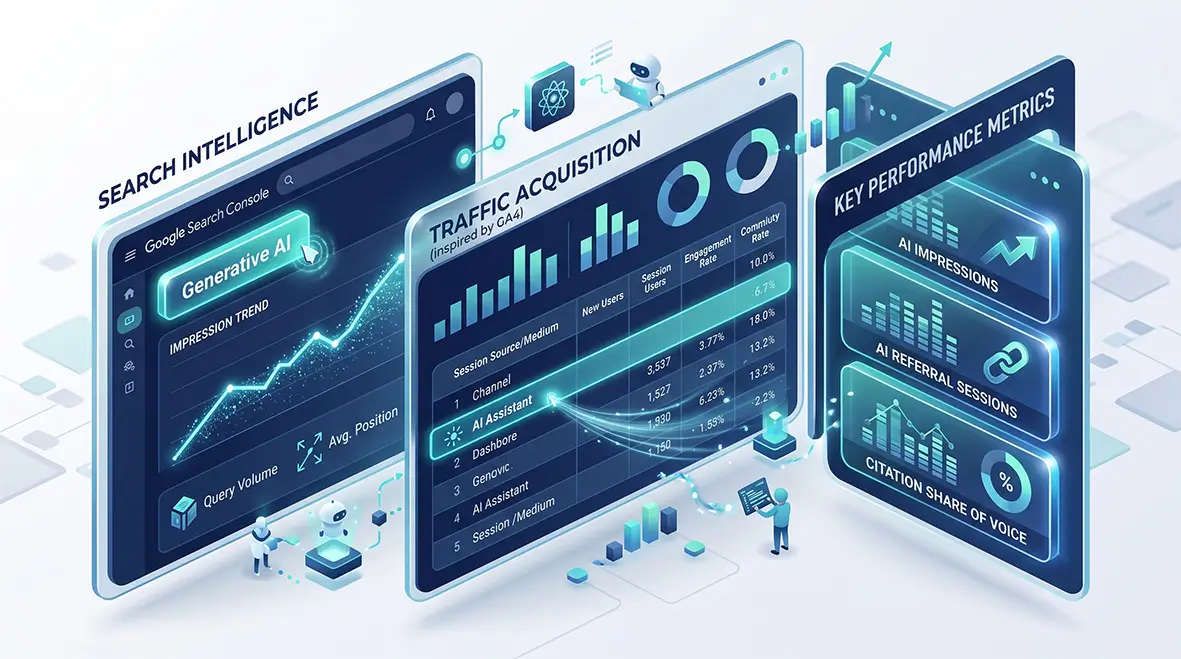
- AI search visibility requires three distinct measurement layers: impressions (GSC), click-through referral sessions (GA4), and citation presence (manual prompt testing or dedicated tools). These measure different things and all three are needed for a complete picture.
- ChatGPT dominates AI referral traffic at ~78% global share (Statcounter, March 2026). Gemini overtook Perplexity as second-largest AI referral source in early 2026. For B2B content specifically, Claude’s share rises to ~18% of measurable B2B AI referrals.
For most of 2025 and early 2026, measuring AI search visibility meant manual prompt testing, referral traffic archaeology in GA4, and a lot of educated guessing. That measurement gap has started to close — specifically in the six weeks before this article’s publication date.
On May 13, 2026, Google added a native AI Assistant channel to GA4’s default channel groups, automatically capturing traffic from ChatGPT, Gemini, and Claude (but only those three).[6] On June 3, 2026, Google launched dedicated Generative AI performance reports in Search Console, giving site owners their first isolated view of AI Overview and AI Mode impressions — though without clicks or queries yet.[1]
Despite these advances, Conductor’s November 2025 study found that 89% of brands could not properly attribute AI referral traffic.[9] Even with perfect GA4 configuration, a significant share of AI-driven visits remain invisible due to referrer stripping in mobile apps and privacy browsers. This guide explains what you can measure, how to measure it, and what you need to accept you can’t measure with current tooling.
💬 According to EverydayOnAI
The most important framing for this entire guide: AI visibility and AI referral traffic are different metrics measuring different phenomena, and conflating them is the source of most reporting confusion we see. Your GA4 AI traffic number tells you how many people clicked through from an AI citation. Your GSC AI impressions number tells you how many times your page appeared in an AI answer. Neither tells you whether your brand is actually being recommended by ChatGPT, Perplexity, or Claude for queries where no one clicks — which is where most AI influence on brand discovery actually happens. A complete AI measurement program requires all three layers, and each has different setup requirements and different reporting implications.
📋 Table of Contents
- Who Should Read This?~ 1 min
- The Three Measurement Layers of AI Search Visibility~ 3 min
- The Numbers: AI Traffic Scale and Platform Share (June 2026)~ 3 min
- Layer 1: Google Search Console — Generative AI Performance Reports~ 4 min
- Layer 2: GA4 — Native Channel + Custom Regex Setup~ 6 min
- Dark AI Traffic: The Attribution Gap You Can’t Fully Close~ 3 min
- Layer 3: Citation Tracking — Visibility Without Clicks~ 4 min
- The Three-Metric AI Visibility Dashboard~ 3 min
- Before & After: Flying Blind vs. Complete AI Measurement~ 2 min
- Tool: AI Tracking Setup Readiness Check~ 2 min
- Frequently Asked Questions~ 2 min
- Google Search Central, “AI Features and Your Website,” last updated December 2025. Google states that SEO best practices remain relevant for AI Overviews and AI Mode, that there are no additional technical requirements beyond Search eligibility and snippets, and that AI features may use query fan-out. developers.google.com
- OpenAI Help Center, “ChatGPT Search,” updated June 2026. ChatGPT Search can search the web, may rewrite a user request into targeted searches, and can show inline citations or a Sources panel when web search is used. help.openai.com
The Three Measurement Layers of AI Search Visibility
AI search visibility is not a single number — it’s three distinct phenomena that require three different measurement approaches. Treating them as the same metric produces misleading conclusions about whether GEO content work is paying off.
| Layer | What It Measures | Tool | What It Misses |
|---|---|---|---|
| 1. AI Impressions | How often your page appears in Google AI-generated answers — regardless of click | Google Search Console (new Generative AI report, June 3, 2026) | Non-Google AI engines (ChatGPT, Perplexity, Claude, Gemini in standalone mode) |
| 2. AI Referral Traffic | Sessions where a user clicked a link from an AI platform to your site | GA4 native AI Assistant channel (May 13, 2026) + custom regex | Sessions where referrer was stripped (dark AI); non-click AI influence on brand discovery |
| 3. Citation Presence | Whether your brand appears in AI-generated answers across all engines, cited or mentioned | Manual prompt testing; Ahrefs Brand Radar, Profound, SEOcrawl AI Tracker | Quantitative click/traffic data; impressions not generated from live user queries |
The diagnostic relationship between these three layers produces specific insights. High impressions (GSC) but low GA4 AI referral traffic suggests your content appears in AI answers but the AI summary fully satisfies user intent — no click needed. The optimization response: create more content that requires a click (deep guides, tools, calculators) rather than informational content that can be fully summarized. High GA4 AI referral traffic but low citation presence (from manual testing) suggests your brand benefits from incidental AI citations — you’re getting cited without deliberate GEO work, which means systematic optimization could multiply the return. Citations rising but GA4 flat suggests the cited page preview (title, meta description, OG image) isn’t compelling enough to drive clicks from users who saw the citation.[10]
📋 Section Summary
- Three measurement layers address three different phenomena: impressions (how often you appear), referral clicks (how many people click through), and citation presence (whether you’re mentioned at all across engines).
- Each layer is incomplete alone — all three together enable diagnostic attribution that individual layers can’t provide.
- The diagnostic combinations (high impressions + low clicks = intent fully satisfied; citations rising + traffic flat = preview problem) are actionable optimization signals unavailable from any single measurement layer.
The Numbers: AI Traffic Scale and Platform Share (June 2026)
78.16%
ChatGPT share of all AI referral traffic globally (Statcounter, March 2026)[8]
8.65%
Gemini share — overtook Perplexity as second-largest AI referral source in early 2026[8]
89%
of brands cannot properly attribute AI referral traffic (Conductor, November 2025)[9]
1-3%
of total website traffic from AI referrals for most sites — growing 80%+ year-over-year[11]
4.4×
conversion rate of AI-referred sessions vs standard organic search[8]
300×
more traffic from Google than all AI platforms combined — context for prioritization[12]
Two platform-specific data points worth noting for tracking prioritization. For B2B content, Claude’s share of measurable AI referrals rises to approximately 18% — far above its ~2.91% global average — because Claude skews toward longer research queries that B2B buyers conduct.[8] Separately, Microsoft Bing Webmaster Tools launched an AI Performance dashboard in February 2026, added grounding query-to-page mapping in March, and previewed Citation Share at SEO Week in May — making Bing Webmaster Tools the most advanced dedicated AI reporting tool as of June 2026, ahead of the equivalent Google capabilities.[2]
📋 Section Summary
- ChatGPT dominates AI referral traffic at 78.16% globally, but Gemini has overtaken Perplexity as second-largest in early 2026 — tracking setup must cover all three plus Perplexity and Copilot.
- AI referral traffic is high-quality but small-volume: 1-3% of total traffic for most sites, converting at 4.4x organic search rates, against Google’s 300x larger traffic base.
- Bing Webmaster Tools is ahead of Google in dedicated AI search reporting as of June 2026 — verify Bing indexing and set up Bing Webmaster Tools if not already done (covered in the Perplexity guide).
Layer 1: Google Search Console — Generative AI Performance Reports
On June 3, 2026, Google launched dedicated Generative AI performance reports in Search Console, providing “dedicated views of impressions within generative AI features on Search, such as AI Overviews and AI Mode, as well as generative AI features in Discover.”[1] This is the first structured measurement of Google AI visibility that doesn’t require combining proxy signals.
What the New GSC Report Shows
The Generative AI report provides five dimensions of data:[4]
- Impressions: How often your page URLs appeared within generative AI features in Search and Discover — the core visibility metric
- Pages: Which specific URLs appeared within AI features — essential for identifying your highest-performing GEO content
- Countries: Your AI visibility broken down by country — relevant for international GEO programs
- Devices: Device type distribution for AI appearances in Search results
- Dates: Performance over time with hourly, daily, weekly, and monthly granularity
Critical limitation to communicate to stakeholders: The report shows impressions only — no click data, no CTR, and no query-level data are included in the current release. Google has indicated it will add metrics “over time,” but there is no confirmed timeline for click data.[3] An impression in the Generative AI report tells you that your page appeared in an AI-generated answer — it does not tell you whether any user read the citation, clicked through to your site, or even saw the AI answer.
The AI Content Blocking Toggle
Alongside the performance report, Google is testing a toggle that lets site owners block their content from appearing in AI Overviews, AI Mode, and Discover AI features. Key facts for decision-making: sites that opt out will not receive impressions or traffic from these features; the control does not affect rankings in standard organic search results — Google explicitly states it will not be used as a ranking signal outside AI features; and the toggle is separate from Google-Extended (which controls training data use) and snippet controls (which manage traditional featured snippets).[2]
How to Access the Report
Step 1: Check your property availability
The report is rolling out to a subset of sites, starting with UK-based properties. In Search Console, navigate to Performance → click the “Search type” dropdown. If “Generative AI” appears as an option, your property has access. If not, it hasn’t rolled out to you yet — check monthly for availability.
Step 2: Pull your 90-day AI impression baseline
Once available, immediately export or record your first 90-day AI impression report. This is your baseline — every subsequent optimization effort and content update needs a benchmark to measure against. Segment by page to identify which URLs are already generating AI impressions without deliberate GEO work.
Step 3: Correlate with the standard performance report
This is a breakout, not new data — AI impressions were always included in your overall performance totals. Compare: total impressions before and after the breakout to understand what percentage of your Google search visibility is AI-driven versus traditional blue-link. For most sites, this number will be surprising — AI impressions account for a larger share of total impressions than most teams expected.
Step 4: Study your highest-impression AI pages
Which pages already surface in Google AI answers? Compare their structure, content depth, and format against pages that don’t appear in the AI report. Pages performing well in Google AI Overviews tend to be “structured, specific, and factual. They answer questions directly, use clear headings, and cite verifiable data.” — per Google’s own documentation.[5] Use these as templates for new GEO-optimized content.
📋 Section Summary
- GSC Generative AI report (June 3, 2026) provides impressions by page, country, device, and date — the first isolated Google AI visibility measurement. No clicks or queries yet; both are expected to be added.
- The AI content blocking toggle allows opting out without organic ranking penalty — useful for publishers concerned about zero-click AI answers cannibalizing traffic.
- The immediate action: establish a 90-day AI impression baseline as soon as the report rolls out to your property, then identify your highest-impression pages as GEO content templates.
Layer 2: GA4 — Native Channel + Custom Regex Setup
GA4 is the tool for measuring AI referral click-through traffic — the sessions where a user actually clicked a link from an AI platform and landed on your site. As of mid-2026, this requires a combination of GA4’s new native channel and a custom regex group.
Method 1: GA4 Native AI Assistant Channel (Fastest Setup)
On May 13, 2026, Google added a native “AI Assistant” channel to GA4’s Default Channel Group. Sessions arriving from recognized AI domains are automatically tagged with medium=ai-assistant and filed under “AI Assistant” in Traffic Acquisition reports.[6]
How to check: Reports → Acquisition → Traffic Acquisition → set primary dimension to “Session default channel group.” If “AI Assistant” appears as its own row with traffic data, the native channel is live on your property.
Three limitations to know before relying on the native channel alone:
- It only recognizes three platforms — ChatGPT, Gemini, and Claude. Perplexity and Copilot traffic stays buried in “Referral” unless you add a custom group.[6]
- It is not retroactive — no historical data before May 13, 2026 is reclassified.
- Sessions where the referrer header was stripped by mobile apps or privacy browsers still land in “Direct” regardless of the native channel.
Method 2: Custom Regex Channel Group (Complete Coverage)
The custom regex channel group captures all major AI platforms including Perplexity, Copilot, DeepSeek, Grok, and others that the native channel misses. Setup: GA4 Admin → Data display → Channel groups → create a new channel or edit Default Channel Group → add a condition above “Referral.”
# Source: organikpi.com (updated Q1 2026, covers 99%+ of AI referral traffic)
chatgpt\.com|chat\.openai\.com|perplexity\.ai|claude\.ai|gemini\.google\.com|copilot\.microsoft\.com|deepseek\.com|grok\.com|meta\.ai|you\.com|poe\.com|phind\.com|pi\.ai|character\.ai
Critical setup note: Place this custom AI channel above Referral in the channel ordering. If Referral appears higher in the list, GA4’s sequential matching will route AI traffic to Referral before your custom rule fires, and your AI channel will show zero sessions even though it’s configured correctly.[9]
Validation: After setup, go to GA4 Admin → DebugView. Visit your site by clicking a link from chatgpt.com or perplexity.ai (ask a colleague if needed), then watch the events stream. Check that Session source shows the AI platform domain. This catches 90% of configuration errors before they corrupt your reporting history.[9]
Building the GA4 AI Exploration
Beyond the default reports, an Explorations dashboard gives you the drill-down data that informs optimization decisions. Go to Explore → Free-form in GA4, then:
- Dimensions: Session source, Landing page, Country, Device category
- Metrics: Sessions, Engaged sessions, Average engagement time, Conversions
- Filter: Session source contains the AI regex pattern above
- Pivot by Landing page to identify which content earns the most AI-referred visits and whether those visits engage at the expected 4.4x rate vs organic
Save this Exploration and share the link with your team. Rebuild the comparison monthly — the GA4 AI traffic distribution shifts as platforms grow and new referrer patterns emerge. Trakkr.ai publishes an updated domain list daily based on 1,429+ GA4 properties; review and update your regex quarterly.[11]
📋 Section Summary
- The native GA4 AI Assistant channel (May 13, 2026) provides zero-configuration ChatGPT/Gemini/Claude tracking — check Traffic Acquisition for the “AI Assistant” row immediately.
- The custom regex channel is required for Perplexity, Copilot, and emerging platforms — must be placed above Referral in channel ordering or it won’t fire.
- GA4 captures only click-through sessions with intact referrer headers — treat the numbers as a minimum baseline, not a complete AI audience count.
Dark AI Traffic: The Attribution Gap You Can’t Fully Close
Even with perfect GA4 configuration and the new GSC Generative AI report, a significant share of AI-driven influence remains unmeasured. This is “dark AI traffic” — and understanding its scale prevents over-reliance on GA4 numbers as a complete measure of AI channel performance.
Dark AI traffic arises from three mechanisms:
Mechanism 1: Referrer stripping. When a user clicks a link inside a ChatGPT or Perplexity mobile app, the app’s link-handling behavior often strips the referrer header before the request reaches your server. GA4 never sees the source and logs the session as Direct. The same happens with privacy-focused browsers (Brave, Firefox Enhanced Tracking Protection) that strip cross-site referrers by default.[9]
Mechanism 2: AI summarization without citation links. When ChatGPT, Perplexity, or Gemini synthesizes your content into an answer without including a clickable link, users who see and act on that information may search your brand directly (branded search lift) or navigate to your site directly — but GA4 records the session as Direct and has no connection to the AI answer that prompted the visit.
Mechanism 3: Non-click AI influence. Brand discovery through AI answers frequently doesn’t generate an immediate click — a user asks ChatGPT for a recommendation, receives your brand name as an answer, and searches your brand on Google a day later. The Google organic click that follows is correctly attributed to organic search, but the source of the brand consideration was the AI answer that GA4 will never see.
The practical implication: branded search volume trends are a proxy indicator for dark AI traffic and non-click AI influence. A rising trend in branded searches that doesn’t correlate with direct content marketing campaigns or paid brand awareness activity may indicate growing AI recommendation volume. This is one reason why brand search volume monitoring is part of a complete AI visibility measurement program even when it looks like a traditional SEO metric.
💬 According to EverydayOnAI
The dark AI traffic reality is worth building into stakeholder expectations before reporting season rather than discovering during it. If your GA4 AI channel shows 500 sessions per month and your GEO team tells leadership that AI is driving 500 monthly visitors, the real number is almost certainly a multiple of that — accounting for stripped referrers, non-click influence, and the branded search lift that follows AI recommendations. We’d suggest presenting AI channel data to leadership with an explicit “minimum baseline” label and a separate branded search trend chart alongside it. Together, they tell a more accurate story than GA4 AI referrals alone — even though neither number is exact.
Layer 3: Citation Tracking — Visibility Without Clicks
GA4 measures the trailing indicator (clicks that reached your site). Citation tracking measures the leading indicator (whether your brand is mentioned in AI answers, regardless of clicks). Both are necessary. Citation tracking answers the question that GA4 cannot: “Is our content being cited for the queries that matter to our business?”
Manual Prompt Testing (Free, Immediate)
The baseline citation tracking methodology: define a set of 15-30 queries that matter to your business — covering your core products, use cases, comparisons, and alternatives — and run them through ChatGPT, Perplexity, Gemini, and Claude on a defined cadence (monthly or quarterly). Record: which platforms cite you, which queries trigger citations, which competitors appear alongside you, and what context your brand appears in (recommended, contrasted, cautioned against).
The share of voice metric that matters most for competitive benchmarking: your brand mentions as a percentage of total brand mentions for your tracked prompt set across all platforms and all competitors. This is the metric SEOcrawl calls “Prompt Tracking” — running the same prompt set for your brand and competitors simultaneously to reveal which prompts competitors win and which represent citation opportunities.[13]
Dedicated AI Citation Tracking Tools
Ahrefs Brand Radar (launched March 2025) tracks brand mentions across six AI indexes: Google AI Overviews, AI Mode, ChatGPT, Perplexity, Gemini, and Microsoft Copilot — using prompts derived from real search behavior rather than manually selected queries.[14] This is the closest available approximation to population-scale AI citation measurement, rather than sample-based manual testing.
Profound (680 million citation dataset, the largest published AI citation research base) provides citation share tracking at enterprise scale. Its data underlies several of the citation statistics cited elsewhere in this AI SEO Hub.[14]
SEOcrawl AI Tracker surfaces per-source AI citation breakdowns and competitor share of voice in a single dashboard, with a prompt tracking feature that maps citation share against a defined query set rather than relying on Ahrefs’ real-search-behavior sample.
For most teams starting AI visibility measurement, the sequencing is: manual prompt testing first (free, immediate, directional) → Google Search Console Generative AI report (impressions, platform-native) → GA4 custom channel setup (referral clicks) → dedicated tool when budget allows and the measurement program matures enough to need at-scale citation tracking.
📋 Section Summary
- Citation tracking addresses what GA4 and GSC cannot: whether your brand is mentioned in AI answers for queries that matter, independent of whether any user clicks.
- Manual prompt testing (15-30 priority queries, monthly cadence, across ChatGPT/Perplexity/Gemini/Claude) provides the baseline; dedicated tools (Ahrefs Brand Radar, Profound, SEOcrawl) provide scale and automation.
- Share of voice (your citations as a percentage of all brand citations for a defined query set) is the competitive citation metric that manual testing and dedicated tools both produce — the number that tells you whether GEO optimization is moving the needle against competitors.
The Three-Metric AI Visibility Dashboard
For leadership reporting, three metrics compress the three-layer measurement system into a board-readable summary. The discipline is simplicity — too many AI visibility metrics produce confusion rather than direction.
| Metric | Source | Cadence | What It Signals |
|---|---|---|---|
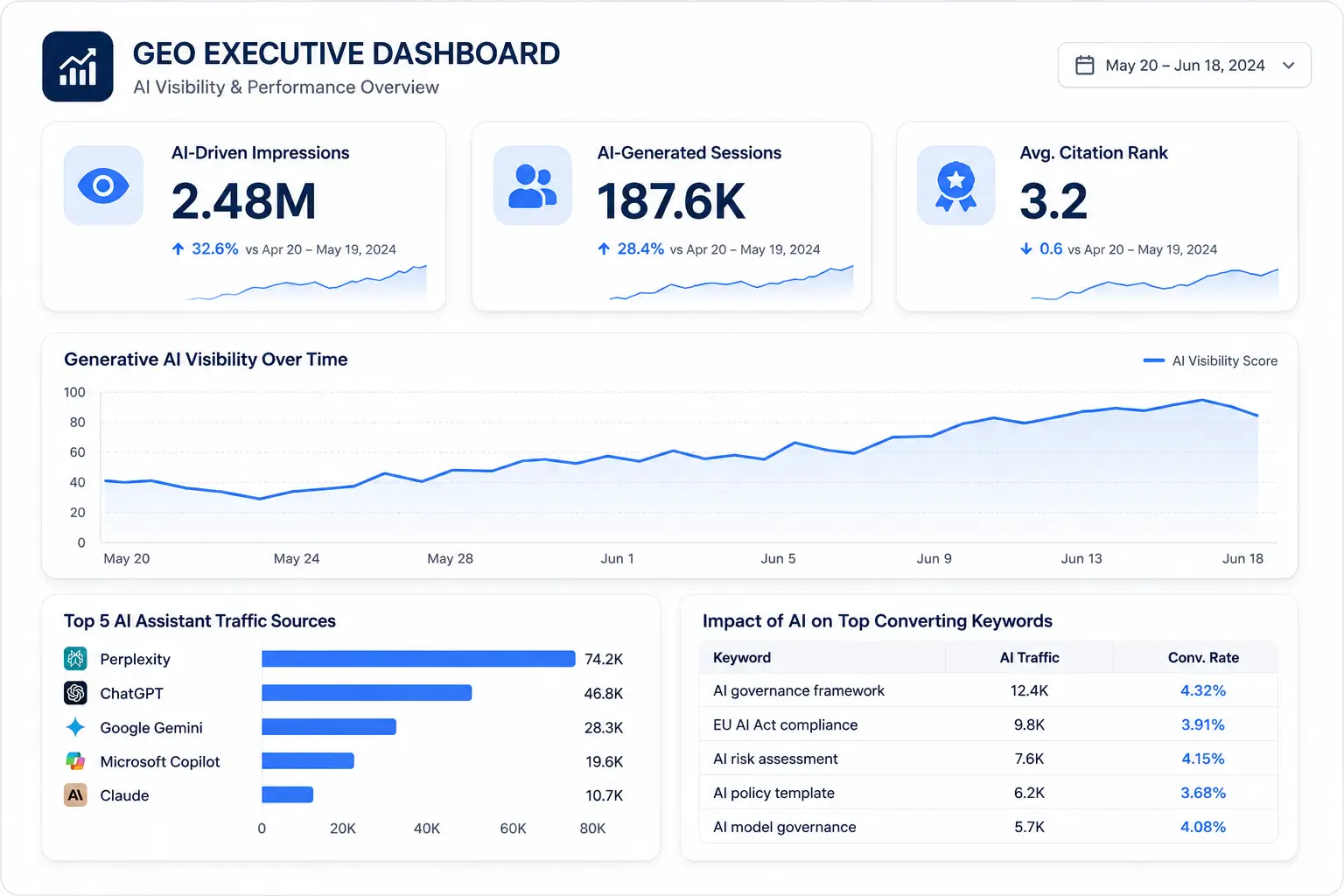
| AI Impressions (MoM trend) | GSC Generative AI report | Monthly | Whether GEO content changes are increasing Google AI visibility — the leading indicator for Google specifically |
| AI Referral Sessions (MoM trend) | GA4 AI channel (native + custom) | Monthly | Traffic conversion of AI citations into actual site visits — the revenue-connected indicator |
| Citation Share of Voice (%) | Manual prompt testing or citation tools | Quarterly | Competitive position in AI answers for priority queries — the strategic visibility metric |
Supplementary metrics worth tracking internally but not reporting as leadership KPIs: branded search volume trend (proxy for dark AI traffic and non-click influence), AI referral conversion rate vs organic (validates the 4.4x quality premium), and page-level AI impressions from GSC (identifies which content to use as GEO templates).[10]
Before & After: Flying Blind vs. Complete AI Measurement
✖ No AI Measurement Setup
AI traffic shows as “Direct” and “Referral” in GA4, indistinguishable from other sources. The marketing team knows AI search is important but cannot demonstrate any attribution to the CEO. When GEO content work increases AI citations, there’s no measurement to show it worked. Board asks: “What’s our return on the GEO content investment?” No one can answer.
✔ Complete Three-Layer Setup
AI Assistant channel and custom regex in GA4 show ChatGPT driving 312 sessions/month at 14.2% conversion vs 2.8% organic. GSC Generative AI report shows 4,200 AI impressions, trending up 28% MoM after recent GEO content updates. Quarterly prompt testing shows citation share of voice at 11% vs competitor at 8%. GEO investment is demonstrably working and the board has the numbers to verify it.
Tool: AI Tracking Setup Readiness Check
🎯 Interactive Tool
AI Tracking Setup Readiness Check
Check every item currently set up for your site. Based on the three-layer tracking system in this guide.
This is a self-assessment of tracking setup completeness. A complete setup doesn’t guarantee accurate measurement — the dark AI traffic attribution gap described in Section 5 exists regardless of how comprehensively you’ve set up tracking.
Frequently Asked Questions
How do I track AI search visibility in Google Search Console?
Via the new Generative AI performance report, launched June 3, 2026. Navigate to Search Console → Performance → check if “Search type: Generative AI” appears in the filter dropdown. If it does, you have access to impressions broken down by page, country, device, and date. If it doesn’t, the report hasn’t rolled out to your property yet — check monthly. Important: the report shows impressions only; no click, CTR, or query-level data is included in the current release.[1]
How do I track ChatGPT and Perplexity traffic in GA4?
Two methods: native channel (ChatGPT, Gemini, Claude) + custom regex (everything else). Check Traffic Acquisition → Session default channel group for an “AI Assistant” row — if it’s there, ChatGPT/Gemini/Claude tracking is already active. Add a custom regex channel group above Referral to capture Perplexity, Copilot, DeepSeek, and emerging platforms:chatgpt\.com|chat\.openai\.com|perplexity\.ai|claude\.ai|gemini\.google\.com|copilot\.microsoft\.com|deepseek\.com|grok\.com
What is ‘dark AI traffic’ and how much does it account for?
AI-driven website visits where the referrer header is stripped before GA4 can capture it. Occurs in AI mobile apps, privacy-focused browsers (Brave, Firefox), and when AI platforms synthesize content without including clickable links. 89% of brands couldn’t properly attribute AI referral traffic even with active tracking (Conductor, November 2025).[9] Treat GA4 AI traffic as a minimum baseline; use branded search volume trends as a proxy for total dark AI traffic and non-click influence.
What is the difference between AI impressions and AI referral traffic?
Impressions measure visibility; referral traffic measures click-through. AI impressions (GSC) = how many times your page appeared in an AI-generated Google answer, regardless of clicks. AI referral traffic (GA4) = sessions where a user clicked from an AI platform to your site. Neither captures brand mentions that never generate a click — that requires citation tracking via manual prompt testing or tools like Ahrefs Brand Radar or Profound. All three are needed for a complete picture.[10]
Which AI platform sends the most referral traffic?
ChatGPT at ~78% of global AI referral traffic (Statcounter, March 2026). Gemini overtook Perplexity as second-largest in early 2026 (8.65% vs Perplexity’s 6-15% depending on methodology). For B2B content, Claude’s share rises to ~18% of measurable B2B AI referrals. AI referral traffic accounts for 1-3% of total website traffic for most sites — growing 80%+ year-over-year — while Google still sends approximately 300x more total traffic than all AI platforms combined.[8]
📚 Complete AI SEO Hub on EverydayOnAI
Download the AI Visibility Tracking Setup Template
GA4 custom channel regex (updated mid-2026), GSC Generative AI report setup checklist, manual citation testing worksheet (30 priority queries + tracking sheet), and the three-metric dashboard template for leadership reporting.
📚 References and Sources
- Google Search Central Blog, “Introducing Search Generative AI performance reports in Search Console,” June 3, 2026. Official announcement of dedicated Generative AI report in GSC; impressions by page/country/device/date; rollout to subset of UK sites first. developers.google.com
- Search Engine Journal, “Google Tests Dedicated AI Search Reports In Search Console,” June 2026. AI content blocking toggle description; does not affect organic rankings; Microsoft moved faster on AI reporting; Bing AI Performance dashboard timeline (February, March, May 2026). searchenginejournal.com
- PikaSEO, “Google Search Console Finally Shows Your AI Overviews & AI Mode Impressions,” June 2026. “Reports show impressions only — no click, CTR, or query data yet”; Google promised more metrics “over time”; clicks arrival expected first. pikaseo.com
- Weblumino, “Search Generative AI Performance Reports in Search Console: 2026 SEO Guide.” Five report dimensions (impressions, pages, countries, devices, dates); AI impression baseline workflow; AI content blocking toggle details; does not affect standard organic ranking signal. weblumino.com
- i-engage.in, “Google Search Console Now Tracks Your AI Search Visibility,” June 2026. “Content that performs well in AI Overviews tends to be structured, specific, and factual”; practical workflow for new GSC AI report. i-engage.in
- Access Newswire / GA4 guide, “How to Track AI Traffic in GA4 (ChatGPT, Gemini, Claude, Perplexity & Copilot),” June 4, 2026. GA4 native AI Assistant channel launched May 13, 2026; medium=ai-assistant; recognizes only ChatGPT, Gemini, Claude; not retroactive; Perplexity stays in Referral without custom group. accessnewswire.com
- Organikpi, “Track AI Search Referrals in GA4: ChatGPT & Gemini,” 2026. Production-ready regex covering 99%+ of AI referral traffic; channel ordering critical (AI must precede Referral); ChatGPT 77.97%, Perplexity 15.10%, Gemini 6.40% by SE Ranking late-2025 measurement; custom channel not retroactive. organikpi.com
- AuthorityTech, “How to Track AI Traffic in GA4: Full 2026 Setup Guide.” ChatGPT 78.16% of global AI referral traffic (Statcounter, March 2026); Gemini 8.65% overtook Perplexity; Claude 2.91% global / ~18% B2B (Goodie 2026 AI Search Traffic Report); AI sessions convert at 4.4x organic search; 80%+ YoY AI-assisted session growth. authoritytech.io
- Discovered Labs, “How to Track ChatGPT, Perplexity, and AI Overviews Traffic in GA4 (Without Guessing),” December 2025. 89% of brands cannot properly attribute AI referral traffic (Conductor, November 2025); dark AI traffic mechanisms (mobile app referrer stripping); DebugView validation process; three GA4 attribution failure modes; channel ordering requirement. discoveredlabs.com
- Solvspot, “GA4 → AI search attribution: tracking ChatGPT and Perplexity referrals correctly,” April 30, 2026. Citations rising + GA4 flat = preview metadata problem; leading vs lagging indicator model for citation + clicks; stacked area chart for AI referral source breakdown; Claude attribution gap (“dark AI”). solvspot.com
- Trakkr.ai, AI Search Traffic Index, 2026 (1,429 anonymized GA4 properties, updated daily). AI referrals 0.5-3% of total traffic for most sites; ChatGPT 60-70% share; Perplexity 12-18%; Gemini growing fastest Q4 2025; updated domain regex published daily. trakkr.ai
- 1ClickReport, “How to Track ChatGPT & AI Traffic in GA4 [5-Min Setup],” March 31, 2026. AI referral traffic growing 165x faster than organic search; Google sends ~300x more traffic than AI platforms combined; AI converts at 15.9% vs Google 1.76%; AI accounts for 1.08% of all web traffic; ChatGPT appends utm_source=chatgpt.com to citation links. 1clickreport.com
- SEOcrawl, “How to Track AI Visibility: 5 Steps for 2026.” Share of voice metric definition; Prompt Tracking feature for competitor comparison; Google AI Overviews triggered on ~30% of US queries (SE Ranking 2026); B2B prioritization (ChatGPT + AI Overviews first). seocrawl.ai
- TechTimes 2026, citing Ahrefs Brand Radar (launched March 2025): tracks brand mentions across six AI indexes. Profound 680M citation dataset as measurement foundation for AI citation research. techtimes.com
Sources verified June 22, 2026. GSC Generative AI report is in staged rollout — availability dates and metric additions may differ from what’s documented here as rollout expands. GA4 AI Assistant channel platform list may be updated by Google without announcement; review quarterly.
Share this article