Top 8 AI Governance Tools and Platforms to Watch in 2026–2027

📌 Key Takeaways
- Organizations using AI governance tools achieve 12x more AI projects in production compared to those without governance infrastructure (Databricks, 2026 State of AI Agents, 20,000+ organizations) — governance is a production enabler, not an obstacle.
- 72% of enterprise buyers now screen for ISO 42001 during AI vendor procurement, making governance platform selection consequential for commercial positioning as well as compliance.
- The most common 2026 enterprise pattern is a two-tier selection: a governance system-of-record (ModelOp, Credo AI, IBM Watsonx.governance) for inventory and compliance documentation + a monitoring specialist (Fiddler AI, Arthur AI) for production observability. These capabilities are complementary, not substitutes.
- The eight platforms covered differ most significantly in three dimensions: regulatory documentation depth (EU AI Act Annex IV automation), AI type coverage (ML vs. LLM vs. agentic vs. third-party), and integration breadth (MLOps pipeline depth vs. governance-focused integration set).
- This guide is editorially independent and not sponsored by any vendor. Pricing changes frequently — verify with vendors directly before procurement decisions.
Three years ago, “AI governance tool” typically meant a homegrown model card template and a compliance spreadsheet. Today it means a purpose-built enterprise software category with meaningful vendor differentiation, institutional demand driven by EU AI Act and OMB M-24-10 compliance pressure, and pricing tiers that reflect regulated-industry urgency.
The market data tells a stark commercial story: organizations using AI governance tools achieve 12x more AI projects in production compared to those without, per Databricks’ analysis of 20,000+ global organizations.[new1] The 88% failure rate of ungoverned agentic AI programs is the denominator; governance tooling is what separates the 12% capturing the median 171% ROI from the 88% absorbing deployment costs without production returns.[new2]
The market has not fully consolidated. Meaningful differences exist between platforms in compliance documentation depth, bias monitoring granularity, MLOps integration breadth, and agentic AI support. A financial services firm needing EU AI Act Annex IV documentation and continuous bias drift monitoring needs a different platform than an ML engineering team embedding governance in a CI/CD pipeline.
💬 According to EverydayOnAI
The tool selection conversation in 2026 has a hidden first question that most organizations skip: “What governance process are we trying to support?” A governance platform selected before the governance process is designed will either be under-utilized (if the process doesn’t use its capabilities) or will define the process by default (if teams build around what the tool does rather than what governance requires). Read the pillar article and the committee guide before platform selection — the governance requirements those define should drive the vendor evaluation, not vice versa.
This guide covers eight platforms appearing most consistently in 2026 enterprise selection processes — strengths, limitations, pricing transparency where available, and specific use cases where each is the strongest fit. Editorially independent — not sponsored by any vendor.
This article is part of our Enterprise AI Governance Implementation Series.
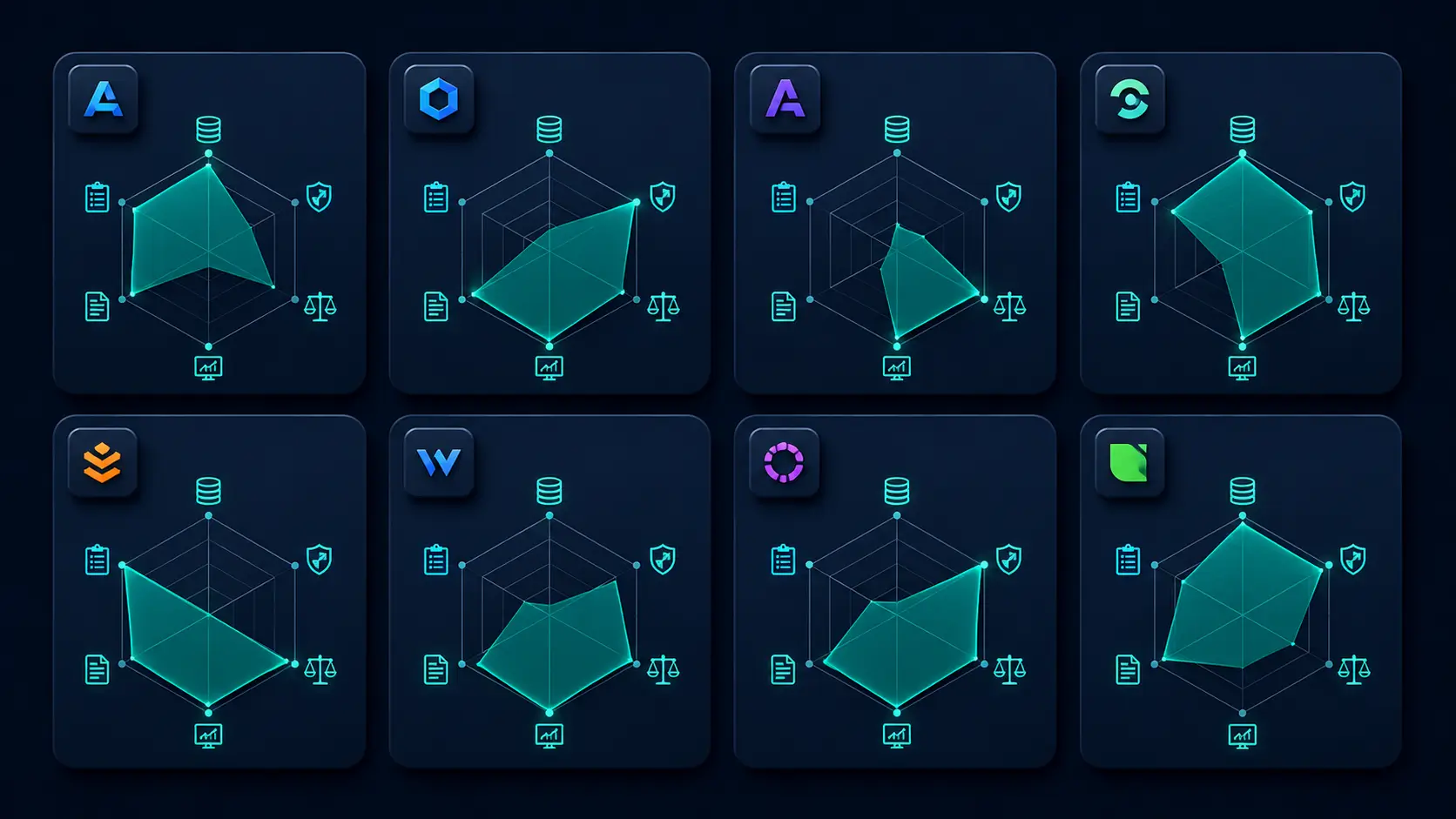
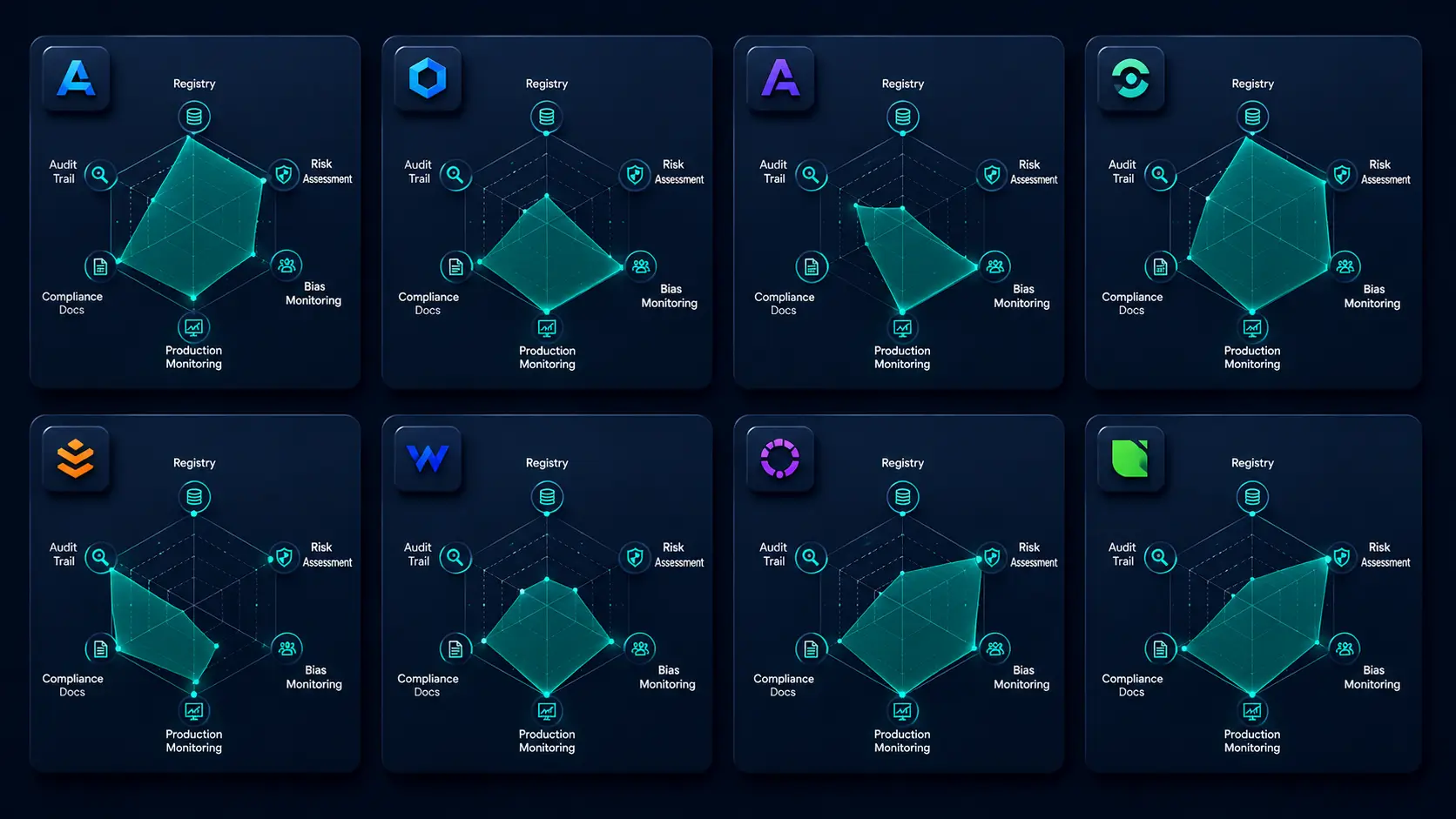
Six Core Capabilities Every Platform Needs
“Governance tooling should be embedded into AI pipelines, not bolted on after deployment. The most dangerous governance gap isn’t a missing tool — it’s a tool that governance teams use but engineering teams never see.”
— Atlan, “7 Top AI Governance Tools for 2026,” December 2025[1]
Evaluating vendors against all six core capabilities prevents selection conversations from being dominated by any single vendor’s strongest feature at the expense of capabilities your program actually needs.
1. AI model registry. A centralized, authoritative inventory of all AI systems — traditional ML, LLMs, agentic AI, and third-party AI embedded in purchased software. Captures governance-relevant metadata: purpose, risk classification, owner, training data provenance, performance metrics, approval status. This is the system of record against which compliance is measured. Without it, governance operates on an incomplete inventory by definition.
2. Risk assessment and intake workflows. Structured pre-deployment evaluation covering risk scoring, fairness assessment, impact assessment, and approval routing — producing documented evidence of the review process, not just a decision. The AI governance committee’s approval decisions should feed directly into the platform’s intake system.
3. Bias and fairness monitoring. Continuous computation of demographic performance metrics in production — not just at deployment. Includes alerting when bias drift crosses defined thresholds, support for multiple fairness metric definitions (demographic parity, equal opportunity, equalized odds, calibration), and report generation aligned with EU AI Act Annex IV requirements. See our Algorithmic Bias Audit guide for the methodology these tools implement.
4. Performance and drift monitoring. Real-time tracking of model accuracy, data drift, and behavioral anomalies. Includes statistical significance testing, configurable alerting thresholds, and dashboards accessible to both technical and non-technical governance stakeholders.
5. Compliance documentation generation. Automated production of governance artifacts — model cards, risk assessments, impact assessments, audit reports — in formats aligned with regulatory requirements (EU AI Act Annex IV, ISO 42001, NIST AI RMF). Following the May 2026 EU AI Act omnibus, most Annex III high-risk obligations now apply December 2, 2027, giving organizations additional time to implement platforms with Annex IV documentation capabilities.
6. Audit trail and evidence management. Continuous, tamper-resistant logging of governance decisions, performance data, bias metrics, human review decisions, and incident responses — accessible for audit response without manual compilation. The difference between a one-week audit response and a four-week audit response is typically the presence or absence of automated audit trail infrastructure.
📋 Section Summary
- Six capabilities form the complete platform baseline: model registry, risk assessment workflows, bias/fairness monitoring, performance/drift monitoring, compliance documentation generation, and audit trail management.
- Organizations should evaluate all six against their governance program requirements — not just the capabilities any single vendor markets most prominently.
- Compliance documentation (item 5) is where platforms differentiate most significantly from manual processes; audit trail (item 6) is what determines audit response time when regulators ask for evidence.
All 8 Platforms at a Glance
| Platform | Best For | Pricing Model | EU AI Act | Agentic AI |
|---|---|---|---|---|
| ModelOp | Enterprise system-of-record; complex AI ecosystems | Enterprise contract | Yes | Yes (explicit) |
| Credo AI | Regulatory compliance documentation; regulated industries | Contract / AWS Marketplace | Strong — policy packs | Yes (agentic risk) |
| IBM Watsonx.governance | IBM ecosystem; large enterprise | IBM enterprise licensing | Yes — automated checks | In development |
| Fiddler AI | Production monitoring; LLM/ML observability | Plan-based; SaaS + on-prem | Fairness + explainability | LLM Trust Service |
| Arthur AI | LLM guardrails; real-time evaluation | Freemium + Enterprise | Bias + performance | Yes (active guardrails) |
| Holistic AI | EU AI Act classification; shadow AI detection | Enterprise contract | Strongest EU focus | Shadow AI detection |
| Monitaur | Regulated industry evidence programs | SaaS subscription | Policy-to-proof structure | Developing |
| DataRobot | Integrated MLOps + governance; predictive AI | SaaS + on-premises | Compliance workflows | Agents + LLMs |
ModelOp — Best Enterprise System-of-Record
ModelOp Center
EnterpriseCompliance
ModelOp is purpose-built for enterprises managing complex AI ecosystems — traditional ML models, generative AI, agentic AI, and third-party AI solutions across their full lifecycle. Its core value: a centralized AI governance system-of-record that integrates with existing enterprise tools rather than requiring teams to change how they work.[2]
Key differentiators: automated governance inventory agnostic across AI types (not limited to models from specific ML platforms), policy enforcement workflows that apply governance controls without disrupting MLOps operations, 50+ enterprise-ready integrations, and executive dashboard reporting that aggregates AI portfolio risk in board-reportable formats.[3] For ISO 42001 certification programs, ModelOp’s system-of-record architecture generates the model registry and audit trail artifacts that represent the most labor-intensive documentation work in a typical certification engagement.
Strengths: Broadest AI type coverage (ML, GenAI, agents, third-party); 50+ integrations; automated governance workflow management; explicit agentic AI support; executive and board reporting dashboards. Limitations: Enterprise contract pricing only; implementation complexity requires dedicated resources; overkill for small AI portfolios.
Best for: Enterprises with 20+ AI systems across multiple business units; organizations needing a governance system-of-record that spans ML, GenAI, and agentic AI; ISO 42001 certification programs requiring comprehensive model inventory and audit trail.
Credo AI — Best for Regulatory Compliance Documentation
Credo AI
ComplianceEnterprise
Credo AI is built specifically around the compliance use case — aligning AI governance with regulatory frameworks and producing audit-ready artifacts that demonstrate compliance. Its policy packs — pre-built governance requirement sets aligned with EU AI Act, NIST AI RMF, and ISO 42001 — are a significant differentiator for organizations that need framework alignment without building requirements from scratch.[4]
Credo AI also manages agentic AI and model-specific risks while automating compliance with specific laws — covering the emerging agentic governance challenge that most compliance-focused platforms are still developing.[1] Its vendor risk management capability — tracking and assessing third-party AI vendors’ compliance posture — addresses a significant governance gap most platforms don’t cover at all.
Strengths: Policy packs for EU AI Act, NIST AI RMF, ISO 42001; automated governance artifact generation (model cards, impact assessments, audit reports); strong third-party vendor risk management; integrates with Snowflake, Databricks. Limitations: Steep learning curve; too enterprise-focused for smaller organizations; less strong on real-time production monitoring vs. compliance documentation; contract-based pricing only.
Best for: Regulated industries (banking, insurance, healthcare) where compliance documentation drives governance; EU AI Act Annex IV conformity assessment or ISO 42001 certification programs; enterprises governing third-party AI vendor risk alongside internal AI.
IBM Watsonx.governance — Best for IBM Ecosystem
IBM Watsonx.governance
EnterpriseComplianceMonitoring
IBM Watsonx.governance provides enterprise-grade AI governance with automated fairness checks, explainability, and drift detection — the combination directly supporting EU AI Act Article 10 bias management and Annex IV documentation. As part of the broader IBM Watsonx platform, it has deep integration with IBM’s data and AI stack, making it the natural choice for IBM-committed enterprise environments.
Its fairness monitoring provides automated demographic performance analysis — computing disaggregated metrics and alerting when disparate impact crosses defined thresholds. Its explainability features produce local and global model explanations supporting both EU AI Act Article 14 human oversight requirements and GDPR Article 22 explanation obligations.
Strengths: Mature automated fairness checks and explainability; deep IBM ecosystem integration; strong EU AI Act alignment documentation; enterprise-grade reliability and support. Limitations: Best value in IBM ecosystem — less optimal for AWS/Azure-primary organizations; IBM enterprise licensing discussions required; implementation complexity without IBM expertise.
Best for: Enterprises using IBM Cloud, Watson, or Cloud Pak for Data; organizations needing proven enterprise-supported automated fairness and explainability; large enterprises with complex model portfolios and multi-cloud deployments.
Fiddler AI — Best for Production Monitoring
Fiddler AI
MonitoringFairness
Fiddler AI is the production monitoring specialist — real-time AI observability, bias detection, drift monitoring, and explainability for deployed ML and LLM systems. Its Fiddler Trust Service adds guardrails and real-time output monitoring for generative AI, making it one of the few platforms with meaningful coverage for both traditional ML and LLM production systems.[5]
Fiddler’s explainability capabilities are particularly strong for organizations subject to GDPR Article 22 and EU AI Act Article 14 requirements — providing case-level explanations in human-understandable terms. Integrations include Amazon SageMaker, Snowflake, Datadog, NVIDIA NIM, and Slack.
Strengths: Best-in-class real-time bias detection and fairness monitoring; strong case-level explainability; LLM Trust Service for generative AI; broad integrations. Limitations: More observability tool than full governance platform — weaker on compliance documentation; enterprise pricing prohibitive for smaller organizations; complex onboarding for organizations without ML infrastructure.
Best for: Organizations with existing deployed ML and LLM systems needing production-grade monitoring; financial services, healthcare, and telecom organizations where continuous bias monitoring is a regulatory requirement; teams needing case-level explainability for regulatory or operational purposes.
Arthur AI — Best for LLM Guardrails
Arthur AI
MonitoringOpen Source Engine
Arthur AI recently open-sourced its real-time AI evaluation engine — providing active guardrails that prevent harmful LLM outputs, customizable evaluation metrics, and on-premises deployment for data-privacy-sensitive environments. It supports generative models (GPT, Claude, Gemini) and traditional ML models.[6]
Arthur’s open-source engine gives engineering-focused governance teams customization depth that commercial-only platforms don’t provide. The on-premises option addresses data residency requirements for regulated industries with strict data sovereignty rules. The free tier makes initial evaluation accessible without procurement overhead.
Strengths: Open-source engine enables deep customization; active LLM guardrails for harmful output prevention; on-premises deployment option; real-time drift and explainability; accessible free tier. Limitations: Smaller feature set in free tier; better for model-centric teams than full compliance program management; less comprehensive compliance documentation than Credo AI or ModelOp.
Best for: Engineering-focused governance programs needing customizable evaluation metrics; organizations deploying LLMs in production needing active output guardrails; regulated industries with data sovereignty requirements preventing cloud-only deployment.
Holistic AI — Best for EU AI Act Risk Classification
Holistic AI
ComplianceEnterprise
Holistic AI stands out for its EU AI Act-specific risk classification dashboard — using the Act’s own risk categories to classify AI systems as high (Red), medium (Amber), and low (Green) risk, and tracking regulatory compliance status accordingly. For organizations needing a visual, board-reportable view of their EU AI Act compliance posture, Holistic AI’s dashboard is the clearest implementation available.[1]
Its shadow AI detection — automatically identifying AI model use in scripts and codebases after deployment — addresses the shadow AI discovery problem that is the first challenge in building a complete AI inventory. Combined with extensive LLM auditing (bias induction, sensitive data leakage, hallucinations, toxicity), Holistic AI provides both pre-deployment compliance assurance and post-deployment portfolio visibility.
Strengths: Strongest EU AI Act risk classification implementation; shadow AI detection post-deployment; extensive LLM auditing; PII safety focus in LLMs; end-to-end lifecycle coverage. Limitations: Primarily EU-focused; less emphasis on US-specific regulatory frameworks; enterprise pricing without public transparency; fewer integrations than ModelOp for complex MLOps environments.
Best for: EU-exposed organizations needing EU AI Act risk classification using the Act’s own framework; organizations struggling with shadow AI discovery; enterprises needing LLM-specific auditing for bias, data leakage, and harmful outputs.
Monitaur — Best for Regulated Industry Evidence
Monitaur ML Assurance
ComplianceMonitoring
Monitaur’s distinguishing concept is the “policy-to-proof roadmap” — a governance approach that maps each governance policy to the specific evidence required to demonstrate compliance, then automates collection and organization of that evidence. For regulated industries where regulators ask not just “what is your policy?” but “prove it,” Monitaur’s evidence-centered architecture is a significant operational advantage.[4]
Its SaaS subscription model provides more accessible pricing than enterprise contract-only competitors, making it viable for mid-market regulated industry organizations needing institutional-grade governance evidence without enterprise procurement complexity.
Strengths: Policy-to-proof evidence architecture for regulatory examination; real-time anomaly, bias, and drift management; structured approach for regulated industry audit cycles; SaaS subscription — more accessible pricing. Limitations: Less brand recognition than ModelOp or Credo AI; agentic AI governance developing; fewer out-of-box integrations than ModelOp.
Best for: Financial services, insurance, and healthcare organizations subject to model risk management guidance (SR 11-7, OCC 2011-12, NAIC Model Bulletin); organizations demonstrating governance compliance during regulatory examination; mid-market regulated industry organizations needing institutional-grade governance evidence.
DataRobot AI Governance — Best for Integrated MLOps + Governance
DataRobot AI Governance
EnterpriseMLOps + Governance
DataRobot’s AI governance capabilities are embedded in the broader DataRobot platform — the same platform where models are built and deployed. This integration addresses the “governance bolted on” problem from the Atlan quote at the start of this article: when governance checkpoints are part of the development pipeline rather than a separate compliance layer, engineering teams encounter them naturally rather than as obstacles. DataRobot provides a central hub for all AI assets, related policies, compliance adherence tests, and real-time alerts.[5]
Coverage of predictive models, LLMs, agents, and AI applications within a single platform makes DataRobot one of the most comprehensive single-vendor solutions for organizations seeking to reduce tool complexity.
Strengths: MLOps and governance in a single platform; covers ML, LLMs, agents; governance embedded in development pipeline; SaaS and on-premises options. Limitations: Governance features most powerful when DataRobot is the primary model development platform; less suitable for diverse MLOps stacks; enterprise pricing.
Best for: Organizations using DataRobot as their primary ML/AI development platform; organizations seeking to reduce tool complexity by combining MLOps and governance; financial services organizations needing model risk management integrated with model development.
📋 Section Summary
- The eight platforms have distinct primary strengths: ModelOp (portfolio system-of-record), Credo AI (compliance documentation), IBM Watsonx.governance (IBM ecosystem), Fiddler AI (production monitoring), Arthur AI (LLM guardrails), Holistic AI (EU AI Act classification), Monitaur (regulated industry evidence), DataRobot (integrated MLOps + governance).
- No single platform leads in all six core capabilities — the two-tier combination pattern (system-of-record + monitoring specialist) addresses this gap better than expecting one platform to excel at both.
- Regulatory exposure is the strongest platform selection signal: EU AI Act → Credo AI or Holistic AI; US financial services → Monitaur; multi-framework → Credo AI + ModelOp.
Before & After: Tool Selection That Works vs. Doesn’t
✖ Process-Last Selection
A compliance team selects a governance platform based on a vendor demo and feature list before defining what governance processes the tool should support. Six months later, the platform is used for model registry only. The compliance documentation, bias monitoring, and audit trail capabilities sit unused because the governance program didn’t require them — or the governance program was shaped by what the tool does, not what governance requires.
✔ Process-First Selection
The same team defines governance requirements first — which regulatory frameworks apply, which AI systems are in scope, which capabilities the governance committee needs to make decisions. They use the six-capability checklist to evaluate vendors against those requirements. The platform selected matches their actual program, and adoption follows naturally because the tool was chosen to support the process, not the other way around.
✖ Single-Platform Assumption
An enterprise selects Fiddler AI for its class-leading bias monitoring, assumes it covers the compliance documentation use case, and discovers 18 months later that their EU AI Act Annex IV documentation is still being assembled manually because Fiddler’s strength is monitoring — not compliance documentation generation. The regulatory deadline is now closer.
✔ Two-Tier Selection
The same enterprise selects Credo AI for EU AI Act policy packs and automated documentation, and Fiddler AI for production monitoring. The platforms address complementary capability gaps. Compliance documentation is automated against Annex IV requirements; production bias monitoring is continuous and alerts the governance committee when drift is detected. Both roles require both tools.
Tool: Which Platform Category Should You Start With?
🎯 Interactive Tool
AI Governance Platform Category Selector
Answer two questions based on your organization’s most urgent governance need to get a starting-point recommendation.
1. What is your primary governance driver right now?
2. What is your primary regulatory exposure?
This provides a directional starting point based on the two primary selection criteria. Verify current pricing, features, and availability with vendors directly — the AI governance software market evolves rapidly. This guide is editorially independent and not sponsored by any vendor.
The most common enterprise pattern in 2026 is a two-tier selection: a governance system-of-record platform (ModelOp, Credo AI, or IBM Watsonx.governance) for inventory, workflow, and compliance documentation — combined with a monitoring-specialist platform (Fiddler AI or Arthur AI) for production observability. Compliance documentation doesn’t eliminate the need for real-time monitoring, and monitoring data alone doesn’t produce the compliance artifacts regulators require.
| Primary Need | Start With | Consider Also |
|---|---|---|
| EU AI Act Annex IV documentation automation | Credo AI (policy packs) or Holistic AI (EU risk dashboard) | IBM Watsonx.governance for large enterprise |
| Enterprise system-of-record across ML, GenAI, agents | ModelOp (broadest coverage, 50+ integrations) | Credo AI for compliance documentation |
| Production monitoring and bias drift detection | Fiddler AI (real-time monitoring + explainability) | Arthur AI for LLM guardrails alongside |
| LLM guardrails and active output controls | Arthur AI (open-source engine, active guardrails) | Fiddler AI Trust Service for ML monitoring |
| Regulatory examination evidence (US financial services) | Monitaur (policy-to-proof architecture) | ModelOp for broader portfolio coverage |
| Shadow AI discovery + EU AI Act classification | Holistic AI | Credo AI for compliance documentation |
| Integrated MLOps + governance (single platform) | DataRobot (platform approach) | ModelOp if multi-platform MLOps environment |
📋 Section Summary
- The two-tier pattern (system-of-record + monitoring specialist) is more common than single-platform selection for enterprises with compliance documentation and production monitoring requirements — both dimensions need both types of capability.
- Regulatory exposure is the strongest determinant of which compliance-focused platform is the best fit: EU AI Act → Credo AI/Holistic AI; US financial services → Monitaur; multi-framework → Credo AI + ModelOp.
- Process-first selection consistently outperforms feature-list-driven selection — define governance requirements before vendor evaluation, not after.
Frequently Asked Questions
What is an AI governance tool?
Software that manages, monitors, documents, and audits AI systems throughout their lifecycle. Core capabilities: AI model registry, risk assessment workflows, bias/fairness monitoring, performance/drift monitoring, compliance documentation generation, and audit trail management. The category has evolved from spreadsheets to purpose-built enterprise platforms driven by EU AI Act compliance deadlines and enterprise AI portfolio growth. Organizations using governance tools achieve 12x more AI projects in production (Databricks, 2026) compared to those without.
Which AI governance tool is best for EU AI Act compliance?
Credo AI and Holistic AI are the most EU AI Act-focused platforms. Credo AI provides EU AI Act policy packs and automated Annex IV documentation. Holistic AI has the clearest EU AI Act risk classification dashboard using the Act’s own risk categories. IBM Watsonx.governance also provides strong EU AI Act alignment with automated fairness checks. For ISO 42001 certification alongside EU AI Act compliance, ModelOp’s governance system-of-record and Credo AI’s audit-ready artifacts are the most relevant combination. Following the May 2026 Digital Omnibus delay, most Annex III high-risk obligations now apply December 2, 2027 — organizations have additional time to implement platforms with documentation capabilities.
What is the difference between an AI governance platform and an MLOps platform?
MLOps platforms focus on operational efficiency; AI governance platforms focus on risk, compliance, and accountability. MLOps handles versioning, experiment tracking, and deployment automation. AI governance handles risk assessment, bias testing, compliance documentation, and audit trail management. Some platforms (DataRobot, Dataiku) offer both. For EU AI Act, ISO 42001, or NIST AI RMF compliance purposes, a dedicated AI governance platform provides capabilities that MLOps platforms don’t — particularly regulatory documentation, fairness assessment, and audit-ready evidence generation.
Do organizations need both a governance platform and a monitoring platform?
The most common enterprise pattern in 2026 is yes — a two-tier selection. A governance system-of-record (ModelOp, Credo AI, or IBM Watsonx.governance) for inventory and compliance documentation, combined with a monitoring specialist (Fiddler AI or Arthur AI) for production observability. These capabilities are complementary: governance documentation doesn’t eliminate the need for real-time monitoring, and monitoring data alone doesn’t produce the compliance artifacts regulators require. Platforms like DataRobot and IBM Watsonx.governance provide meaningful coverage of both dimensions in a single vendor relationship, though specialists typically lead in each category.
What is the ROI case for AI governance tools?
Databricks’ analysis of 20,000+ global organizations found that organizations using AI governance tools achieve 12x more AI projects in production compared to those without governance infrastructure.[new1] The governance investment case: organizations without governance absorb 88% project failure rates and miss the median 171% ROI of successful deployments. Organizations with governance tooling capture those returns. ISO 42001-certified organizations additionally experience 60% fewer AI incidents (ElevateConsult, 2026) — a second ROI lever on top of the production success rate improvement.
📚 References and Sources
- Atlan, “7 Top AI Governance Tools for 2026,” December 2025. Governance tooling embedded in pipelines; Credo AI, Holistic AI, DataRobot, Fiddler AI capabilities. atlan.com
- Gartner Peer Insights, “Best AI Governance Platforms Reviews 2026.” ModelOp: manages traditional ML, generative AI, agentic AI, third-party AI across full lifecycle. gartner.com
- ModelOp, “AI Governance Companies” comparative analysis. 50+ enterprise-ready integrations; automated governance workflow management. modelop.com
- Splunk, “The Best AI Governance Platforms in 2026.” Credo AI policy packs; Monitaur policy-to-proof roadmap. splunk.com
- Reco.ai, “Top 10 AI Governance Tools.” Fiddler AI real-time bias, drift, anomaly detection; LLM Trust Service; DataRobot central governance hub. reco.ai
- Clarifai, “Top 30 AI Governance Tools,” January 2026. Arthur AI open-source evaluation engine; active guardrails; on-premises deployment option. clarifai.com
- People Managing People, “15 Best AI Governance Tools,” January 2026. Fiddler AI explainability and real-time alerts; Credo AI regulatory automation; Holistic AI EU AI Act classification. peoplemanagingpeople.com
- Databricks, “Enterprise AI Agent Trends: Top Use Cases, Governance + Evaluations,” 2026 State of AI Agents (20,000+ organizations). Organizations using AI governance tools achieve 12x more AI projects into production; evaluation tools: 6x more production deployments. databricks.com
- Digital Applied, “Agentic AI Statistics 2026: 150+ Data Points,” March 2026. 88% agentic AI project failure rate; 171% median ROI for projects reaching production. digitalapplied.com
Sources verified June 21, 2026. Editorially independent — no vendor sponsorship. Pricing changes frequently; verify with vendors directly. EU AI Act deadline update (December 2027, not August 2026) applied throughout.
📚 Enterprise AI Governance Series
- → AI Governance for Enterprise: Policy to Operational Readiness (Pillar)
- → What Does a Chief AI Officer (CAIO) Actually Do?
- → How to Build an AI Governance Committee
- → Algorithmic Bias Audit: EU AI Act and NYC Requirements
- → ISO 42001 vs. NIST AI RMF
- → How to Govern Agentic AI Systems
- → AI Governance as Competitive Advantage
💬 According to EverydayOnAI
The 12x production success figure is the headline — but the more actionable implication is what it says about the cost structure of ungovernability. Organizations absorbing 88% failure rates are not just missing the ROI of successful deployments; they’re paying the full cost of failed projects with no return. The governance tool investment doesn’t need to be justified against compliance cost alone — it should be justified against the baseline cost of 88% project failures. That’s a very different, and typically much more persuasive, business case in a budget conversation. Most governance tool vendors undersell this angle because it requires knowing something about the cost of their customer’s failures — a number organizations rarely share with vendors.
Download the AI Governance Platform RFP Template
Structured RFP for AI governance platform selection — covering all six core capabilities, EU AI Act compliance requirements (updated for December 2027 deadline), ISO 42001 alignment, agentic AI governance support, and vendor evaluation scoring matrix.
Share this article